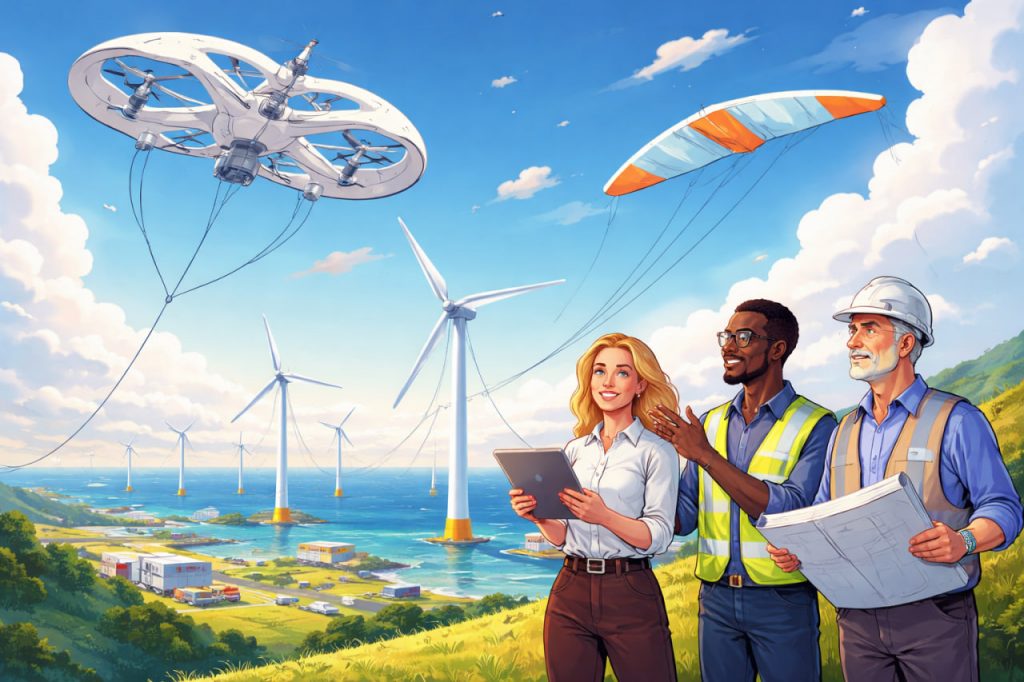
Wind energy has become one of the fastest-growing sources of renewable electricity in the world. For decades, large wind turbines placed on hills, plains, and offshore platforms have converted moving air into clean power for cities and industries. These systems rely on relatively simple physical principles: wind turns the blades, the rotor spins a generator, and electricity flows into the grid. However, engineers and scientists continue to push the boundaries of what wind power can achieve. New technologies aim to capture stronger, more stable winds at higher altitudes, where energy potential is significantly greater than near the ground. As a result, wind energy is evolving from traditional towers into experimental airborne power systems, sometimes described as “flying power plants.” These innovations could dramatically expand the possibilities of renewable energy while reducing land use and construction costs.
How Traditional Wind Turbines Work
Conventional wind turbines are designed to capture the kinetic energy of moving air and transform it into electrical energy. Modern turbines can reach heights of over 150 meters, with blades spanning more than 100 meters across. As wind pushes against the blades, the rotor spins and transfers mechanical energy through a shaft connected to a generator. Inside the generator, electromagnetic processes convert the mechanical rotation into electricity that can be transmitted through power lines. According to renewable energy engineer Dr. Marta Alvarez:
“Wind turbines are essentially elegant machines that translate invisible air movement into reliable electrical power.”
Although the basic concept is simple, modern turbines are highly sophisticated structures equipped with sensors, control systems, and aerodynamic designs that maximize efficiency while protecting the equipment during strong storms.
The Growth of Offshore Wind Farms
As land suitable for large wind farms becomes limited, many countries are expanding into offshore wind energy. At sea, wind speeds are often stronger and more consistent than on land, allowing turbines to generate more electricity. Offshore wind farms can include hundreds of turbines placed kilometers away from the coastline, minimizing visual and noise impact on communities. Engineers must design these structures to withstand powerful ocean waves, salt corrosion, and extreme weather conditions. Despite the technical challenges, offshore wind projects are rapidly increasing in scale and importance. Some of the world’s largest offshore turbines now produce enough electricity to power thousands of homes with a single unit.
High-Altitude Wind and Airborne Energy Systems
One of the most exciting frontiers in wind energy involves capturing winds at high altitudes, where air currents are stronger and more consistent. Instead of building extremely tall towers, engineers are developing airborne systems that use tethered drones, kites, or gliders connected to generators on the ground. These devices can fly hundreds of meters above the surface, harnessing powerful jet-like wind streams. When the airborne device moves in controlled loops, it pulls on a tether connected to a ground-based generator, producing electricity. Energy researcher Dr. Leon Richter explains:
“High-altitude wind systems could access an enormous reservoir of energy that traditional turbines simply cannot reach.”
Because these systems require far less steel and concrete than large towers, they could reduce the environmental footprint of wind power infrastructure.
Flying Wind Turbines and Experimental Designs
Several experimental projects are exploring flying wind turbines, which resemble lightweight aircraft equipped with rotating blades or aerodynamic wings. Some designs generate electricity onboard and send it down through conductive cables, while others convert the motion of the tether into energy at ground stations. These airborne turbines can automatically adjust their altitude to find optimal wind conditions, improving efficiency compared to fixed towers. Although still in development, early prototypes have demonstrated promising results in test environments. Researchers believe these systems could eventually provide energy in remote areas where building large towers is impractical.
Challenges and the Future of Airborne Wind Power
Despite their potential, airborne wind energy systems face several technical and regulatory challenges. Maintaining stable flight in changing wind conditions requires advanced control algorithms and reliable safety systems. Airspace regulations must also be considered to prevent conflicts with aviation routes. Engineers are working to improve durability, autonomous control, and efficient energy transmission through tethers. If these obstacles can be overcome, airborne wind technology may complement traditional turbines and expand renewable energy production in new locations around the world.
Interesting Facts
- The largest modern wind turbines can reach heights taller than the Eiffel Tower when the blades point upward.
- Offshore wind turbines often generate more electricity than land-based turbines due to stronger and steadier winds.
- Winds at altitudes of 300–600 meters can contain several times more energy than surface winds.
- Some airborne wind prototypes use giant automated kites that fly in looping patterns to generate power.
- Engineers estimate that high-altitude wind could potentially provide a significant share of global electricity demand.
Glossary
- Wind Turbine — a device that converts wind energy into electrical power using rotating blades and a generator.
- Offshore Wind Farm — a group of wind turbines installed in ocean waters to capture strong marine winds.
- High-Altitude Wind — stronger and more consistent wind currents found hundreds of meters above the ground.
- Airborne Wind Energy — technology that generates electricity using flying devices such as drones or kites connected by tethers.
- Generator — a machine that converts mechanical motion into electrical energy.