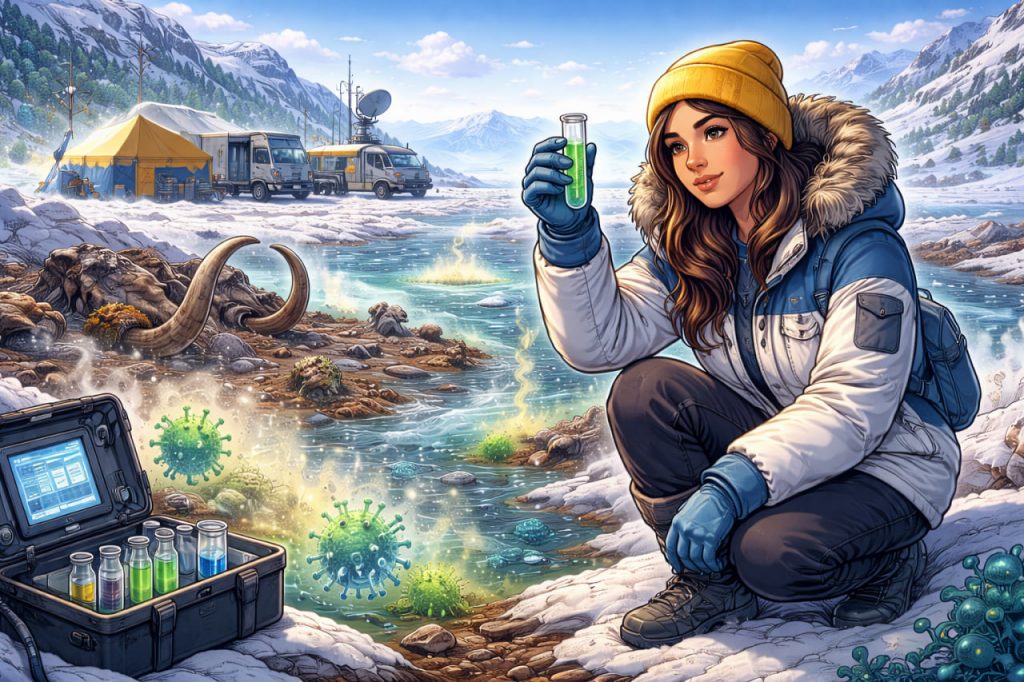
As global temperatures rise, scientists are increasingly concerned about the thawing of permafrost, the permanently frozen ground found in Arctic and subarctic regions. For thousands of years, permafrost has acted as a natural freezer, preserving organic material, ancient microbes, and even viruses that existed long before modern human civilization. With warming climates causing the ground to thaw more rapidly, these frozen biological materials are gradually being exposed to the environment again. Researchers are studying whether some of these ancient microorganisms could remain viable after being frozen for centuries or even millennia. While most microbes released from thawing permafrost are harmless or quickly destroyed by modern environmental conditions, the possibility of dormant pathogens re-emerging has drawn increasing scientific attention. Understanding these risks helps scientists prepare for potential ecological and public health challenges in rapidly changing Arctic environments.
What Permafrost Is and Why It Matters
Permafrost refers to soil, rock, and sediment that have remained frozen for at least two consecutive years, though in many regions it has remained frozen for thousands of years. These frozen layers can extend hundreds of meters below the surface and contain vast amounts of organic material, including plant remains, animal carcasses, and microorganisms. Because cold temperatures slow down decomposition, biological material within permafrost can remain remarkably well preserved. According to environmental microbiologist Dr. Elena Markov:
“Permafrost acts like a massive natural archive, preserving traces of ancient ecosystems and microorganisms from distant periods of Earth’s history.”
As the Arctic warms at a rate faster than the global average, these frozen archives are beginning to thaw.
Ancient Microorganisms Preserved in Ice
Over the past decade, researchers have discovered that certain microorganisms can survive extremely long periods in frozen conditions. Some bacteria and viruses have been successfully revived in laboratory settings after being frozen for tens of thousands of years. These discoveries demonstrate the resilience of microbial life in extreme environments. However, scientists emphasize that the revival of ancient microorganisms in controlled research conditions does not necessarily mean they pose a realistic threat in natural ecosystems. Many ancient microbes are poorly adapted to modern environments and may not survive outside laboratory conditions.
Potential Ecological and Health Concerns
Despite the low probability of widespread risk, scientists still study thawing permafrost carefully because of its potential ecological consequences. When frozen ground thaws, buried organic matter begins to decompose, releasing greenhouse gases such as carbon dioxide and methane. In rare cases, thawing may also expose animal remains or microbial communities that have been sealed for centuries. Epidemiologist Dr. Victor Hansen explains:
“Monitoring Arctic ecosystems helps scientists understand how environmental changes might influence microbial activity and ecological balance.”
Ongoing research allows scientists to track these changes and develop strategies to manage potential risks.
Scientific Research and Monitoring Efforts
International research teams are studying permafrost regions using field observations, satellite data, and microbiological analysis. These studies aim to understand how quickly permafrost is thawing, what types of microorganisms are present, and how ecosystems respond to environmental change. Scientists also investigate how thawing ground affects local communities, infrastructure, and Arctic wildlife. By combining climate science, microbiology, and environmental monitoring, researchers hope to better understand how thawing permafrost may influence both local and global systems.
The Importance of Climate Awareness
The issue of thawing permafrost highlights the interconnected nature of Earth’s climate systems. Changes in Arctic environments can influence global weather patterns, ecosystems, and atmospheric chemistry. Studying these processes provides valuable insights into how environmental changes affect the planet as a whole. Continued scientific observation and international collaboration remain essential for understanding and responding to these complex environmental developments.
Interesting Facts
- Permafrost covers about a quarter of the land area in the Northern Hemisphere.
- Some permafrost layers have remained frozen for hundreds of thousands of years.
- Ancient animal remains, including mammoths, have been discovered preserved in permafrost.
- Thawing permafrost can release methane, a powerful greenhouse gas.
- Scientists often study Arctic microbes to understand how life survives in extreme environments.
Glossary
- Permafrost — permanently frozen ground that remains at or below 0°C for at least two consecutive years.
- Dormant Microorganism — a microbe that is inactive but capable of becoming active again under suitable conditions.
- Methane — a greenhouse gas produced during the decomposition of organic material.
- Microbial Ecology — the study of microorganisms and their interactions with environments.
- Climate Monitoring — scientific observation of environmental conditions to track climate changes.