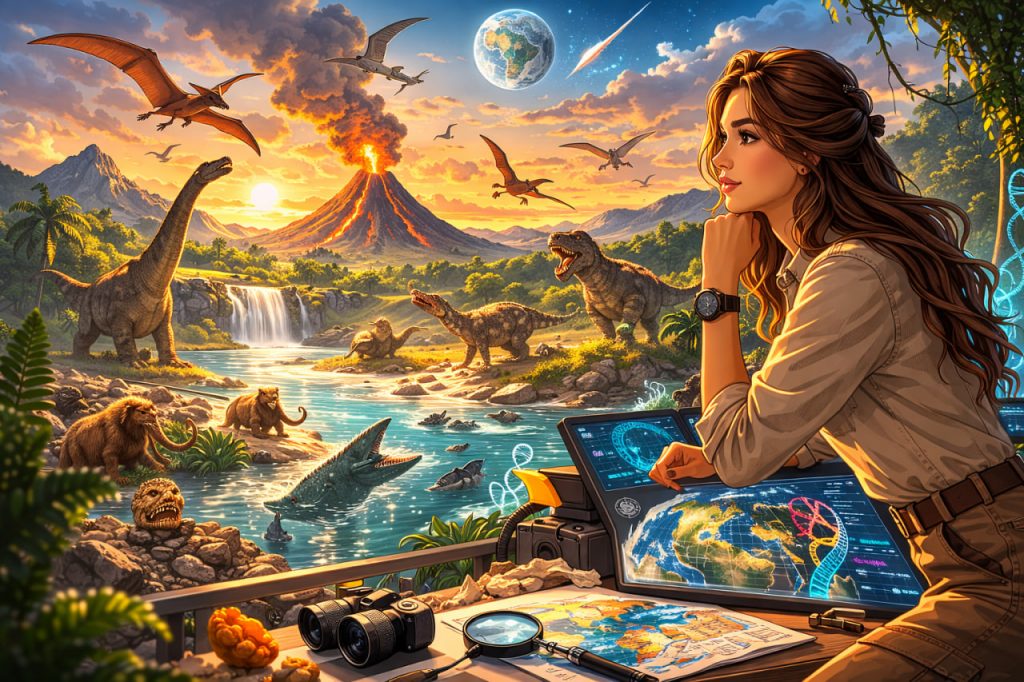
Long before humans walked the planet, Earth experienced billions of years of dramatic transformations. Mountains rose and eroded, oceans formed and shifted, and life evolved through countless stages of complexity. The planet’s history stretches back about 4.5 billion years, beginning with a hot, chaotic world shaped by volcanic activity and asteroid impacts. Over time, Earth gradually cooled, oceans formed, and the first simple life emerged. These early stages laid the foundation for the ecosystems that eventually supported complex plants, animals, and ultimately human civilization. Understanding what Earth was like before humans helps scientists reconstruct the history of life and the powerful natural forces that shaped our planet.
The Early Earth: A Harsh and Volcanic World
During its earliest period, Earth looked nothing like the world we know today. The young planet was extremely hot, with widespread volcanic eruptions and frequent asteroid impacts. There were no continents as we recognize them, and the atmosphere contained gases very different from modern air. Over millions of years, volcanic activity released water vapor that eventually condensed to form the first oceans. According to geologist Dr. Marcus Bell:
“The early Earth was a dynamic and unstable environment, but these conditions were essential for shaping the planet’s future.”
These early geological processes gradually stabilized the planet’s surface and atmosphere.
The First Life in Ancient Oceans
Life on Earth is believed to have appeared more than 3.5 billion years ago, beginning with simple microorganisms living in the oceans. These early life forms were extremely small and simple compared to modern organisms, yet they played a crucial role in transforming the planet. Some microorganisms developed the ability to perform photosynthesis, releasing oxygen into the atmosphere as a byproduct. Over millions of years, this process slowly increased oxygen levels in the atmosphere, making it possible for more complex life to evolve.
The Age of Giant Creatures
Hundreds of millions of years later, Earth entered periods when large and diverse animals dominated land and sea. During the Mesozoic Era, dinosaurs became the most prominent land animals, while enormous marine reptiles inhabited the oceans. Dense forests covered much of the land, and the climate was generally warmer than today. Many species that lived during this time eventually became extinct due to natural events such as climate shifts and asteroid impacts. These extinctions opened ecological opportunities for new species to evolve.
The Rise of Mammals and Changing Ecosystems
After the extinction of the dinosaurs about 66 million years ago, mammals began to diversify and occupy ecological roles previously dominated by reptiles. Over time, mammals evolved into a wide range of species—from tiny rodents to massive grazing animals. Plant life also expanded and diversified, creating complex ecosystems across continents. Forests, grasslands, and wetlands supported an enormous variety of organisms long before humans appeared.
A Planet Constantly Changing
Earth has never been a static world. Throughout its history, continents have drifted across the planet’s surface through the process of plate tectonics, forming and breaking apart supercontinents. Climate conditions have shifted dramatically, including several global ice ages and warmer greenhouse periods. These changes continuously reshaped the environment and influenced the evolution of life. By the time the first human ancestors appeared, Earth had already undergone billions of years of geological and biological development.
Interesting Facts
- Earth formed about 4.5 billion years ago from material in the early solar system.
- The first simple life forms appeared more than 3.5 billion years ago.
- Dinosaurs dominated Earth for over 160 million years before their extinction.
- Oxygen in the atmosphere was largely produced by ancient photosynthetic microorganisms.
- Continents move slowly across the planet through plate tectonics, reshaping Earth over millions of years.
Glossary
- Early Earth — the earliest stage of the planet’s history shortly after its formation.
- Photosynthesis — the process by which certain organisms use sunlight to produce energy and oxygen.
- Mesozoic Era — a geological era when dinosaurs dominated life on land.
- Plate Tectonics — the movement of large sections of Earth’s crust that shape continents and oceans.
- Extinction — the disappearance of a species from Earth.