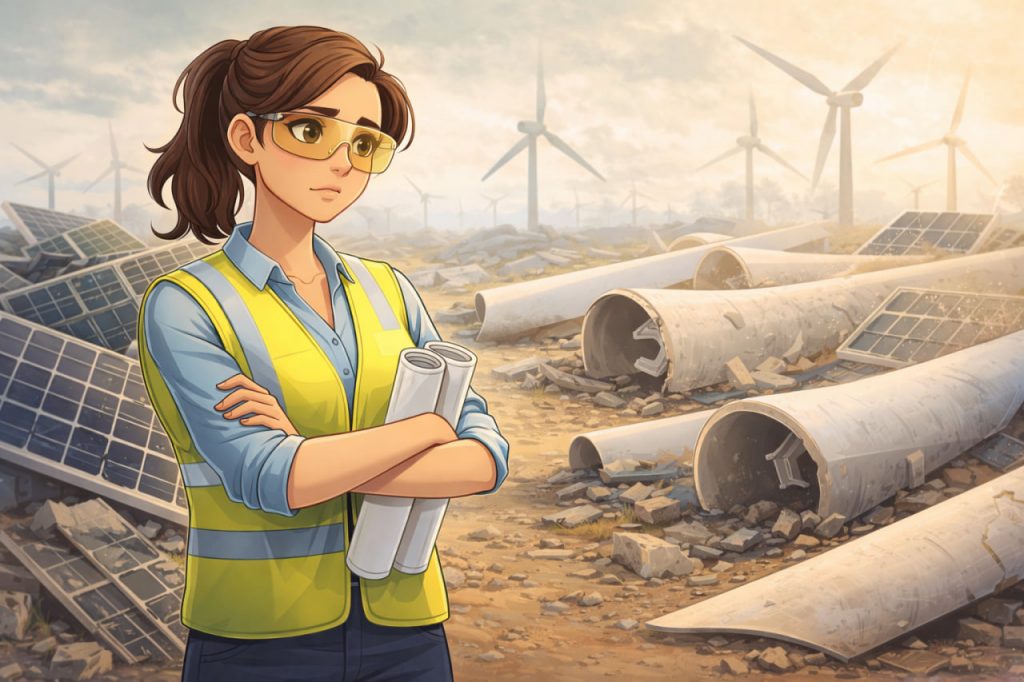
Renewable energy technologies such as solar panels and wind turbines are widely seen as a key solution to reducing carbon emissions and combating climate change. However, as these technologies become more widespread, a new issue is emerging — the disposal and recycling of their components at the end of their life cycle. Most solar panels and wind turbine blades have a lifespan of around 20–30 years, after which they must be replaced. This creates a growing stream of waste that requires careful management. While renewable energy reduces environmental impact during operation, its long-term sustainability depends on how effectively these materials are handled after use. Understanding this challenge is essential for building a truly sustainable energy system.
Why Recycling Renewable Technologies Is Difficult
One of the main challenges lies in the complex structure of materials used in these technologies. Solar panels consist of layers of glass, aluminum, silicon, and trace metals that are difficult to separate efficiently. Wind turbine blades are typically made from composite materials such as fiberglass and resins, which are extremely durable but hard to recycle. These materials were originally designed for strength and longevity, not for easy disassembly. As a result, recycling processes can be expensive and technically demanding. Environmental engineer Dr. Martin Keller explains:
“Renewable energy must be sustainable across its entire life cycle,
not only during energy production but also in how its materials are reused or disposed of.”
This highlights the need for innovation in recycling technologies.
The Growing Scale of the Problem
As renewable energy infrastructure expands globally, so does the volume of future waste. Millions of solar panels and thousands of wind turbine blades are expected to reach the end of their lifespan in the coming decades. Without effective recycling systems, these materials could accumulate in landfills, creating long-term environmental risks. Some countries are beginning to implement regulations and recycling programs, but global solutions are still limited. The scale of the issue makes it an urgent topic for policymakers, engineers, and environmental scientists.
Emerging Recycling Technologies
Researchers are developing new methods to improve the recycling of renewable energy components. For solar panels, technologies are being designed to recover silicon, glass, and valuable metals for reuse. In the case of turbine blades, scientists are exploring mechanical recycling, chemical decomposition, and repurposing materials for construction. Some companies have already started transforming old blades into structural elements such as bridges or architectural components. Although these solutions are still evolving, they demonstrate promising directions for reducing waste.
Economic and Policy Challenges
Economic factors remain a major barrier to large-scale recycling. In many cases, it is cheaper to produce new materials than to recycle existing ones. This limits the incentive for companies to invest in recycling infrastructure. To address this issue, governments may need to introduce regulations, subsidies, and circular economy policies that encourage responsible disposal and reuse. Establishing clear standards and financial incentives can help make recycling more viable and widespread.
Towards a Sustainable Energy Lifecycle
Renewable energy remains essential for reducing global emissions, but its long-term success depends on addressing its full lifecycle impact. Designing equipment with recycling in mind, improving material recovery processes, and strengthening international cooperation can help minimize environmental risks. Ultimately, sustainability is not only about clean energy production but also about ensuring that technologies remain environmentally responsible from creation to disposal.
Interesting Facts
- Solar panels typically last around 25–30 years before needing replacement.
- By 2050, solar panel waste could reach tens of millions of tons globally.
- Wind turbine blades can exceed 80 meters in length, making disposal challenging.
- Up to 90% of solar panel materials can potentially be recovered with advanced recycling.
- Some recycled turbine blades are already used in construction and infrastructure projects.
Glossary
- Renewable Energy — energy derived from natural sources such as sunlight and wind.
- Composite Materials — materials made from multiple components with different properties.
- Recycling — the process of converting waste into reusable materials.
- Circular Economy — an economic system focused on minimizing waste and reusing resources.
- Lifecycle — the full process from creation to disposal of a product.