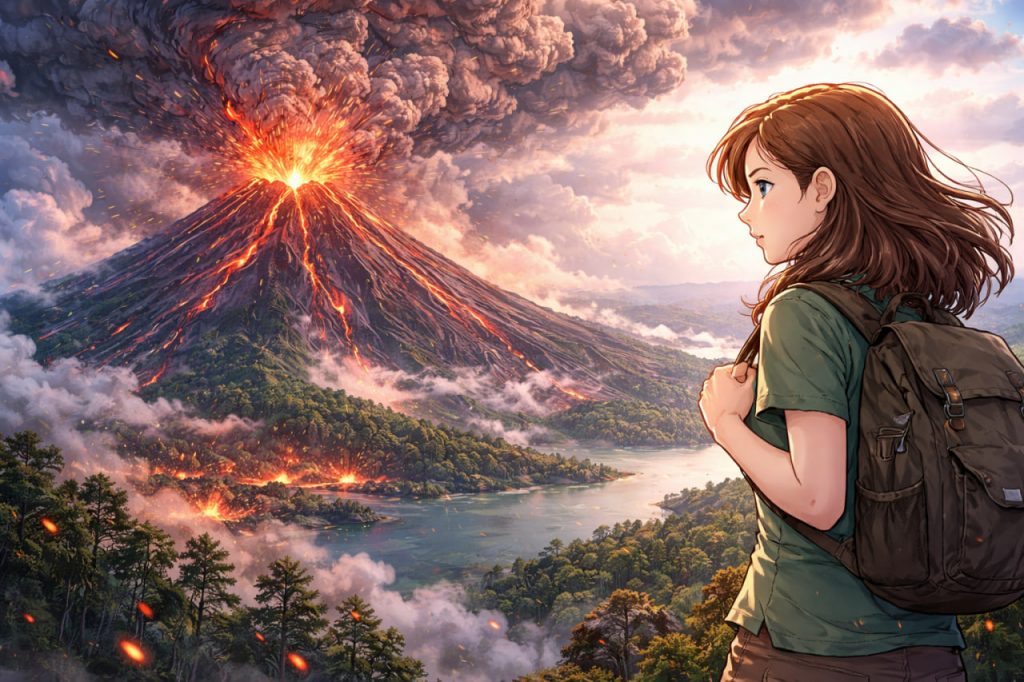
The supereruption of the Toba volcano, which occurred around 74,000 years ago, is considered one of the most powerful volcanic events in Earth’s history. Located on the island of Sumatra in modern-day Indonesia, the eruption released enormous amounts of ash, gas, and volcanic material into the atmosphere. This event was so intense that it may have triggered a volcanic winter, significantly affecting global climate. The scale of the eruption reshaped landscapes and may have had consequences for early human populations. Studying the Toba supereruption helps scientists understand extreme natural events and their impact on life on Earth. It also highlights how closely connected geological and climatic systems can be.
What Makes It a Supereruption?
A supereruption is defined as an eruption with a magnitude of VEI 8 (Volcanic Explosivity Index), the highest level on the scale. The Toba eruption ejected more than 2,000 cubic kilometers of material, far exceeding ordinary volcanic eruptions. Volcanologist Dr. Michael Harris explains:
“A supereruption is not just a large eruption — it is a planetary-scale event
capable of altering climate and ecosystems for years.”
This classification places Toba among the most extreme natural events known to science. Unlike smaller eruptions that mainly affect regional environments, supereruptions can influence atmospheric circulation, sunlight levels, and ecological stability across vast areas. That is why Toba remains such an important case study in volcanology and paleoclimate research.
Global Climate Impact
The massive release of volcanic ash and sulfur dioxide likely reduced the amount of sunlight reaching Earth’s surface. This phenomenon, known as a volcanic winter, may have lowered temperatures for several years after the eruption. Reduced sunlight would have affected plant growth, weakened food chains, and placed stress on ecosystems already dependent on stable climate conditions. Some scientists have suggested that this cooling event created severe challenges for early human groups, although the scale of that impact is still debated. Even so, Toba remains one of the strongest examples of how a volcanic event can potentially influence the global climate system far beyond its source region.
Geological Consequences
The eruption led to the collapse of the volcano’s magma chamber, forming a giant caldera that later became Lake Toba, one of the largest volcanic lakes in the world. Layers of ash from this eruption have been found across large parts of Asia and in distant geological records, showing how far the material spread. These deposits give scientists valuable evidence for reconstructing the eruption’s power and reach. The landscape around Toba was permanently transformed, and the caldera itself stands as a visible reminder of the scale of the event. Geological traces like these help researchers compare Toba with other ancient and modern eruptions, improving our understanding of volcanic hazards.
Evidence and Scientific Debate
Scientists study sediment layers, volcanic ash deposits, and climate records to understand the full effects of the Toba eruption. While there is broad agreement that it was an exceptionally large event, researchers still debate how dramatic its consequences were for climate and human populations. Some studies suggest that Toba caused major cooling and ecological disruption, while others argue that the effects may have been more regionally uneven or shorter in duration than once thought. This debate reflects the complexity of Earth’s climate system and the difficulty of reconstructing ancient events with complete certainty. Even so, the eruption remains one of the most important prehistoric volcanic episodes ever studied.
Why It Still Matters Today
Understanding supereruptions like Toba is important not only for studying the past but also for preparing for the future. Although such eruptions are extremely rare, their effects could be global, disrupting agriculture, climate, transport, and human health. Research on ancient supereruptions helps scientists improve volcanic monitoring and assess large-scale environmental risks. Toba also reminds us that Earth’s history includes events far more powerful than anything recorded in modern civilization. By studying them carefully, researchers gain a deeper understanding of how the planet changes — and how life responds to extreme disruption.
Interesting Facts
- The Toba eruption happened about 74,000 years ago
- It is classified as a VEI 8 supereruption
- Lake Toba is one of the largest volcanic lakes in the world
- Ash from the eruption has been found across huge parts of Asia
- The event may have influenced ancient human populations
Glossary
- Supereruption — an extremely large volcanic eruption classified at the highest level of explosivity
- Caldera — a large volcanic depression formed after the collapse of a magma chamber
- Volcanic Winter — a period of cooling caused by volcanic ash and gases blocking sunlight
- Magma Chamber — an underground reservoir of molten rock beneath a volcano
- VEI (Volcanic Explosivity Index) — a scale used to measure the strength of volcanic eruptions