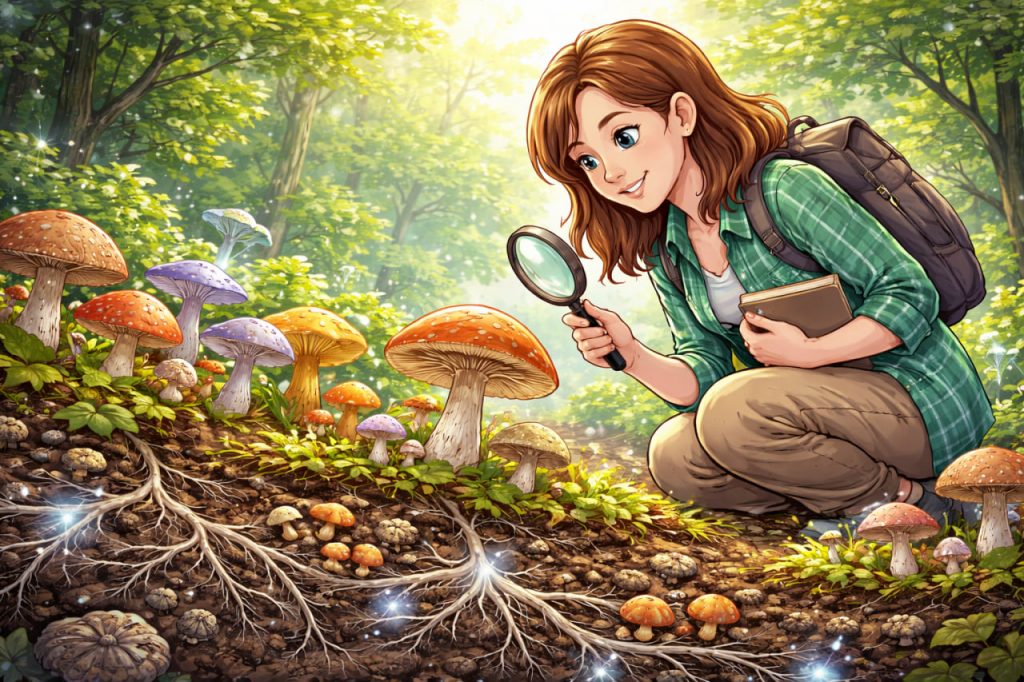
Fungi are often overlooked, yet they form one of the most important and unique groups of organisms on Earth. Neither plants nor animals, fungi belong to a separate biological kingdom, with their own structure, metabolism, and ecological roles. For a long time, they were mistakenly classified as plants, but modern science has revealed that they are fundamentally different. Fungi play a critical role in ecosystem balance, nutrient cycling, and even human survival. From mushrooms and molds to microscopic yeasts, this kingdom is vast and essential. Understanding fungi helps us see nature not as separate parts, but as an interconnected system where hidden organisms perform vital functions.
Why Fungi Are a Separate Kingdom
Fungi differ from plants and animals in several key ways. Unlike plants, they do not perform photosynthesis and cannot produce their own food. Instead, they absorb nutrients from their environment by breaking down organic material. At the same time, they are not animals, as they have cell walls and grow differently. Biologist Dr. Laura Bennett explains:
“Fungi occupy a unique position in life’s tree,
bridging characteristics of both plants and animals while remaining distinct.”
This uniqueness is why fungi are classified as a separate kingdom.
Masters of Decomposition
One of the most important roles of fungi is decomposition. They break down dead plants, animals, and organic matter, returning nutrients to the soil. Without fungi, ecosystems would be overwhelmed by undecomposed material. This process supports plant growth and maintains the balance of natural systems. Fungi act as nature’s recyclers, ensuring that life continues in a sustainable cycle.
Hidden Networks Beneath Our Feet
Fungi form vast underground networks known as mycelium, which connect plants and trees. These networks allow plants to exchange nutrients, water, and even chemical signals. Some scientists describe this system as a “wood wide web,” highlighting its complexity and importance. Through these connections, fungi help forests function as cooperative systems rather than isolated individuals.
Fungi and Human Life
Fungi are deeply connected to human life in many ways. They are used in food production (such as bread, cheese, and fermentation), medicine (including antibiotics), and biotechnology. At the same time, some fungi can cause diseases or spoil food. This dual role makes them both beneficial and potentially harmful, depending on the context.
Why Fungi Are More Important Than We Think
Despite their importance, fungi remain one of the least studied kingdoms of life. Scientists estimate that millions of fungal species have yet to be discovered. Their potential applications in medicine, environmental restoration, and sustainable technology are enormous. Recognizing their role helps shift our perspective on nature and highlights the importance of preserving biodiversity.
Interesting Facts
- Fungi are more closely related to animals than plants
- Mycelium networks can span large underground areas
- Some fungi can survive in extreme environments
- Penicillin, one of the first antibiotics, comes from fungi
- Scientists have identified only a fraction of all fungal species
Glossary
- Fungi — a kingdom of organisms distinct from plants and animals
- Mycelium — a network of fungal threads growing underground
- Decomposition — breakdown of organic material into nutrients
- Photosynthesis — process used by plants to produce energy from sunlight
- Yeast — a type of fungus used in fermentation