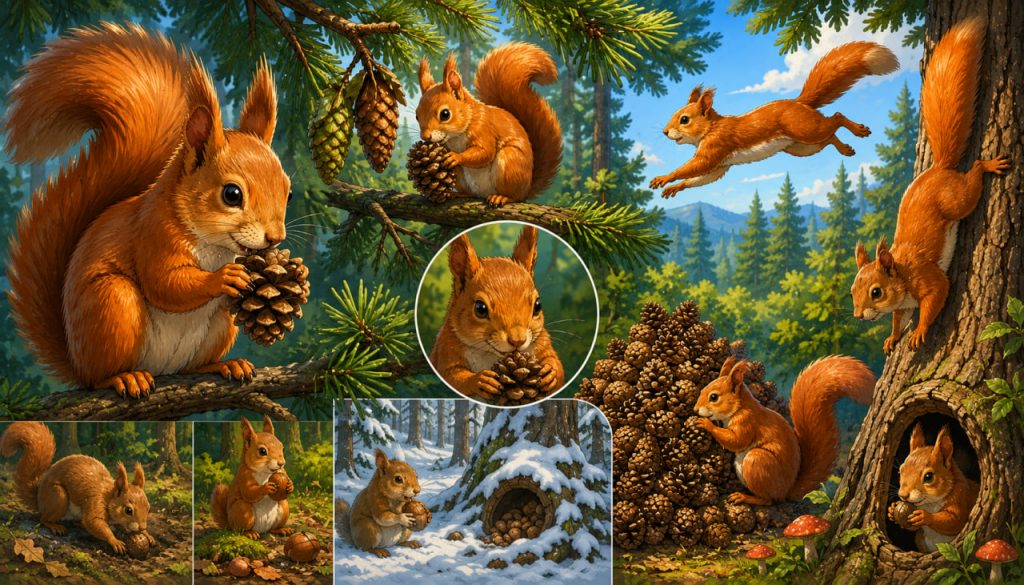
Squirrels are among the most recognizable and agile animals found in forests around the world. Many species are famous for:
- Gnawing pine cones
- Climbing trees
- Jumping between branches
- Storing nuts for winter
These energetic rodents play an important role in:
- Forest ecosystems
- Seed distribution
- Tree regeneration
Although squirrels often appear cute and harmless, they are highly adapted survival specialists with:
- Sharp teeth
- Excellent memory
- Powerful hind legs
- Remarkable climbing ability
Scientists study squirrels because their behavior reveals fascinating insights into:
- Animal intelligence
- Memory
- Evolution
- Forest ecology
Their relationship with pine cones is especially important for understanding how some forests naturally reproduce and spread.
What Are Squirrels?
Squirrels belong to the:
- Rodent family
There are more than:
- 200 squirrel species
living across:
- Europe
- Asia
- North America
- South America
- Africa
Most tree squirrels are famous for eating:
- Seeds
- Nuts
- Pine cone seeds
- Fruits
- Mushrooms
Some species also occasionally consume:
- Insects
- Bird eggs
- Small animals
Why Do Squirrels Gnaw Pine Cones?
Pine cones contain:
- Nutritious seeds
hidden between hard woody scales.
Squirrels use their strong front teeth to:
- Tear apart cone scales
- Reach the seeds inside
Their teeth never stop growing throughout life, so constant gnawing helps:
- Prevent overgrowth
- Maintain sharpness
Squirrels can process cones extremely quickly compared to most other animals.
Their Teeth Are Perfect Survival Tools
Squirrels possess:
- Powerful incisors
designed for gnawing hard materials.
These teeth contain:
- Strong enamel
especially on the front surface.
Because squirrel teeth continuously grow:
- They must constantly chew and wear them down.
Without gnawing behavior:
- Their teeth could become dangerously oversized.
Squirrels Help Forests Grow
Interestingly, squirrels accidentally help forests survive.
When squirrels:
- Hide seeds
- Bury nuts
- Forget food caches
some buried seeds later grow into:
- New trees
Ecologists consider squirrels important:
- Seed dispersers
especially in pine forests.
Their food-storage behavior helps spread:
- Forest vegetation naturally.
Why Squirrels Store Food
Many squirrel species survive winter by creating:
- Hidden food caches
They bury:
- Nuts
- Seeds
- Pine cones
in many different locations.
This behavior is called:
- Scatter hoarding
Squirrels rely heavily on:
- Spatial memory
- Smell
- Environmental landmarks
to recover stored food later.
Their Memory Is Surprisingly Advanced
Scientists discovered squirrels possess impressive:
- Spatial memory abilities
They can remember:
- Hundreds of hiding places
across large territories.
Neuroscientists study food-caching animals because their brains provide insights into:
- Memory formation
- Navigation
- Learning
Some squirrel species even organize food storage strategically depending on:
- Food type
- Spoilage risk
Incredible Climbers and Jumpers
Tree squirrels are highly adapted for:
- Arboreal life
meaning:
- Living in trees.
They possess:
- Flexible ankles
- Sharp claws
- Strong hind legs
- Excellent balance
Squirrels can rotate their ankles almost:
- 180 degrees
allowing them to descend trees headfirst.
Their jumping ability is remarkable compared to body size.
Squirrels and Seasonal Survival
Winter creates major survival challenges for small mammals.
Squirrels adapt through:
- Food storage
- Thick winter fur
- Reduced activity
Unlike some animals, most tree squirrels do not fully:
- Hibernate
Instead they remain active periodically during colder months.
Stored food becomes critically important for survival.
Why Pine Cones Are Valuable Food Sources
Pine seeds contain:
- Fat
- Protein
- Energy-rich nutrients
This makes them ideal food for animals preparing for:
- Winter survival
Some squirrel species evolved specifically alongside:
- Conifer forests
developing behaviors specialized for:
- Cone harvesting.
Red Squirrels and Cone Piles
Some squirrels create enormous:
- Cone piles
called:
- Middens
These piles may contain:
- Thousands of eaten cones
Scientists sometimes study cone piles to analyze:
- Feeding behavior
- Population health
- Forest ecosystems
Squirrels Have Excellent Senses
Squirrels rely heavily on:
- Vision
- Smell
- Hearing
Their eyes help them judge:
- Distance
- Branch movement
- Predator threats
Their sense of smell helps locate:
- Buried food under snow or leaves.
Predators and Survival
Despite their agility, squirrels face many predators including:
- Hawks
- Owls
- Foxes
- Snakes
- Wild cats
Their quick reflexes and tree-climbing ability help them:
- Escape danger rapidly.
The famous flicking squirrel tail also helps with:
- Communication
- Balance
- Predator distraction.
Squirrels and Human Cities
Many squirrel species adapted surprisingly well to:
- Urban environments
City parks provide:
- Trees
- Human food sources
- Shelter
Urban squirrels often become:
- Less fearful of humans
compared to forest populations.
Scientists study urban wildlife adaptation to better understand:
- Animal intelligence
- Behavioral flexibility.
Are Squirrels Intelligent?
Researchers increasingly recognize squirrels as:
- Clever problem-solvers
They can:
- Learn patterns
- Solve food puzzles
- Adapt to obstacles
- Outsmart bird feeders
Some experiments suggest squirrels may even use:
- Strategic deception
to protect hidden food from thieves.
Why Squirrels Matter Ecologically
Although small, squirrels strongly influence:
- Forest ecology
- Seed distribution
- Predator food chains
Without animals spreading seeds:
- Many forests would regenerate differently.
Squirrels therefore play important ecological roles far beyond:
- Simple nut collecting.
Why Humans Find Squirrels Fascinating
Squirrels combine:
- Speed
- Intelligence
- Curiosity
- Acrobatic movement
in ways humans naturally notice.
Their behavior often appears:
- Energetic
- Funny
- Surprisingly human-like
Scientists continue studying squirrels because even these common forest animals reveal important lessons about:
- Evolution
- Adaptation
- Memory
- Ecosystem dynamics
all hidden behind the simple image of a small animal chewing on a pine cone.
Interesting Facts
- Squirrel teeth never stop growing.
- Some squirrels remember hundreds of food hiding spots.
- Squirrels help forests grow by accidentally planting seeds.
- Tree squirrels can rotate their ankles to climb downward headfirst.
- Cone piles called middens may contain thousands of eaten cones.
Glossary
- Rodent — Mammal with continuously growing front teeth.
- Arboreal — Adapted for living in trees.
- Scatter Hoarding — Storing food in many hidden locations.
- Ecosystem — Community of organisms interacting with their environment.
- Incisors — Front cutting teeth used for gnawing.