Swamps are usually associated with:
- Water
- Wet soil
- Mud
- Marsh plants
Because of this, many people are surprised when they hear about:
- Massive swamp fires
- Peat fires
- Underground burning wetlands
In reality, swamps can become extremely dangerous fire zones under certain environmental conditions.
Some swamp fires may continue burning for:
- Weeks
- Months
- Even years
deep underground.
These fires release enormous amounts of:
- Smoke
- Carbon dioxide
- Toxic gases
and may become very difficult to extinguish.
Modern climate change, droughts, and human activity increasingly contribute to:
- Wetland fires
- Peatland destruction
- Ecological disasters
Understanding why swamps burn requires knowledge of:
- Peat formation
- Soil chemistry
- Hydrology
- Climate systems
- Fire behavior
Surprisingly, one of the wettest ecosystems on Earth can sometimes become one of the hardest places to stop a fire.
What Is a Swamp?
A swamp is a type of:
- Wetland ecosystem
where water partially or completely saturates the ground.
Swamps often contain:
- Dense vegetation
- Moss
- Trees
- Organic material
- Muddy soils
Many wetlands also contain:
- Peat
which plays a major role in swamp fires.
What Is Peat?
Peat is:
- Partially decomposed plant material
that accumulates over thousands of years in wet environments.
Because swamp conditions often lack enough oxygen for full decomposition:
- Dead plants slowly build up layer after layer.
Peatlands may store enormous amounts of:
- Carbon
- Organic matter
Some peat deposits become:
- Several meters deep
over geological time.
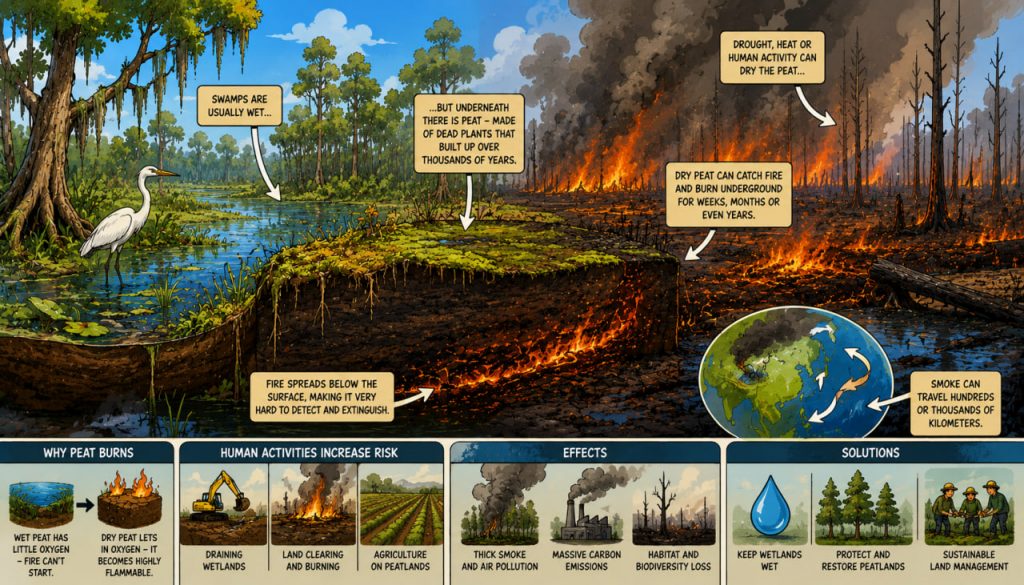
Why Peat Can Burn
Although swamps appear wet on the surface, dry peat behaves almost like:
- Natural fuel
When peat dries:
- Oxygen enters deeper soil layers.
This makes ancient organic material highly flammable.
Once ignited:
- Peat fires may burn underground slowly for long periods.
Unlike ordinary forest fires, peat fires often spread:
- Beneath the surface
making them difficult to detect and extinguish.
Droughts Make Swamps Dangerous
Healthy wetlands normally remain:
- Waterlogged
which helps prevent burning.
However, during:
- Heat waves
- Droughts
- Climate change
water levels may drop significantly.
As swamps dry:
- Peat becomes exposed to oxygen and heat.
This dramatically increases fire risk.
Scientists observed growing peat fire activity in regions experiencing:
- Severe drought conditions.
Human Activity and Wetland Fires
Humans often worsen swamp fire risks through:
- Draining wetlands
- Agriculture
- Deforestation
- Land clearing
Drained peatlands lose moisture and become highly combustible.
In some regions, fires are intentionally started to:
- Clear land for farming
but these fires may spread uncontrollably underground.
Large-scale peat fires became major environmental problems in:
- Indonesia
- Russia
- Canada
- Parts of South America
Underground Fires Are Extremely Difficult to Stop
One reason swamp fires are so dangerous is that:
- They burn below ground level.
Surface flames may disappear while fire continues spreading through:
- Deep peat layers
Firefighters often struggle because:
- Water does not easily penetrate thick burning peat.
Some peat fires survive:
- Rainfall
- Snow
- Seasonal weather changes
and later reignite.
Why Swamp Fires Produce So Much Smoke
Peat fires generate enormous quantities of:
- Dense smoke
- Fine particles
- Toxic gases
This happens because peat burns:
- Slowly
- Incompletely
The smoke may travel:
- Hundreds or thousands of kilometers
causing serious air pollution.
Health effects may include:
- Breathing problems
- Eye irritation
- Cardiovascular stress
especially for vulnerable populations.
Swamps Store Huge Amounts of Carbon
Peatlands are among Earth’s largest:
- Natural carbon storage systems
Over thousands of years, wetlands trap carbon inside accumulated plant material.
When peat burns:
- Massive amounts of stored carbon enter the atmosphere.
Climate scientist Susan Page explained:
“Peatlands are one of the world’s most important terrestrial carbon stores.”
This means swamp fires contribute significantly to:
- Greenhouse gas emissions.
Climate Change and a Dangerous Cycle
Scientists worry about a dangerous feedback loop involving:
- Climate change
- Drought
- Peat fires
Warmer temperatures increase:
- Dry conditions
Dry peat increases:
- Fire risk
Fires release:
- More carbon dioxide
which may further intensify:
- Global warming
This creates a potentially self-reinforcing environmental cycle.
Can Swamps Burn Naturally?
Yes.
Natural causes of swamp fires include:
- Lightning strikes
- Extreme heat
- Long drought periods
However, many modern peat fires are linked partly to:
- Human land modification
- Drainage systems
- Agricultural expansion
Human activity often makes wetlands far more vulnerable to ignition.
Why Peat Fires Sometimes Smolder for Months
Peat burns differently from:
- Dry wood
- Grass fires
Instead of rapid open flames, peat often:
- Smolders slowly underground
This low-oxygen burning process allows fires to:
- Spread horizontally
- Remain hidden
- Consume deep organic layers gradually
Some underground fires become known as:
- Zombie fires
because they appear extinguished but later reactivate.
Environmental Damage from Swamp Fires
Wetland fires may destroy:
- Animal habitats
- Forest ecosystems
- Rare species
- Water systems
Peatlands normally support unique biodiversity involving:
- Birds
- Amphibians
- Insects
- Specialized plants
Severe fires may permanently alter:
- Soil structure
- Hydrology
- Ecosystem balance
The Importance of Wetlands
Healthy wetlands perform extremely important environmental functions:
- Carbon storage
- Flood control
- Water filtration
- Biodiversity support
Protecting wetlands helps reduce:
- Fire risk
- Climate impacts
- Ecosystem collapse
Modern environmental policies increasingly focus on:
- Wetland restoration
- Rewetting peatlands
- Sustainable land management
Why Swamp Fires Are Hard to Predict
Swamp fire behavior depends on many factors including:
- Soil moisture
- Temperature
- Wind
- Peat depth
- Underground oxygen levels
Because fire spreads below the surface:
- Satellite monitoring and thermal imaging are often required.
Scientists continue developing better methods for:
- Detection
- Prevention
- Fire suppression
Why Swamps Burning Is So Surprising
Humans naturally associate water with:
- Fire prevention
This makes burning wetlands seem almost impossible.
But swamp fires demonstrate how:
- Organic chemistry
- Climate
- Soil conditions
can transform wet environments into enormous underground fuel reserves.
In some cases, the very material created by ancient wet ecosystems becomes:
- The source of long-lasting fires.
Why Swamp Fires Matter Globally
Swamp fires are not only local environmental problems.
They affect:
- Climate systems
- Air quality
- Carbon emissions
- Human health
- Global ecosystems
As climate change increases drought frequency in some regions, scientists expect:
- Wetland fire risks may continue growing.
Understanding how swamps burn helps humanity better protect one of Earth’s most important and fragile ecosystems.
Interesting Facts
- Peatlands store enormous amounts of Earth’s carbon.
- Some peat fires burn underground for months.
- Wetlands can become highly flammable during droughts.
- Peat fires often produce thick toxic smoke.
- “Zombie fires” may reignite after appearing extinguished.
Glossary
- Peat — Accumulated partially decomposed plant material in wetlands.
- Wetland — Ecosystem where water saturates soil for long periods.
- Smoldering Fire — Slow low-oxygen combustion producing heavy smoke.
- Carbon Storage — Natural trapping of carbon in ecosystems or materials.
- Hydrology — Scientific study of water movement and distribution.