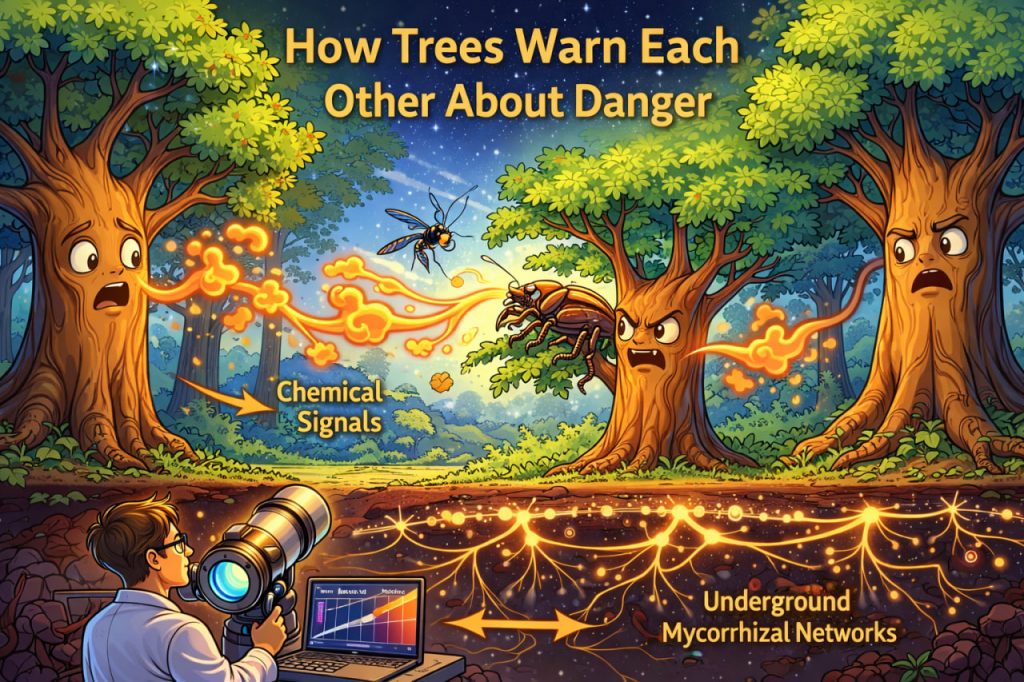
Trees may appear silent and passive, but modern science reveals that they are part of a highly connected and responsive network capable of communication and cooperation. When faced with threats such as insects, disease, or environmental stress, trees can send warning signals to nearby plants, helping them prepare defenses in advance. This communication occurs through both chemical signals in the air and underground networks of roots and fungi, often called the “wood wide web.” These systems allow forests to function not as isolated individuals, but as interconnected communities. Understanding how trees communicate challenges traditional views of plant life and highlights the complexity of ecosystems. It also shows that forests are dynamic systems capable of collective responses to danger.
Airborne Chemical Signals
One of the fastest ways trees communicate danger is through the release of volatile organic compounds (VOCs) into the air. When a tree is attacked by insects or damaged, it emits specific chemical signals that nearby trees can detect. These signals trigger defensive responses, such as producing bitter compounds or toxins that make leaves less appealing to herbivores. In some cases, trees can even attract predators of the insects that are attacking them. According to plant ecologist Dr. Laura Jensen:
“Trees don’t have voices, but their chemical signals carry clear messages —
warning their neighbors and giving them time to prepare.”
This airborne communication can occur within minutes, making it a rapid response system.
Underground Networks: The “Wood Wide Web”
Beneath the forest floor lies a vast network of fungal connections, known as mycorrhizal networks, linking the roots of different trees. Through these networks, trees can exchange nutrients, water, and chemical signals. When one tree experiences stress or attack, it can send warning signals through this underground system to neighboring trees. These signals can trigger defensive responses even before the threat reaches them. This hidden communication network plays a crucial role in maintaining forest health and resilience.
Defense Mechanisms Triggered by Signals
Once a tree receives a warning signal, it activates various defense mechanisms. These may include producing toxic chemicals, strengthening cell walls, or altering growth patterns to reduce damage. Some trees can even increase the production of compounds that deter specific pests. This coordinated response allows entire sections of a forest to become more resistant to threats. The ability to prepare in advance gives trees a significant survival advantage.
Cooperation and Resource Sharing
Tree communication is not limited to warnings. Through underground networks, trees can also share resources such as nutrients and carbon. Older, larger trees—sometimes called “mother trees”—can support younger or weaker trees by transferring essential nutrients. This cooperative behavior helps maintain the stability of forest ecosystems and ensures long-term survival.
Implications for Science and Ecology
The discovery of tree communication has transformed our understanding of ecosystems. It shows that forests operate as interconnected systems rather than collections of individual organisms. This insight has important implications for conservation, forestry, and climate research. Protecting these communication networks is essential for maintaining healthy and resilient forests in a changing environment.
Interesting Facts
- Trees can release chemical signals within minutes of being attacked.
- Underground fungal networks can connect hundreds of trees.
- Some trees can “recognize” related species and respond more strongly.
- Chemical signals can attract predators of harmful insects.
- Forests function more like communities than isolated organisms.
Glossary
- Volatile Organic Compounds (VOCs) — chemical signals released into the air by plants.
- Mycorrhizal Network — a symbiotic underground system connecting tree roots through fungi.
- Defense Mechanisms — biological responses that protect plants from threats.
- Ecosystem — a community of living organisms interacting with their environment.
- Symbiosis — a close and beneficial relationship between different organisms.