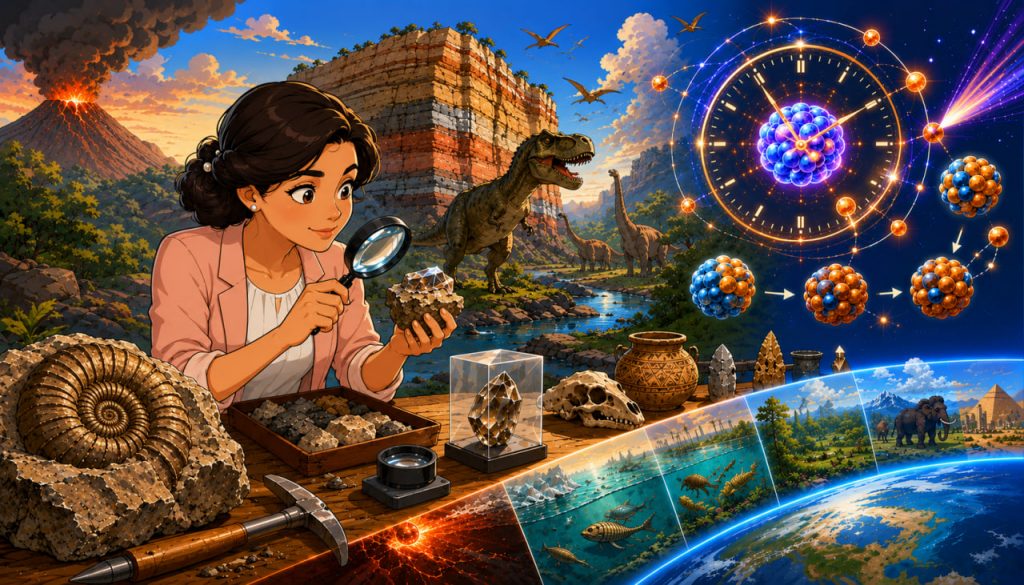
One of the greatest challenges in science is determining the age of objects that existed long before written history. How old is a fossil? When did a volcanic eruption occur? How ancient is an archaeological artifact? For centuries, these questions were impossible to answer with precision. The breakthrough came with the discovery of radioactivity and the realization that radioactive atoms behave like extraordinarily reliable clocks.
Today, radioactive dating methods allow scientists to determine the ages of rocks, fossils, archaeological remains, and even entire geological events. These techniques have transformed our understanding of Earth’s history, human evolution, and the age of the Solar System itself.
The remarkable aspect of radioactive dating is that it relies on a process occurring deep inside atomic nuclei—one that proceeds with extraordinary regularity regardless of temperature, pressure, or chemical environment.
What Is Radioactive Decay?
Radioactive decay is the spontaneous transformation of an unstable atomic nucleus into a more stable form.
During this process, the nucleus may emit:
- Alpha particles
- Beta particles
- Gamma radiation
As decay continues, one element may gradually transform into another.
For example:
- Uranium can eventually become lead.
- Potassium can become argon.
- Carbon-14 becomes nitrogen.
These transformations occur naturally throughout the universe.
Why Radioactive Decay Acts Like a Clock
The key feature of radioactive decay is its predictability.
Scientists cannot predict exactly when an individual atom will decay.
However, when enormous numbers of atoms are considered together, their behavior becomes highly predictable.
This predictability is described by the concept of half-life.
Understanding Half-Life
A half-life is the amount of time required for half of a radioactive sample to decay.
For example:
- After one half-life, 50% remains.
- After two half-lives, 25% remains.
- After three half-lives, 12.5% remains.
This process continues according to precise mathematical rules.
Because decay occurs at a constant statistical rate, radioactive materials function as natural clocks.
The Birth of Radiometric Dating
The foundations of radiometric dating emerged after the discoveries of radioactivity by Henri Becquerel and later research by Marie Curie and Pierre Curie.
Scientists soon realized that radioactive decay could provide a method for measuring immense spans of time.
This revolutionized geology because it provided actual numerical ages instead of relative estimates.
Carbon-14 Dating
One of the most famous dating methods is radiocarbon dating.
It relies on Carbon-14, a radioactive isotope continuously produced in Earth’s atmosphere.
Living organisms constantly exchange carbon with their environment.
When an organism dies:
- Carbon intake stops.
- Carbon-14 begins decaying.
By measuring the remaining Carbon-14, scientists can estimate when the organism died.
Carbon-14 dating is particularly useful for:
- Ancient wood
- Bones
- Textiles
- Archaeological remains
Its effective range extends to roughly 50,000 years.
Dating Ancient Rocks
Carbon-14 is unsuitable for very old geological materials.
For rocks millions or billions of years old, scientists use longer-lived isotopes.
Important systems include:
- Uranium-Lead dating
- Potassium-Argon dating
- Rubidium-Strontium dating
These methods allow researchers to investigate some of the oldest materials on Earth.
Uranium-Lead Dating
Uranium-Lead dating is among the most accurate techniques available.
Certain minerals, especially zircon crystals, incorporate uranium when they form but exclude lead.
As uranium decays into lead, the growing lead concentration serves as a record of elapsed time.
This method can determine ages exceeding four billion years.
Many of Earth’s oldest known minerals have been dated using uranium-lead techniques.
Potassium-Argon Dating
Potassium-40 slowly decays into argon gas.
When volcanic rocks solidify:
- Argon initially escapes.
- New argon accumulates as radioactive decay proceeds.
By measuring potassium and argon concentrations, scientists can estimate the rock’s age.
This method is especially valuable for studying volcanic regions and ancient human ancestors.
Geochronology: Building Earth’s Timeline
The science of determining geological ages is called geochronology.
Radiometric dating has enabled scientists to construct a detailed timeline of Earth’s history.
Major events include:
- Formation of Earth about 4.54 billion years ago
- Emergence of early life
- Dinosaur evolution and extinction
- Human evolution
Without radioactive dating, this timeline would remain largely unknown.
Dating Archaeological Discoveries
Archaeologists frequently use radiometric methods to understand ancient civilizations.
Dating techniques help determine:
- Ages of settlements
- Burial sites
- Artifacts
- Human remains
Accurate dating provides essential context for interpreting historical discoveries.
Limitations and Sources of Error
Radiometric dating is powerful but not perfect.
Potential challenges include:
- Contamination
- Loss of parent isotopes
- Gain of daughter isotopes
- Sample alteration
To improve reliability, scientists often apply multiple independent dating methods to the same material.
Agreement among different techniques increases confidence in results.
Why Scientists Trust Radiometric Dating
Radiometric dating is supported by several independent lines of evidence.
Different isotope systems frequently produce consistent results.
Ages obtained through radiometric methods often agree with:
- Geological observations
- Ice-core records
- Tree-ring data
- Historical records
This convergence strengthens confidence in the technique.
Expert Perspective
Geochemist Clair Cameron Patterson played a crucial role in determining the age of Earth using uranium-lead dating. His groundbreaking work established the modern estimate of approximately 4.54 billion years. Patterson’s research demonstrated the extraordinary precision that radioactive dating methods can achieve when carefully applied.
Radioactive Clocks Beyond Earth
Radiometric dating is not limited to Earth.
Scientists use these methods to study:
- Lunar rocks
- Meteorites
- Martian samples
- Solar System formation
Some meteorites have been dated to approximately 4.56 billion years, providing insights into the earliest stages of planetary formation.
Conclusion
Radioactive decay serves as one of nature’s most reliable clocks. Through the predictable behavior of unstable atomic nuclei, scientists can measure timescales ranging from centuries to billions of years. Techniques such as carbon-14 dating, uranium-lead dating, and potassium-argon dating have transformed geology, archaeology, and planetary science.
By allowing researchers to determine the ages of rocks, fossils, artifacts, and even planets, radiometric dating has provided one of humanity’s most powerful tools for exploring the deep history of Earth and the universe.
Interesting Facts
- Earth’s age is estimated at approximately 4.54 billion years.
- Some zircon crystals are more than 4 billion years old.
- Carbon-14 dating helped revolutionize archaeology in the 20th century.
- Meteorites often preserve information from the birth of the Solar System.
- Radioactive decay rates remain remarkably stable under ordinary conditions.
- Multiple radiometric dating methods are often used together to verify results.
Glossary
- Radioactive Decay — The spontaneous transformation of an unstable atomic nucleus.
- Half-Life — The time required for half of a radioactive sample to decay.
- Radiometric Dating — Determining age using radioactive isotopes.
- Carbon-14 — A radioactive isotope used for dating once-living materials.
- Geochronology — The science of determining the ages of geological events and materials.
- Isotope — Atoms of the same element with different numbers of neutrons.
- Zircon — A mineral commonly used in uranium-lead dating because of its durability and ability to preserve radioactive signatures.