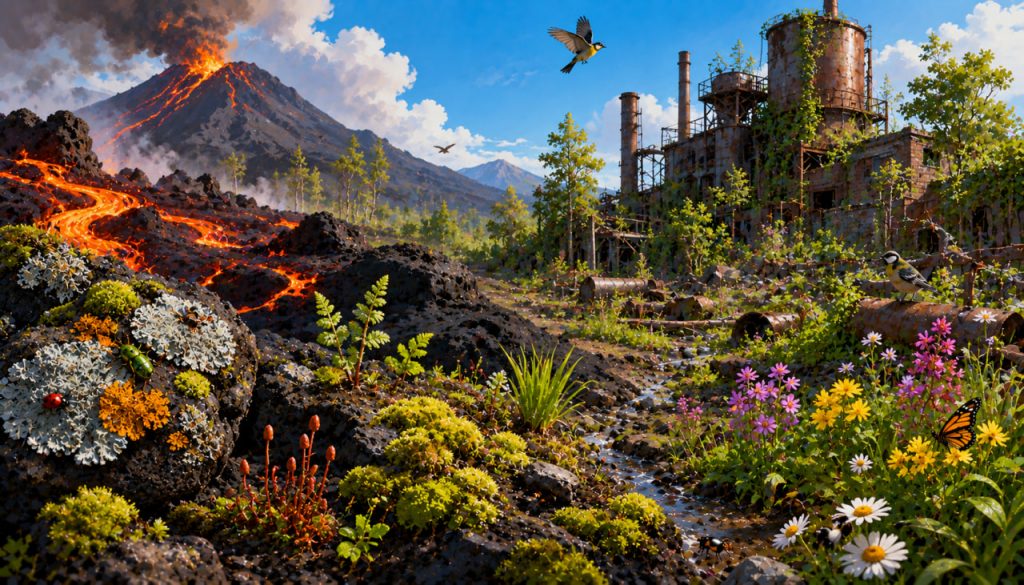
When a volcanic eruption covers the landscape with fresh lava, or when an abandoned industrial site is left barren and seemingly lifeless, it may appear that nature has been completely erased. Yet life is remarkably resilient. Within months, years, or decades, depending on conditions, organisms begin to return. The first settlers of these harsh environments are known as pioneer species.
Pioneer species are nature’s ecological trailblazers. They are specially adapted to survive in places where most organisms cannot. By establishing themselves on bare rock, disturbed soil, or contaminated land, they begin a process called ecological succession, gradually transforming hostile environments into thriving ecosystems.
Understanding pioneer species reveals one of the most fascinating stories in ecology: how life rebuilds itself from almost nothing.
What Are Pioneer Species?
Pioneer species are the first organisms to colonize newly formed or severely disturbed habitats.
These habitats may include:
- Lava flows
- Volcanic islands
- Glacial retreats
- Sand dunes
- Mine tailings
- Industrial wastelands
- Landslide zones
Pioneer species must tolerate extreme conditions such as:
- Limited nutrients
- Intense sunlight
- Temperature fluctuations
- Drought
- Poor soil quality
Their ability to survive where other species cannot makes them crucial ecosystem builders.
Ecological Succession: Nature’s Recovery Process
The arrival of pioneer species marks the beginning of ecological succession.
Succession generally occurs in stages:
- Pioneer species colonize bare habitat.
- Organic matter accumulates.
- Soil develops.
- Additional plants establish themselves.
- Animal diversity increases.
- Mature ecosystems eventually emerge.
This process may take years, decades, or even centuries depending on environmental conditions.
Pioneer species lay the foundation for everything that follows.
Life on Fresh Lava
Fresh lava presents one of the most challenging environments on Earth.
New lava fields typically contain:
- Bare rock
- No soil
- Little water retention
- Extreme temperature variation
Yet colonization begins surprisingly quickly.
The first arrivals often include:
- Windblown microbes
- Bacteria
- Fungi
- Lichens
These organisms gradually begin breaking down rock surfaces.
Over time, they contribute to the formation of the first primitive soils.
Lichens: The Masters of Colonization
Lichens are among the most important pioneer organisms.
A lichen is a partnership between:
- A fungus
- An alga or cyanobacterium
This remarkable symbiosis allows lichens to survive in extremely harsh conditions.
Lichens can:
- Grow directly on rock
- Tolerate drought
- Withstand intense sunlight
- Produce acids that slowly weather stone
By breaking down rock surfaces, lichens help initiate soil formation.
Many ecosystems owe their existence to these tiny pioneers.
Mosses Follow the First Colonizers
Once lichens begin creating small amounts of soil, mosses often arrive.
Mosses provide several ecological benefits:
- Retaining moisture
- Stabilizing surfaces
- Accumulating organic matter
- Supporting microorganisms
Their growth accelerates soil development and creates more favorable conditions for larger plants.
Pioneer Plants on Volcanic Landscapes
As soils improve, hardy plants begin establishing themselves.
Common pioneer plants include:
- Grasses
- Ferns
- Certain shrubs
- Nitrogen-fixing species
These plants often possess adaptations such as:
- Rapid growth
- Deep root systems
- Efficient nutrient use
Their roots further break apart rock and stabilize developing soils.
Nature’s Recovery After Glacier Retreat
Pioneer species also colonize landscapes exposed by melting glaciers.
These environments resemble volcanic landscapes in many ways.
Recently exposed terrain often lacks:
- Soil
- Nutrients
- Established vegetation
Scientists studying glacier forefields have documented predictable sequences of colonization involving microbes, lichens, mosses, grasses, and eventually forests.
These areas provide valuable natural laboratories for studying ecological succession.
Industrial Wastelands and Urban Pioneer Species
Surprisingly, abandoned industrial sites can also become habitats for pioneer species.
Examples include:
- Old factories
- Railway yards
- Mining areas
- Quarries
- Landfills
These sites often contain:
- Disturbed soils
- Chemical contamination
- Harsh microclimates
Yet certain species thrive under such conditions.
Plants That Colonize Industrial Areas
Many industrial pioneers are highly adaptable.
Common examples include:
- Birch trees
- Willows
- Poplars
- Wildflowers
- Tough grasses
Some species can tolerate elevated levels of:
- Heavy metals
- Salinity
- Pollution
Researchers study these plants because they may help restore degraded landscapes.
Microbes: The Invisible Pioneers
Before visible plants arrive, microorganisms often establish themselves.
These microscopic pioneers include:
- Bacteria
- Archaea
- Fungi
- Cyanobacteria
Microbes perform critical functions:
- Nutrient cycling
- Soil formation
- Organic matter production
- Symbiotic relationships with plants
Without them, ecosystem recovery would proceed far more slowly.
Animals Join the New Ecosystem
As vegetation develops, animals begin arriving.
Early colonists may include:
- Insects
- Spiders
- Beetles
- Pollinators
These animals contribute to:
- Pollination
- Seed dispersal
- Food-web development
Gradually, larger animals follow as habitats become more complex.
Expert Perspective
Ecologist Frederic Clements was one of the pioneers of ecological succession theory. His work emphasized that ecosystems often develop through predictable stages, with pioneer species serving as the essential first step toward more mature biological communities. Although modern ecology recognizes greater complexity than early succession models suggested, Clements’ insights helped establish the importance of pioneer organisms in ecosystem recovery.
Why Pioneer Species Matter
Pioneer species provide numerous ecological services.
They help:
- Build soil
- Stabilize surfaces
- Increase biodiversity
- Improve nutrient availability
- Facilitate ecosystem recovery
Without pioneers, many damaged landscapes would remain barren far longer.
They are nature’s restoration specialists.
Conclusion
Pioneer species demonstrate the extraordinary resilience of life. Whether colonizing fresh lava fields, newly exposed glacial terrain, or abandoned industrial sites, these remarkable organisms begin the long process of ecosystem recovery. Through soil formation, nutrient cycling, and habitat creation, they transform barren landscapes into thriving ecosystems capable of supporting diverse communities of plants and animals.
Their work often goes unnoticed, yet pioneer species are among the most important architects of ecological renewal. They remind us that even in the harshest environments, nature possesses an extraordinary capacity for recovery and rebirth.
Interesting Facts
- Lichens can survive in some of the harshest environments on Earth.
- Fresh volcanic islands often begin receiving microbial colonists within months.
- Certain plants can grow in soils contaminated with heavy metals.
- Mosses may retain many times their own weight in water.
- Ecological succession can continue for centuries after a major disturbance.
- Scientists use volcanic landscapes as natural laboratories to study ecosystem development.
Glossary
- Pioneer Species — The first organisms to colonize a newly formed or disturbed habitat.
- Ecological Succession — The gradual process of ecosystem development over time.
- Lichen — A symbiotic partnership between a fungus and an alga or cyanobacterium.
- Symbiosis — A close biological relationship between different organisms.
- Nitrogen Fixation — The conversion of atmospheric nitrogen into forms usable by plants.
- Microbiome — A community of microorganisms living in a particular environment.
- Soil Formation — The process by which rock and organic matter develop into soil.