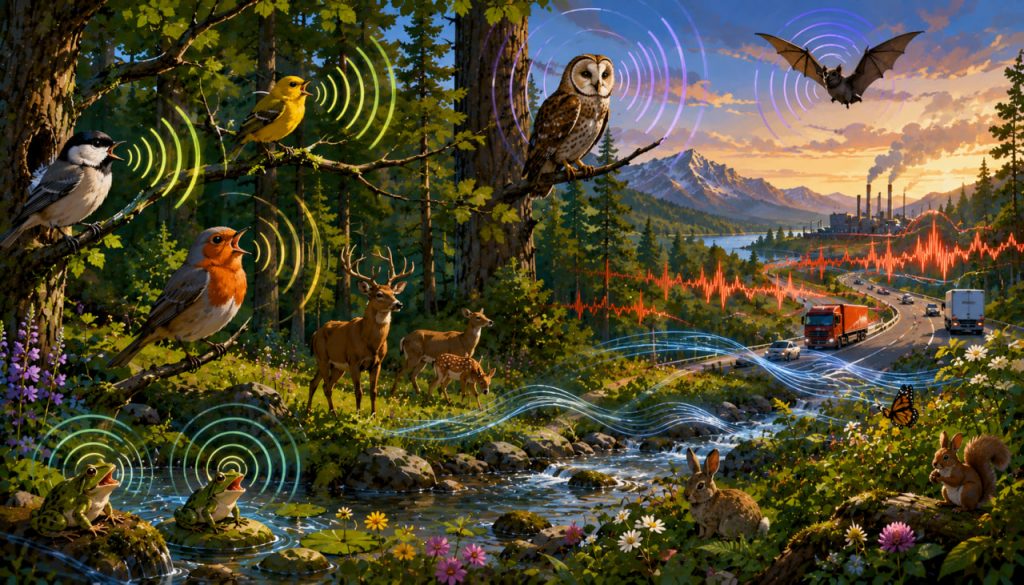
When people think about protecting wildlife, they often focus on forests, rivers, oceans, and habitats. However, there is another crucial part of the natural world that is often overlooked: sound. For many animals, hearing is just as important as sight, and sometimes even more important. The collection of natural sounds in an environment is known as a soundscape, and it plays a vital role in the survival of countless species.
Birds use songs to defend territories and attract mates. Frogs call to potential partners. Whales communicate across vast ocean distances. Predators listen for prey, while prey animals listen for approaching danger. In many ecosystems, sound forms an invisible network that helps life function smoothly.
Unfortunately, human-generated noise is increasingly disrupting these natural soundscapes. Roads, aircraft, ships, industrial activity, and urban development are changing what wildlife hears, often with serious consequences.
Understanding how animals experience sound helps reveal why noise pollution has become a growing conservation concern worldwide.
What Is a Natural Soundscape?
A soundscape is the complete collection of sounds within a particular environment.
Natural soundscapes typically include:
- Birdsong
- Wind through vegetation
- Flowing water
- Insect calls
- Animal vocalizations
- Rainfall
Together, these sounds create an acoustic environment that many species rely upon.
Animals have evolved within these soundscapes over millions of years.
Why Sound Matters to Wildlife
For many species, sound is a primary source of information.
Animals use sound for:
- Finding mates
- Locating food
- Avoiding predators
- Navigating environments
- Coordinating group behavior
- Caring for offspring
In dense forests, murky water, or nighttime conditions, hearing may be more useful than vision.
Sound allows information to travel around obstacles and across long distances.
Birds and Their Acoustic World
Birds are among the most vocal animals on Earth.
Bird songs serve several purposes:
- Territory defense
- Mate attraction
- Species recognition
- Alarm communication
Each species has evolved vocalizations adapted to its habitat.
Forest birds often produce lower-frequency sounds that travel through vegetation, while birds in open habitats may use different frequencies.
Noise pollution can interfere with these signals.
How Marine Animals Depend on Sound
In the oceans, sound becomes even more important.
Water transmits sound much more efficiently than air.
Marine animals use sound for:
- Communication
- Navigation
- Hunting
- Social interaction
Many whales can communicate across hundreds or even thousands of kilometers.
Dolphins use echolocation to detect objects and locate prey.
For these species, the acoustic environment is essential.
The Rise of Noise Pollution
Human activities have dramatically increased environmental noise.
Major sources include:
- Highways
- Railways
- Aircraft
- Construction
- Industrial machinery
- Shipping traffic
Many natural environments are now significantly louder than they were only a century ago.
This change affects both terrestrial and aquatic ecosystems.
Acoustic Masking: When Animals Cannot Hear
One of the most serious consequences of noise pollution is acoustic masking.
This occurs when artificial sounds cover up important biological signals.
Examples include:
- Birds unable to hear mating calls
- Frogs struggling to locate partners
- Marine mammals missing communication signals
If critical sounds become masked, animals may experience reduced reproductive success and increased stress.
Behavioral Changes Caused by Noise
Animals often alter their behavior in response to noise.
Researchers have observed:
- Changes in singing frequency
- Shifts in activity patterns
- Avoidance of noisy areas
- Reduced feeding efficiency
Some birds now sing at higher pitches in cities to overcome traffic noise.
While these adaptations may help, they often require additional energy and may not fully compensate for noise interference.
Effects on Predators and Prey
Noise pollution affects both hunters and hunted animals.
Predators may struggle to:
- Detect prey movements
- Hear warning signals
Prey animals may find it harder to:
- Detect approaching predators
- Communicate danger
This disruption can alter ecological relationships and affect entire food webs.
Stress and Health Impacts
Chronic noise can act as a biological stressor.
Studies suggest excessive noise may contribute to:
- Elevated stress hormones
- Reduced reproductive success
- Impaired immune function
- Lower survival rates
The effects can be subtle but significant over long periods.
Wildlife may appear present in noisy environments while experiencing hidden physiological stress.
Underwater Noise Is a Growing Concern
Ocean noise has increased dramatically due to human activity.
Major sources include:
- Cargo ships
- Oil exploration
- Sonar systems
- Marine construction
Scientists have documented changes in whale and dolphin behavior associated with elevated underwater noise levels.
Because many marine mammals rely heavily on sound, underwater noise pollution has become a major conservation issue.
Expert Perspective
Bioacoustics pioneer Bernie Krause has spent decades recording natural soundscapes around the world. His research demonstrates that healthy ecosystems often possess rich and complex acoustic signatures, while degraded habitats frequently become quieter or acoustically simplified. Krause argues that listening to nature provides valuable insight into ecosystem health that may not be visible through traditional observation alone.
Protecting Natural Soundscapes
Conservationists are increasingly recognizing sound as an environmental resource.
Protection measures include:
- Quiet zones in protected areas
- Improved road design
- Noise reduction technologies
- Ship-speed regulations
- Habitat restoration
Some national parks now actively monitor acoustic conditions as part of ecosystem management.
The Future of Acoustic Conservation
As technology improves, scientists are using sound monitoring to study ecosystems more effectively.
Automated recording systems can:
- Detect species presence
- Track migration patterns
- Monitor biodiversity
- Measure environmental change
Sound may become one of the most powerful tools for conservation in the coming decades.
Conclusion
Natural soundscapes are an essential but often overlooked component of healthy ecosystems. Animals rely on sound to communicate, reproduce, find food, avoid predators, and navigate their environments. As human-generated noise spreads across the planet, these vital acoustic networks face increasing disruption.
Protecting wildlife requires more than preserving physical habitats. It also means preserving the sounds that make those habitats function. By reducing noise pollution and safeguarding natural soundscapes, we help ensure that animals can continue hearing the information they need to survive in an increasingly noisy world.
Interesting Facts
- Some whales can communicate across distances of hundreds of kilometers.
- Owls can locate prey using sound even in complete darkness.
- Certain birds alter the pitch of their songs in noisy cities.
- Sound travels roughly four times faster in water than in air.
- Scientists can identify entire ecosystems by analyzing their soundscapes.
- Many animals hear frequencies beyond the range of human hearing.
Glossary
- Soundscape — The complete collection of sounds within an environment.
- Bioacoustics — The study of sound production and perception in living organisms.
- Acoustic Masking — Interference that prevents important sounds from being heard.
- Echolocation — The use of reflected sound waves to locate objects.
- Noise Pollution — Unwanted human-generated sound that affects the environment.
- Territory — An area defended by an animal against competitors.
- Biodiversity — The variety of living organisms within an ecosystem.