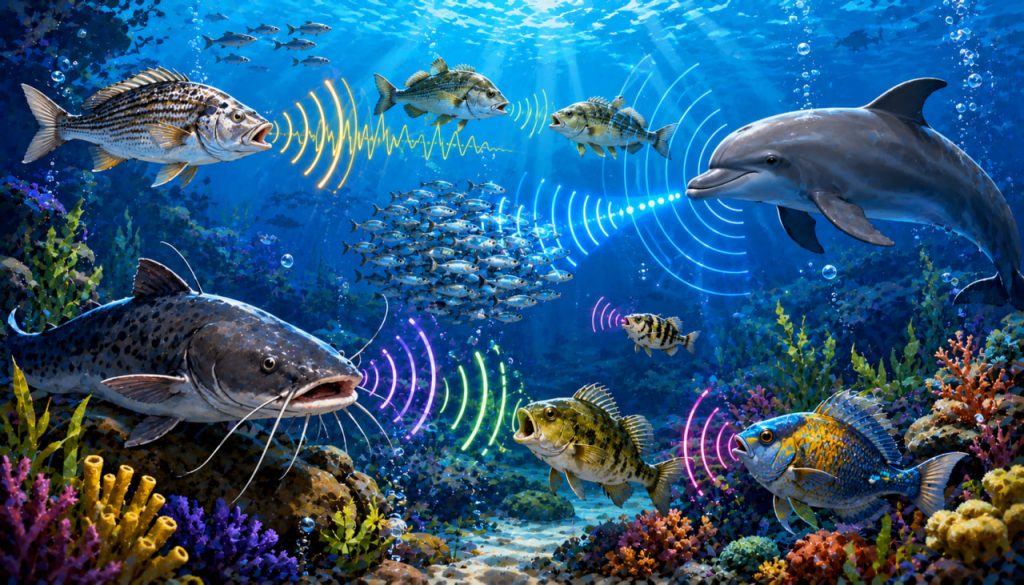
For a long time, people believed that fish lived in a silent world. Oceans, lakes, and rivers appeared calm beneath the surface, leading many scientists to assume that fish relied mostly on sight, smell, and movement to communicate. Modern research has completely changed that view. Today, scientists know that underwater environments are filled with sounds, and many fish actively produce noises to communicate with one another.
From clicks and grunts to hums, drumming sounds, and even vibrations transmitted through water, fish possess a surprising variety of communication methods. Some species use sound to attract mates, defend territories, warn rivals, or coordinate group behavior. In the broader underwater world, marine mammals such as dolphins and whales have developed even more sophisticated acoustic systems, including echolocation.
Understanding how aquatic animals communicate reveals an extraordinary hidden world that humans rarely experience directly.
Why Sound Works So Well Underwater
Sound behaves differently in water than it does in air.
Water transmits sound:
- Faster
- Farther
- More efficiently
In seawater, sound travels approximately four times faster than in air.
Because visibility underwater is often limited by:
- Darkness
- Sediment
- Depth
- Vegetation
sound becomes one of the most effective ways to exchange information.
Many aquatic animals rely heavily on acoustic communication because it works even when vision is restricted.
Can Fish Really Make Sounds?
Yes. Scientists have identified hundreds of fish species capable of producing sounds.
Common sound-producing groups include:
- Catfish
- Croakers
- Drums
- Cod
- Seahorses
- Triggerfish
Researchers suspect that many additional species also communicate acoustically.
Some fish produce sounds frequently, while others vocalize only during specific situations.
The Most Common Fish Sounds
Fish sounds vary widely.
Researchers have recorded:
- Grunts
- Croaks
- Hums
- Knocks
- Clicks
- Rumbles
- Drumming noises
The names of some fish families even reflect their vocal abilities.
For example, the drum and croaker families received their names because of the sounds they produce.
These noises may seem simple, but they often carry important information.
How Fish Produce Sound
Fish use several different mechanisms to create sound.
One common method involves the swim bladder, a gas-filled organ normally used for buoyancy control.
Specialized muscles can rapidly vibrate the swim bladder, producing sound waves.
Other fish create sounds by:
- Grinding teeth
- Rubbing bones together
- Moving fin structures
- Vibrating skeletal components
These techniques evolved independently in various groups of fish.
Communication During Mating
One of the most important functions of fish sounds is reproduction.
Many species use vocalizations to:
- Attract mates
- Demonstrate fitness
- Synchronize spawning
Male fish often produce calls during breeding seasons.
Females may use these sounds to evaluate potential partners.
In some species, underwater choruses form when large numbers of males call simultaneously.
These natural soundscapes can be surprisingly loud.
Territorial and Aggressive Signals
Fish also use sound to establish territory.
Vocalizations may communicate:
- Ownership of a territory
- Dominance status
- Aggressive intent
By producing warning sounds, fish can sometimes avoid physical confrontations.
Communication helps reduce unnecessary energy expenditure and injury risk.
Group Coordination and Schooling
Some fish species appear to use sound during social interactions.
Acoustic signals may assist with:
- Maintaining group cohesion
- Coordinating movements
- Alerting nearby individuals
Although visual cues remain important, sound provides an additional communication channel in murky environments.
Hearing Underwater
Producing sound is only part of the story.
Fish also possess sophisticated hearing systems.
Many detect sound through:
- Inner ears
- Specialized sensory structures
- Vibrations transmitted through water
Some species can detect extremely subtle vibrations that humans would never notice.
This sensitivity helps them locate predators, prey, and other members of their species.
The Lateral Line: A Unique Sensory System
Fish possess a remarkable sensory structure called the lateral line.
The lateral line allows fish to detect:
- Water movement
- Vibrations
- Pressure changes
It functions almost like a distant-touch system.
This ability helps fish navigate, avoid obstacles, and coordinate movements within schools.
Although not hearing in the traditional sense, it complements acoustic communication.
Dolphins and Echolocation
When discussing underwater sound, dolphins deserve special attention.
Unlike fish, dolphins are mammals.
They use an advanced biological sonar system known as echolocation.
Echolocation involves:
- Producing high-frequency clicks
- Receiving returning echoes
- Interpreting reflected sound
This system allows dolphins to:
- Detect prey
- Navigate murky waters
- Identify objects
- Estimate distance and size
Echolocation is one of the most sophisticated sensory systems found in nature.
Whales and Long-Distance Communication
Many whales communicate using powerful low-frequency sounds.
These calls can travel extraordinary distances through the ocean.
Whales use sound for:
- Social communication
- Group coordination
- Navigation
- Mate attraction
Some whale vocalizations may travel hundreds of kilometers under favorable conditions.
The ocean effectively becomes a giant acoustic communication network.
Noise Pollution: A Growing Threat
Human activity is increasingly affecting underwater soundscapes.
Major sources of underwater noise include:
- Cargo ships
- Oil exploration
- Sonar systems
- Marine construction
Excessive noise can interfere with animal communication.
Scientists have documented changes in behavior among both fish and marine mammals exposed to elevated noise levels.
Protecting underwater acoustic environments is becoming an important conservation priority.
Expert Perspective
Marine bioacoustics researcher Arthur N. Popper has spent decades studying fish hearing and underwater sound perception. His work has demonstrated that fish possess far more sophisticated acoustic abilities than scientists once believed. Popper’s research helped overturn the outdated assumption that fish inhabit a largely silent world.
The Future of Underwater Sound Research
New technologies are allowing researchers to listen to aquatic ecosystems with unprecedented detail.
Scientists now use:
- Hydrophones
- Acoustic monitoring networks
- Artificial intelligence analysis
- Underwater recording systems
These tools are helping reveal hidden communication systems throughout the aquatic world.
Many discoveries almost certainly remain ahead.
Conclusion
Fish do not live in silence. They inhabit a rich acoustic environment filled with grunts, clicks, hums, knocks, and vibrations that help them communicate, reproduce, defend territories, and coordinate behavior. Combined with the extraordinary echolocation abilities of dolphins and the long-distance calls of whales, underwater sound forms one of the most fascinating communication systems in nature.
As scientists continue exploring aquatic soundscapes, they are uncovering an increasingly complex world where sound is often just as important as sight. Beneath the water’s surface lies a hidden conversation that has been taking place for millions of years.
Interesting Facts
- Some fish produce sounds loud enough to be detected by underwater microphones hundreds of meters away.
- Croaker fish received their name because of the noises they make.
- Sound travels about four times faster in water than in air.
- Dolphins can identify objects using echolocation even in complete darkness.
- Certain fish create nighttime choruses similar to groups of singing birds.
- The lateral line allows fish to sense water movements that humans cannot detect.
Glossary
- Acoustic Communication — Communication using sound.
- Swim Bladder — A gas-filled organ that helps fish control buoyancy.
- Echolocation — Biological sonar using reflected sound waves.
- Hydrophone — A microphone designed for underwater sound recording.
- Lateral Line — A sensory system that detects water movement and vibrations.
- Bioacoustics — The study of sound in living organisms.
- Soundscape — The collection of sounds within an environment.