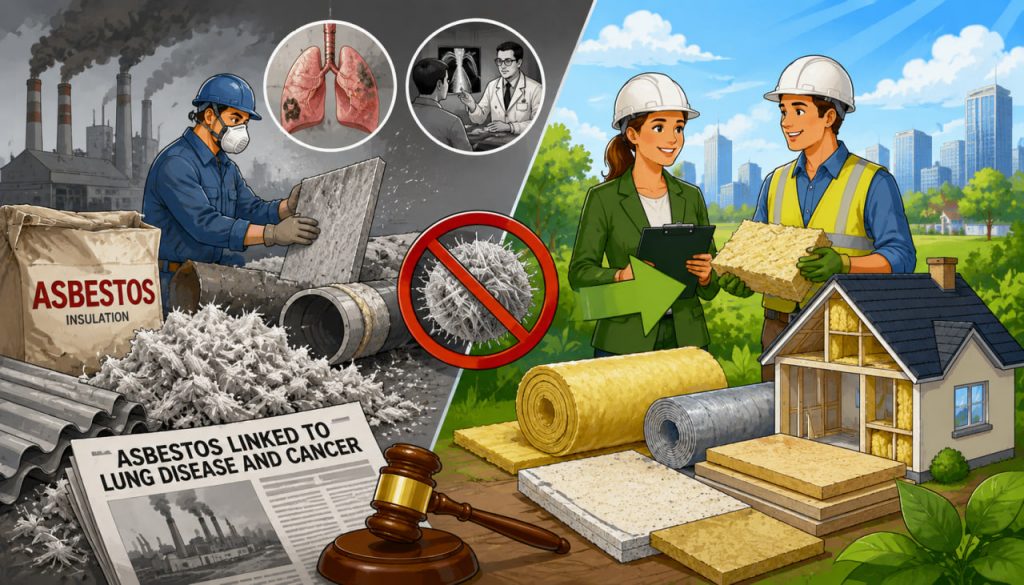
For much of the twentieth century, asbestos was considered one of the most useful industrial materials ever discovered. It was strong, resistant to heat, electricity, and chemicals, and inexpensive to produce. Engineers, builders, and manufacturers used it in thousands of products, from insulation and roofing materials to brake pads and ship construction.
However, what was once celebrated as a miracle material eventually became recognized as a major public health hazard. The story of how humanity gradually abandoned asbestos is a powerful example of how scientific research can transform industry and protect millions of lives.
What Is Asbestos?
Asbestos is a naturally occurring mineral composed of microscopic fibers. These fibers are extremely durable and resistant to fire, making asbestos highly attractive for industrial applications.
There are several types of asbestos, but all share similar properties:
- Heat resistance
- Fire resistance
- Chemical stability
- Excellent insulation capabilities
- High tensile strength
Because of these characteristics, asbestos use expanded rapidly during the Industrial Revolution and throughout the twentieth century.
Why Asbestos Became So Popular
The rise of modern industry created enormous demand for affordable materials capable of withstanding extreme conditions.
Asbestos found its way into:
- Building insulation
- Roofing materials
- Cement products
- Floor tiles
- Automotive brakes
- Pipes and boilers
- Ships and power plants
By the mid-1900s, millions of tons of asbestos were being mined and used worldwide.
Many experts considered it indispensable for modern construction.
The First Warning Signs
Although asbestos was widely praised, concerns about its health effects began to emerge surprisingly early.
Doctors working with miners and factory workers noticed unusual lung diseases among people exposed to asbestos dust.
Workers frequently experienced:
- Chronic coughing
- Breathing difficulties
- Lung scarring
- Reduced lung function
Initially, these health problems were poorly understood, and many industries continued using asbestos despite growing concerns.
The Discovery of Asbestos-Related Diseases
As medical research improved, scientists identified direct links between asbestos exposure and severe illnesses.
The most important discoveries included:
Asbestosis
Asbestosis is a chronic lung disease caused by inhaling asbestos fibers. These fibers become trapped in lung tissue and gradually cause scarring.
Over time, this scarring makes breathing increasingly difficult.
Lung Cancer
Researchers found that long-term asbestos exposure significantly increased the risk of lung cancer, particularly among smokers.
The combination of smoking and asbestos exposure proved especially dangerous.
Mesothelioma
Perhaps the most devastating discovery was mesothelioma, a rare and aggressive cancer affecting the lining of the lungs and other organs.
Mesothelioma became one of the strongest pieces of evidence linking asbestos to severe health consequences.
A particularly troubling feature of the disease is that symptoms may not appear until 20 to 50 years after exposure.
Scientific Evidence Changes Public Opinion
By the 1960s and 1970s, the scientific evidence had become increasingly difficult to ignore.
Studies consistently demonstrated that:
- Even relatively low exposure could be harmful
- Workers were at significant risk
- Family members could be exposed through contaminated clothing
- Health effects could appear decades later
According to Dr. Irving Selikoff, one of the pioneers of asbestos research:
“The danger from asbestos lies not in its use alone, but in the invisible fibers that can be inhaled and remain in the body for decades.”
His research played a crucial role in changing public awareness and influencing government policy.
Government Regulations Begin to Appear
As evidence accumulated, governments started introducing regulations designed to reduce exposure.
These measures included:
- Workplace safety standards
- Air quality monitoring
- Protective equipment requirements
- Restrictions on asbestos-containing products
Many countries gradually reduced or eliminated asbestos use during the late twentieth century.
Why the Transition Was Difficult
Despite the growing evidence, abandoning asbestos was not easy.
Several factors slowed the transition:
- Massive economic investments
- Existing infrastructure containing asbestos
- Industry resistance
- Lack of immediate alternatives
Many companies argued that controlled use could be safe, while public health experts increasingly advocated for complete bans.
Development of Safer Alternatives
The decline of asbestos accelerated as manufacturers developed substitute materials.
Common alternatives include:
- Fiberglass insulation
- Mineral wool
- Cellulose insulation
- Ceramic fibers
- Advanced fire-resistant composites
These materials provide many of the same benefits without the severe health risks associated with asbestos.
The Global Status of Asbestos Today
Many developed countries have banned or severely restricted asbestos.
However, asbestos has not disappeared completely.
Some nations still allow limited use in specific industries, while others continue mining and exporting asbestos products.
International health organizations, including the World Health Organization (WHO), continue to advocate for reducing and ultimately eliminating asbestos exposure worldwide.
The WHO has repeatedly stated that no safe level of asbestos exposure has been established.
Lessons Humanity Learned from Asbestos
The asbestos story offers valuable lessons for modern society.
It demonstrates:
- The importance of long-term health research
- The need for independent scientific investigation
- The risks of widespread adoption before fully understanding health consequences
- The value of preventive regulation
Many experts now view asbestos as one of history’s most important public health lessons.
Why Asbestos Remains Relevant Today
Although new asbestos use has declined in many regions, millions of older buildings still contain asbestos materials.
As a result, careful management remains necessary during:
- Building renovations
- Demolition projects
- Industrial maintenance
- Infrastructure upgrades
Proper handling by trained professionals is essential to prevent the release of dangerous fibers.
Interesting Facts
- Ancient Greeks and Romans used asbestos more than 2,000 years ago.
- The word “asbestos” comes from a Greek term meaning “inextinguishable.”
- Asbestos fibers are so small that many cannot be seen without a microscope.
- Mesothelioma remains one of the rarest but most strongly asbestos-related cancers.
- Some countries banned asbestos decades ago, while others still permit limited use today.
Glossary
- Asbestos — A group of naturally occurring fibrous minerals once widely used in industry.
- Asbestosis — A lung disease caused by inhaling asbestos fibers.
- Mesothelioma — A rare cancer strongly linked to asbestos exposure.
- Insulation — Material used to reduce heat transfer.
- Fiberglass — A common insulation material made from fine glass fibers.