Earth is one of the most thoroughly explored planets in the known universe, yet many places remain shrouded in mystery. Despite advances in geology, archaeology, satellite imaging, and scientific research, certain locations continue to challenge our understanding.
Some mysterious places are associated with:
- Unusual natural phenomena
- Ancient civilizations
- Strange disappearances
- Unique geological formations
- Unexplained historical questions
While science has solved many mysteries once attributed to myths and legends, some locations still raise fascinating questions.
These mysterious places remind us that even in the age of modern technology, our planet retains secrets waiting to be understood.
Why Are Some Places Considered Mysterious?
A location becomes mysterious when:
- Observations are difficult to explain.
- Historical records are incomplete.
- Natural processes appear unusual.
- Scientific understanding remains limited.
Importantly, mystery does not necessarily mean supernatural.
In many cases, mysterious places become important scientific laboratories that help researchers learn more about:
- Earth sciences
- Human history
- Ecology
- Astronomy
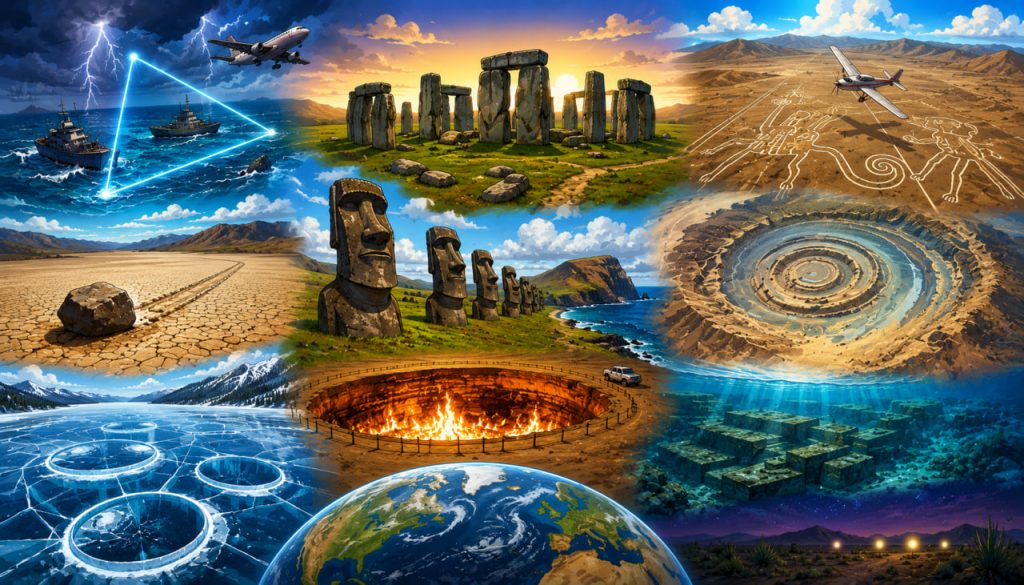
The Bermuda Triangle
Perhaps the most famous mysterious region is the:
Bermuda Triangle
Located between:
- Florida
- Bermuda
- Puerto Rico
the region gained fame because of reports involving:
- Missing ships
- Disappearing aircraft
- Navigation anomalies
Over the years, scientists have proposed explanations including:
- Severe weather
- Human error
- Ocean currents
- Instrument failures
Most researchers do not consider the area uniquely dangerous, yet its reputation continues to fascinate the public.
Stonehenge
One of the world’s most famous prehistoric monuments is:
Stonehenge
Constructed thousands of years ago, Stonehenge consists of massive stone blocks arranged in a circular pattern.
Questions remain regarding:
- Construction methods
- Transportation of stones
- Exact purpose
Researchers believe it may have served:
- Ceremonial functions
- Astronomical observations
- Social gatherings
However, many details remain uncertain.
The Nazca Lines
In the deserts of:
Peru
lie the remarkable:
Nazca Lines
These enormous geoglyphs depict:
- Animals
- Plants
- Geometric shapes
Many designs can only be fully appreciated from the air.
Scientists continue debating their precise purpose, though theories include:
- Religious rituals
- Astronomical alignments
- Water-related ceremonies
The scale and precision of the lines remain impressive even today.
The Sailing Stones of Death Valley
Inside:
Racetrack Playa
large rocks appear to move across the dry lakebed by themselves.
For decades, scientists puzzled over:
- Long tracks behind stones
- Apparent self-motion
Eventually, research revealed that a combination of:
- Thin ice sheets
- Wind
- Water
can slowly push the rocks across the surface.
Even after the mystery was largely solved, the phenomenon remains one of nature’s most unusual spectacles.
Easter Island
Far out in the Pacific Ocean lies:
Easter Island
famous for its giant stone statues known as:
- Moai
Researchers still investigate:
- How the statues were transported
- Their cultural significance
- The history of the island’s civilization
The engineering achievements of the island’s inhabitants continue to inspire scientific study.
The Richat Structure
In the Sahara Desert of:
Mauritania
sits a massive circular formation called:
Richat Structure
Also known as:
- The Eye of the Sahara
the formation stretches roughly 40 kilometers across.
Although initially thought to be an impact crater, scientists now believe it formed through geological uplift and erosion.
Its striking appearance makes it visible from space.
Lake Baikal
Located in:
Russia
Lake Baikal
is the deepest freshwater lake on Earth.
The lake contains:
- Unique ecosystems
- Rare species
- Strange ice formations
Researchers continue studying unusual circular ice patterns that occasionally appear on its frozen surface.
Many of these phenomena involve complex interactions between:
- Water currents
- Ice
- Temperature
The Door to Hell
In:
Turkmenistan
lies the famous:
Darvaza Gas Crater
Often called:
- The Door to Hell
This enormous burning crater has been aflame for decades.
The fire began after a drilling accident exposed natural gas deposits.
Although scientists understand the cause, its dramatic appearance continues to inspire mystery and fascination.
The Underwater Yonaguni Monument
Near:
Japan
researchers discovered the:
Yonaguni Monument
This underwater rock formation contains:
- Flat surfaces
- Sharp angles
- Terrace-like structures
Some researchers believe it may be entirely natural.
Others suggest possible human modification.
The debate remains unresolved.
The Moving Lights of Marfa
Near:
Marfa
people have reported mysterious glowing lights for more than a century.
Known as:
- The Marfa Lights
possible explanations include:
- Atmospheric effects
- Vehicle lights
- Temperature inversions
Despite scientific investigations, the phenomenon continues attracting visitors.
Why Scientists Study Mysterious Places
Mysterious locations often drive scientific discovery.
Investigating unusual phenomena can lead to advances in:
- Geology
- Archaeology
- Astronomy
- Climate science
Many mysteries that once seemed impossible eventually found scientific explanations.
Others remain active areas of research.
Expert Opinion on Scientific Mysteries
Astronomer and science communicator Carl Sagan often emphasized that mysteries should inspire curiosity rather than immediate supernatural conclusions.
His approach encouraged rigorous investigation while maintaining wonder about the natural world.
This philosophy continues guiding scientific exploration today.
Why Earth’s Mysteries Matter
Mysterious places remind us that exploration is far from complete.
Even with satellites, computers, and advanced scientific instruments, our planet still contains:
- Unanswered questions
- Rare phenomena
- Hidden histories
Some mysteries eventually receive clear explanations.
Others may take decades or centuries to fully understand.
What makes these places fascinating is not simply the unknown itself, but the opportunity to learn more about our world.
In many cases, today’s mystery becomes tomorrow’s scientific discovery.
Interesting Facts
- Lake Baikal contains about 20% of the world’s unfrozen freshwater.
- The Nazca Lines are best viewed from the air.
- The Richat Structure is so large that astronauts use it as a landmark from space.
- Some Moai statues on Easter Island weigh more than 80 tons.
- The Bermuda Triangle covers more than one million square kilometers of ocean.
Glossary
- Geoglyph — Large design created on the ground and visible from above.
- Erosion — Gradual wearing away of rock by natural forces.
- Moai — Monumental stone statues of Easter Island.
- Crater — Circular depression formed by impact or geological activity.
- Atmospheric Phenomenon — Event caused by processes occurring in Earth’s atmosphere.