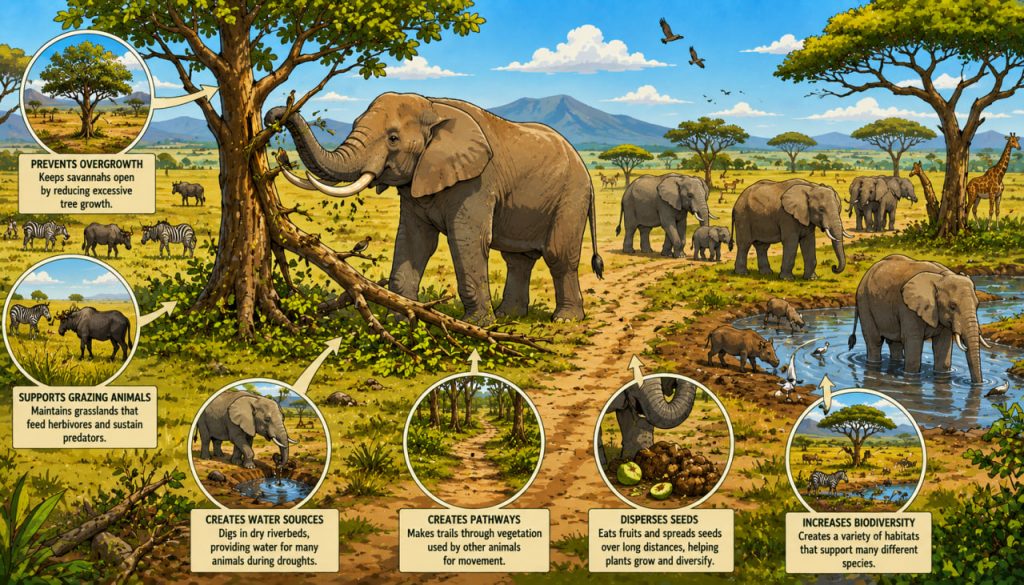
Elephants are often called the giants of the animal kingdom, but their importance goes far beyond their impressive size. In African savannahs, elephants act as ecosystem engineers—animals that physically modify their environment in ways that affect countless other species. Through their feeding habits, movements, and interactions with vegetation, elephants help maintain the delicate balance of one of Earth’s most iconic ecosystems.
Scientists have discovered that removing elephants from a savannah can trigger profound ecological changes. Trees, grasses, insects, birds, and mammals all depend, directly or indirectly, on the activities of these remarkable animals. In many ways, elephants help shape the very landscape around them.
Understanding their role reveals why elephant conservation is not only about protecting a single species but also about preserving entire ecosystems.
What Makes Elephants Ecosystem Engineers?
An ecosystem engineer is an organism that alters its environment in a way that creates new habitats or influences other species.
Elephants qualify because they:
- Knock down trees
- Create pathways
- Dig for water
- Disperse seeds
- Modify vegetation structure
Because an adult African elephant can weigh more than six tons and consume hundreds of kilograms of plant material per day, its impact on the landscape is enormous.
Few other animals have such a widespread influence.
How Elephants Prevent Savannahs from Becoming Forests
One of the most important ecological roles of elephants is controlling tree growth.
Elephants frequently:
- Break branches
- Strip bark
- Push over trees
- Feed on woody vegetation
At first glance, this may seem destructive.
However, these activities help maintain the open grasslands that characterize savannah ecosystems.
Without elephants, many areas would gradually become denser woodlands or forests.
This shift would dramatically alter habitat conditions for numerous species adapted to open landscapes.
Supporting Grazing Animals
Many animals depend on grasslands for survival.
These include:
- Zebras
- Wildebeest
- Antelopes
- Buffalo
By limiting tree expansion, elephants allow sunlight to reach the ground, promoting grass growth.
Healthy grasslands support large herbivore populations, which in turn support predators such as lions, cheetahs, and hyenas.
In this way, elephants indirectly influence the entire food web.
Creating Water Sources
Water is often scarce in savannah environments.
During dry periods, elephants use their tusks and feet to dig into dry riverbeds in search of groundwater.
These excavations can create small water holes used by:
- Birds
- Antelopes
- Warthogs
- Smaller mammals
- Insects
Many species survive droughts partly because elephants uncover otherwise inaccessible water.
Natural Landscape Architects
As elephants move across vast territories, they create pathways through dense vegetation.
These routes are often used by:
- Other mammals
- Reptiles
- Birds
- Human researchers and park rangers
The trails can influence animal movement patterns throughout entire regions.
In some cases, elephant pathways become long-lasting landscape features.
The Role of Elephants in Seed Dispersal
Elephants are among nature’s most effective seed dispersers.
Many fruits are eaten whole, and seeds pass through the digestive system before being deposited elsewhere.
This process offers several advantages:
- Seeds are transported long distances.
- Natural fertilizer accompanies the seeds.
- Plant populations become more genetically diverse.
Some tree species depend heavily on large animals like elephants for successful dispersal.
Without elephants, certain plants may struggle to spread across the landscape.
How Elephants Increase Biodiversity
Biodiversity refers to the variety of living organisms within an ecosystem.
Elephants help increase biodiversity by creating a mosaic of habitats.
Their activities generate:
- Open grasslands
- Shrub-covered areas
- Mixed woodlands
- Water sources
- Disturbed soil patches
Different species prefer different habitat types.
As a result, elephant-modified landscapes often support a greater diversity of life than areas lacking elephants.
What Happens When Elephants Disappear?
Scientists have studied ecosystems where elephant populations declined significantly.
The consequences can include:
- Increased tree density
- Reduced grassland habitat
- Changes in plant composition
- Declines in grazing species
- Altered predator populations
These changes may ripple through entire ecological communities.
Because elephants influence so many environmental factors, their loss can trigger what ecologists call a trophic cascade, a chain reaction affecting multiple levels of the ecosystem.
Expert Perspective
Ecologist Iain Douglas-Hamilton, one of the world’s leading elephant researchers, emphasized the importance of elephants by stating:
“Elephants are architects of the natural world. Their presence shapes ecosystems on a scale few other animals can match.”
Decades of research support this view, demonstrating that elephants play critical roles in maintaining ecological balance.
Threats Facing Elephant Populations
Despite their importance, elephants face serious challenges.
Major threats include:
- Habitat loss
- Human-wildlife conflict
- Poaching for ivory
- Fragmentation of migration routes
- Climate change
Conservation efforts increasingly focus not only on protecting elephants themselves but also on preserving the ecosystems they help sustain.
Why Protecting Elephants Protects Entire Ecosystems
Conservation biologists often refer to elephants as a keystone species, meaning their influence on the environment is disproportionately large compared to their population size.
Protecting elephants helps preserve:
- Grasslands
- Water resources
- Plant diversity
- Animal migrations
- Ecological stability
When elephants thrive, many other species benefit as well.
The Future of the Savannah
African savannahs are among the most biologically rich ecosystems on Earth.
Their future depends partly on maintaining the natural processes that have shaped them for thousands of years.
Elephants are central to those processes.
Far more than simply large herbivores, they are engineers, gardeners, and architects of the savannah landscape. Their daily activities influence countless organisms and help maintain the balance that allows these ecosystems to flourish.
Without elephants, the savannah would not simply lose one species—it would become a fundamentally different place.
Interesting Facts
- An adult African elephant can eat more than 150 kilograms of vegetation per day.
- Elephants can disperse seeds over distances exceeding several kilometers.
- Their tusks can be used to dig for water during droughts.
- Elephant-created pathways are often used by many other animal species.
- Some trees have evolved fruits specifically suited for dispersal by large mammals like elephants.
Glossary
- Ecosystem Engineer — An organism that physically modifies its environment and influences other species.
- Biodiversity — The variety of living organisms in an ecosystem.
- Keystone Species — A species whose ecological impact is much greater than its abundance would suggest.
- Seed Dispersal — The movement of seeds away from a parent plant.
- Trophic Cascade — A chain reaction of ecological effects spreading through multiple levels of a food web.