For most living creatures, aging seems inevitable. Cells accumulate damage, tissues gradually lose efficiency, and eventually organisms die. Yet nature contains fascinating exceptions that challenge our understanding of life itself. Some animals appear capable of avoiding typical aging, while others can regenerate lost body parts so effectively that they seem almost immortal.
Among the most remarkable examples are hydras and certain sea cucumbers, organisms that have become valuable subjects in scientific research on aging, regeneration, and longevity. By studying these unusual creatures, scientists hope to better understand why aging evolved and whether its effects can someday be slowed or even partially reversed in humans.
The phenomenon of biological immortality remains one of the most intriguing topics in modern biology.
What Is Biological Immortality?
When scientists discuss biological immortality, they do not mean that an organism can never die.
A biologically immortal organism can still be killed by:
- Predators
- Disease
- Environmental changes
- Accidents
Instead, biological immortality means the organism does not appear to experience the normal age-related decline seen in most animals.
In other words:
Its probability of dying does not increase significantly with age.
This concept challenges the traditional view that aging is an unavoidable consequence of life.
Why Most Organisms Age
Aging, also called senescence, refers to the gradual deterioration of biological functions over time.
Scientists believe aging occurs because:
- Cellular damage accumulates
- DNA mutations build up
- Repair systems become less efficient
- Natural selection weakens after reproduction
Evolution does not necessarily favor indefinite survival. Instead, traits that improve reproductive success tend to be preserved.
As a result, many organisms invest more energy in reproduction than in maintaining their bodies forever.
Hydra: The Animal That Barely Ages
Hydras are tiny freshwater animals belonging to a group called cnidarians, which also includes jellyfish and corals.
Although they measure only a few millimeters in length, hydras possess extraordinary biological abilities.
Research has shown that some hydra species exhibit little or no measurable senescence.
In laboratory conditions, hydras can survive for many years without showing typical signs of aging.
The Secret of Hydra’s Longevity
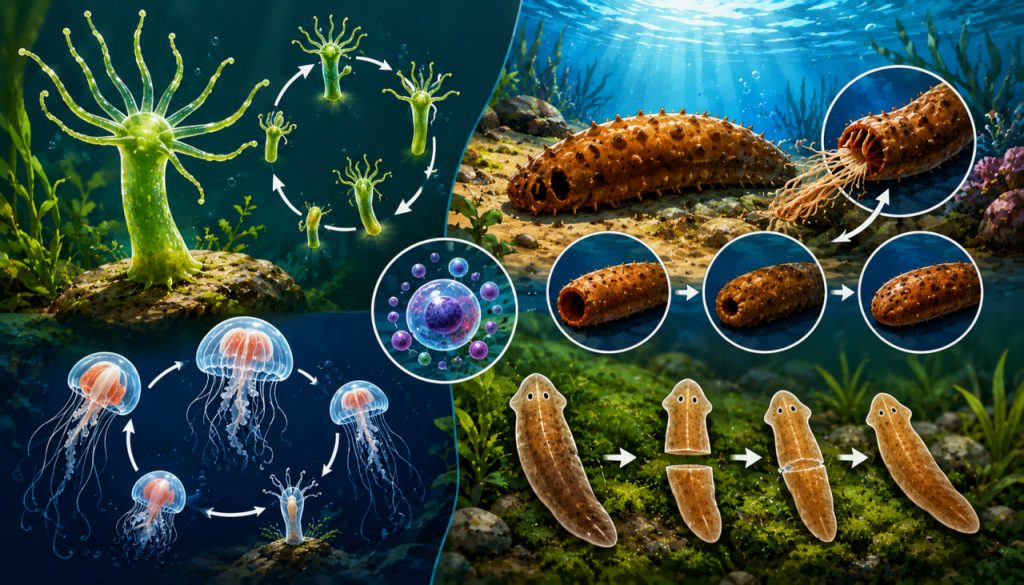
Hydras owe their remarkable lifespan largely to stem cells.
Stem cells are specialized cells capable of producing many different cell types.
In hydras:
- Stem cells continuously divide.
- Old cells are constantly replaced.
- Tissues remain perpetually renewed.
Because cellular renewal is so effective, hydras avoid many of the biological problems associated with aging.
Some researchers consider them one of the closest examples of biological immortality found in nature.
Sea Cucumbers and Extreme Regeneration
Sea cucumbers, members of the echinoderm family that also includes sea stars and sea urchins, possess another remarkable strategy for survival.
Certain species can:
- Regenerate internal organs
- Replace damaged tissues
- Recover from severe injuries
Some sea cucumbers can even eject portions of their internal organs when threatened and later regrow them.
This process is known as evisceration.
While sea cucumbers do age, their regenerative abilities make them important models for understanding tissue repair.
Regeneration Versus Immortality
Regeneration and immortality are not the same thing.
An organism may regenerate damaged body parts yet still age normally.
However, both processes rely on similar biological mechanisms:
- Stem cell activity
- Tissue renewal
- Cellular repair systems
Scientists study these mechanisms to understand how some species maintain healthy tissues for extended periods.
Other Animals That Challenge Aging
Hydras and sea cucumbers are not alone.
Several other organisms exhibit extraordinary longevity or regenerative abilities.
The “Immortal” Jellyfish
The species Turritopsis dohrnii has attracted worldwide attention because it can reverse its life cycle.
When stressed or injured, it can transform from its adult form back into an earlier developmental stage.
This process effectively resets part of its biological clock.
Planarian Flatworms
Planarians are famous for their regenerative capabilities.
Even small body fragments can regenerate into complete individuals.
Their large population of stem cells contributes to their exceptional regenerative potential.
What Aging Research Can Learn
Studying these organisms helps scientists investigate key questions:
- Why do cells age?
- How can damaged tissues be repaired?
- Can stem cells rejuvenate organs?
- What mechanisms control longevity?
The answers may eventually contribute to advances in medicine.
Potential applications include:
- Tissue regeneration
- Improved wound healing
- Treatment of age-related diseases
- Organ repair technologies
However, researchers emphasize that human biological immortality remains far beyond current scientific capabilities.
The Evolutionary Puzzle of Aging
One of biology’s biggest questions is why aging evolved at all.
Several theories attempt to explain it.
One leading explanation suggests that natural selection becomes less effective later in life because reproduction usually occurs earlier.
As a result:
- Harmful late-life effects accumulate.
- Maintenance systems receive limited evolutionary investment.
Species like hydras provide valuable exceptions that help scientists test these ideas.
Expert Perspective
Evolutionary biologist Thomas Kirkwood, known for developing the disposable soma theory of aging, has noted:
“Aging is not programmed death but the consequence of limited biological resources devoted to maintenance and repair.”
This perspective helps explain why some organisms age rapidly while others possess extraordinary repair mechanisms.
Could Humans Ever Stop Aging?
The discovery of biologically unusual organisms often leads to speculation about human immortality.
Current scientific evidence suggests that completely eliminating aging is extremely unlikely in the foreseeable future.
However, research inspired by hydras, sea cucumbers, and other regenerative organisms may eventually help:
- Extend healthy lifespan
- Improve tissue repair
- Reduce age-related diseases
- Enhance regenerative medicine
Rather than immortality, the more realistic goal is improving health during aging.
Why These Creatures Matter
Hydras and sea cucumbers demonstrate that nature has evolved multiple solutions to the challenges of aging and survival.
Their extraordinary abilities remind us that biological possibilities are often broader than expected.
By studying these animals, scientists gain insights into some of life’s deepest mysteries, including how organisms maintain themselves, repair damage, and sometimes appear to escape the normal limits of aging.
Interesting Facts
- Some hydras have shown no measurable increase in mortality over many years of observation.
- Certain sea cucumbers can regenerate entire internal organ systems.
- The “immortal jellyfish” can repeatedly return to an earlier life stage.
- Planarian flatworms possess remarkable regenerative stem cells throughout their bodies.
- Regeneration research is helping advance modern regenerative medicine.
Glossary
- Biological Immortality — The absence of a measurable increase in mortality with age.
- Senescence — The gradual deterioration of biological function associated with aging.
- Stem Cell — A cell capable of developing into multiple specialized cell types.
- Regeneration — The process of replacing lost or damaged tissues.
- Evisceration — The expulsion of internal organs, followed by regeneration in some animals.
- Cnidarian — A group of animals that includes hydras, jellyfish, and corals.