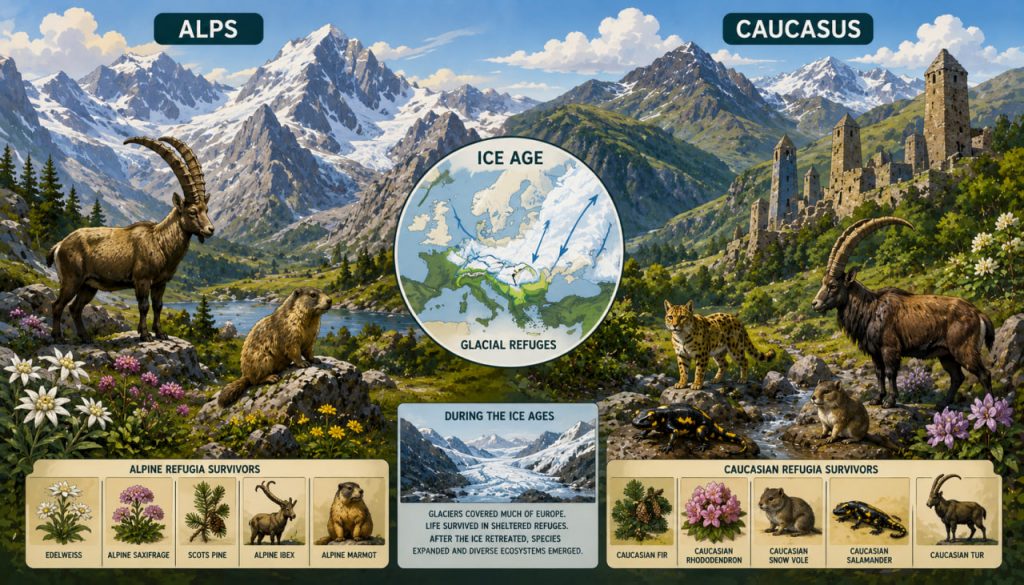
The Ice Ages were among the most dramatic climatic events in Earth’s history. Vast glaciers covered large portions of Europe, transforming landscapes and forcing plants and animals to either adapt, migrate, or face extinction. Yet despite these harsh conditions, many species managed to survive in isolated pockets known as glacial refuges.
The Alps and the Caucasus Mountains became some of the most important refuges during the last glacial periods. These mountainous regions provided sheltered habitats where life persisted while surrounding areas were buried beneath ice or exposed to extreme cold. Today, scientists study these refuges to understand evolution, biodiversity, and the resilience of life during periods of climate change.
The story of glacial refuges is not only about survival—it is also about how modern ecosystems were shaped by ancient climatic challenges.
What Are Glacial Refuges?
A glacial refuge is an area that remained habitable during periods when glaciers expanded across surrounding regions.
These refuges typically possessed:
- Milder microclimates
- Reduced ice coverage
- Accessible water sources
- Suitable vegetation
Because conditions remained relatively stable, plants and animals could survive there while populations elsewhere disappeared.
When glaciers eventually retreated, species expanded outward from these refuges and recolonized large areas.
Modern genetic research has confirmed the crucial role of glacial refuges in preserving biodiversity.
Why the Alps and Caucasus Were Special
Both the Alps and the Caucasus contain highly varied landscapes.
Their mountains create:
- Deep valleys
- Sunny slopes
- Sheltered basins
- Diverse elevations
These features generate numerous microhabitats where local conditions may differ dramatically from nearby areas.
Even during cold periods, certain valleys and slopes remained suitable for survival.
The Caucasus, located between the Black Sea and the Caspian Sea, was particularly important because it experienced less extensive glaciation than northern Europe.
Life During the Ice Ages
The last major glacial maximum occurred roughly 20,000 years ago.
At that time:
- Massive ice sheets covered much of northern Europe.
- Temperatures were significantly lower.
- Growing seasons were shorter.
- Habitats were fragmented.
Yet life persisted in carefully sheltered locations.
Species that survived these conditions often evolved unique adaptations that can still be observed today.
Plant Species That Survived
Plants formed the foundation of refuge ecosystems.
Many species persisted in isolated mountain valleys and rocky outcrops.
Edelweiss
One of the most famous Alpine plants is edelweiss.
Its woolly white hairs help protect it from:
- Cold temperatures
- Strong sunlight
- Dry mountain winds
Scientists believe ancestral populations survived glacial periods in refugial habitats before spreading throughout alpine regions.
Alpine Saxifrages
Saxifrages are hardy flowering plants capable of growing in cracks between rocks.
Their ability to tolerate:
- Thin soils
- Low temperatures
- Limited nutrients
made them well suited for survival during glacial periods.
Many species found today in the Alps and Caucasus trace their origins to ancient refuges.
Trees That Endured
Although forests contracted dramatically during glacial periods, some tree species survived in sheltered locations.
Examples include:
- Pine species
- Junipers
- Certain birches
- Yews
These trees later played major roles in recolonizing Europe after the glaciers retreated.
Genetic studies often reveal distinct lineages associated with separate refugial populations.
Animal Survivors of the Alps
The Alps supported a surprising diversity of animal life despite harsh conditions.
Alpine Ibex
The Alpine ibex is one of Europe’s most iconic mountain mammals.
Its powerful hooves allow it to navigate steep rocky terrain.
Ancestors of modern ibex populations likely survived in isolated mountain refuges where suitable grazing remained available.
Alpine Marmot
Marmots survived through a combination of adaptation and hibernation.
Their ability to spend long winters underground helped them endure severe climatic conditions.
Today they remain characteristic inhabitants of Alpine ecosystems.
Survivors in the Caucasus
The Caucasus is considered one of the world’s biodiversity hotspots.
Its refugial history contributed to exceptionally high levels of endemism, meaning species found nowhere else.
Caucasian Snow Vole
This small rodent survives in rocky high-altitude habitats.
Its ancestors likely persisted in glacial refuges while environmental conditions fluctuated dramatically.
Caucasian Salamanders
Several amphibian species survived in humid forest refuges.
Because amphibians are highly sensitive to environmental changes, their survival highlights the importance of sheltered habitats.
Many Caucasian amphibians remain geographically restricted today.
Why Refuges Increased Biodiversity
Glacial refuges did more than simply preserve species.
They also promoted evolution.
When populations become isolated:
- Genetic differences accumulate.
- New adaptations emerge.
- Speciation may occur.
As a result, many modern species and subspecies originated from populations separated during glacial periods.
The Caucasus is particularly rich in unique species because isolation occurred repeatedly over long periods.
Modern Evidence from Genetics
Advances in DNA analysis have transformed the study of glacial refuges.
Scientists can compare genetic patterns across populations and identify ancient migration routes.
These studies reveal:
- Where species survived
- How they expanded afterward
- How populations became genetically distinct
Genetic evidence often confirms predictions made by paleontologists and ecologists.
Lessons for Modern Climate Change
Glacial refuges offer valuable insights into how species respond to environmental change.
Today, climate change is again altering habitats worldwide.
Researchers study ancient refuges to understand:
- Species resilience
- Migration patterns
- Adaptation mechanisms
- Conservation priorities
Protecting modern climate refuges may become increasingly important as temperatures continue to change.
Expert Perspective
Biogeographer John C. Avise, a pioneer in phylogeography—the study of historical population movements using genetics—has emphasized that genetic evidence reveals how ancient climatic events shaped modern biodiversity.
His work has helped demonstrate that glacial refuges were essential reservoirs of life during periods of extreme environmental stress.
Why Glacial Refuges Matter Today
The Alps and Caucasus are living museums of evolutionary history.
Many species inhabiting these mountains today are descendants of populations that survived some of the harshest climatic conditions Earth has experienced.
Their survival demonstrates the extraordinary resilience of life and highlights the importance of preserving habitats that serve as refuges during times of environmental change.
Without glacial refuges, much of Europe’s modern biodiversity might never have existed.
Interesting Facts
- The last major glacial maximum occurred about 20,000 years ago.
- The Caucasus Mountains contain thousands of endemic species.
- Genetic studies can identify ancient refuge locations even when physical evidence is scarce.
- Some alpine plants survived repeated Ice Age cycles.
- Many modern European forests originated from trees that survived in southern refuges.
Glossary
- Glacial Refuge — A habitat where species survived during periods of extensive glaciation.
- Endemism — The condition of being found only in a particular geographic region.
- Microclimate — Local climatic conditions that differ from surrounding areas.
- Speciation — The evolutionary process through which new species form.
- Phylogeography — The study of historical population movements using genetic evidence.