Orchids are among the most extraordinary plants on Earth. With more than 25,000 known species, they inhabit nearly every continent and display an astonishing variety of shapes, colors, and fragrances. Their flowers are often admired for their beauty, but behind their elegant appearance lies a world of remarkable evolutionary strategies.
Unlike many plants that simply offer nectar as a reward for pollinators, numerous orchid species have evolved sophisticated methods of deception. Some mimic insects, others imitate food sources, and a few even create convincing illusions that manipulate insect behavior. These botanical tricksters demonstrate how evolution can produce highly specialized relationships between plants and animals.
The secret life of orchids reveals one of nature’s most fascinating examples of biological ingenuity.
Why Pollination Is So Important
Pollination occurs when pollen is transferred from one flower to another, allowing fertilization and seed production.
For flowering plants, successful pollination is essential for:
- Reproduction
- Genetic diversity
- Long-term survival
Many plants achieve this by offering rewards such as nectar.
Insects visit flowers for food and unintentionally transport pollen between them.
However, producing nectar requires energy. Over millions of years, some orchids evolved a different strategy: deception.
Masters of Evolutionary Trickery
Orchids are famous for developing highly specialized relationships with pollinators.
In some cases, a flower may rely on only a single insect species.
This extreme specialization has driven the evolution of elaborate tricks designed to attract pollinators without providing rewards.
The result is a remarkable collection of floral illusions.
Sexual Deception: The Orchid That Pretends to Be an Insect
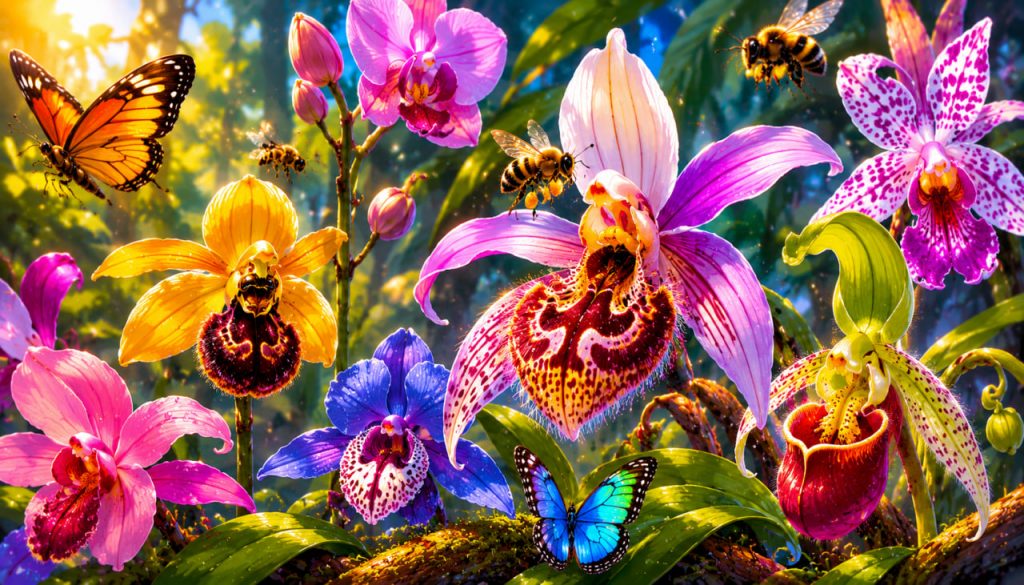
One of the most astonishing examples occurs in the genus Ophrys, often called bee orchids.
These flowers imitate female insects with incredible precision.
They can mimic:
- Body shape
- Hair patterns
- Coloration
- Surface texture
Male bees or wasps mistake the flower for a potential mate and attempt to copulate with it.
This behavior is known as pseudocopulation.
During the attempt, pollen becomes attached to the insect’s body and is carried to another flower.
The orchid gains pollination without offering any reward.
Chemical Mimicry: Fooling Insects Through Scent
Visual imitation is only part of the deception.
Many orchids also produce chemical compounds that closely resemble insect pheromones.
Pheromones are natural signaling chemicals used for communication between animals.
Some orchid species release scents that are nearly identical to those produced by receptive female insects.
Male insects can detect these signals from considerable distances.
When they arrive expecting a mate, they instead encounter an orchid flower.
This level of chemical mimicry is so precise that scientists often describe it as one of nature’s most sophisticated forms of deception.
Fake Food Sources
Not all orchids imitate insects.
Some species mimic flowers that normally provide nectar.
These orchids display:
- Bright colors
- Attractive shapes
- Familiar visual patterns
Pollinators approach expecting food but discover none.
Even though the insect receives no reward, the flower may still achieve successful pollination before the deception is recognized.
Researchers call this strategy food deception.
Trap Flowers and Temporary Imprisonment
Certain orchids use even more elaborate methods.
Some species temporarily trap visiting insects inside their flowers.
The insect must follow a specific route to escape.
During this process:
- Pollen becomes attached to its body.
- Previously collected pollen may be deposited.
- Pollination occurs automatically.
The insect eventually escapes unharmed but unintentionally serves the orchid’s reproductive needs.
The Famous Darwin Orchid
One of the most celebrated orchid stories involves the star orchid of Madagascar.
This species possesses an exceptionally long nectar tube.
After examining the flower in 1862, naturalist Charles Darwin predicted that an unknown moth with an extraordinarily long proboscis—a tube-like feeding structure—must exist to pollinate it.
At the time, no such insect was known.
Decades later, scientists discovered exactly such a moth.
The finding became one of the most famous confirmations of evolutionary theory.
Why Deception Works
At first glance, deception seems risky.
If insects learn to avoid deceptive flowers, pollination should fail.
However, several factors help orchids succeed:
- Pollinators often encounter flowers infrequently.
- Many insects rely on instinctive responses.
- Deceptive orchids may be relatively rare.
- Pollinators continue searching for resources despite occasional mistakes.
As a result, even imperfect deception can remain highly effective.
Orchids and Coevolution
The relationship between orchids and their pollinators illustrates coevolution, a process in which two species influence each other’s evolution.
Over time:
- Flowers become better mimics.
- Pollinators become more selective.
- New adaptations emerge.
This evolutionary arms race has contributed to the extraordinary diversity of orchids seen today.
Expert Perspective
Evolutionary biologist Florian P. Schiestl, a leading researcher on orchid pollination, has emphasized that orchid deception represents one of the most remarkable examples of communication manipulation in nature.
His research has shown how orchids use highly specific chemical signals to exploit the sensory systems of insects with extraordinary precision.
Why Orchids Fascinate Scientists
Orchids provide valuable insights into:
- Evolution
- Animal behavior
- Chemical communication
- Ecology
- Plant reproduction
Their deceptive strategies reveal how natural selection can produce solutions that seem almost unbelievable.
What appears to be a simple flower is often a highly specialized biological machine designed to manipulate the behavior of other organisms.
The Hidden Intelligence of Evolution
Orchids do not think or plan, yet their flowers often appear astonishingly clever.
Through millions of years of natural selection, countless small adaptations accumulated until some species became masters of deception.
The result is one of nature’s most captivating spectacles: flowers that trick insects into becoming unwilling partners in reproduction.
Far from passive plants, orchids are among the most sophisticated evolutionary strategists in the natural world.
Interesting Facts
- Orchids represent one of the largest families of flowering plants.
- Some orchid flowers mimic female insects so accurately that males attempt to mate with them.
- Certain orchid scents closely imitate insect pheromones.
- Many deceptive orchids produce no nectar at all.
- Some orchids depend on a single pollinator species for reproduction.
- Darwin correctly predicted the existence of a long-tongued moth based solely on an orchid’s structure.
Glossary
- Pollination — The transfer of pollen between flowers for reproduction.
- Pheromone — A chemical signal used for communication between members of the same species.
- Pseudocopulation — Mating behavior directed toward a flower that mimics an insect.
- Coevolution — Reciprocal evolutionary change between interacting species.
- Proboscis — A long feeding tube used by certain insects.
- Food Deception — A pollination strategy in which flowers imitate rewarding plants without providing food.