At first glance, a tree may seem like a simple organism. It stands in one place, grows slowly, and appears far less active than animals. Yet modern science reveals a surprising reality: a tree is one of the most sophisticated living systems on Earth.
A mature tree is simultaneously a solar power plant, water transport network, chemical factory, structural engineering masterpiece, environmental sensor, and living habitat for countless organisms. Every leaf, root, branch, and cell performs specialized functions that contribute to the survival of the whole organism.
The more scientists study trees, the more they discover that these seemingly simple plants are astonishingly complex.
A Living Structure Built from Billions of Cells
Like all multicellular organisms, trees are composed of cells.
However, a large tree may contain billions or even trillions of cells, organized into specialized tissues that perform different tasks.
Some cells:
- Transport water
- Carry nutrients
- Store energy
- Produce protective chemicals
- Support structural stability
Unlike animals, trees continuously produce new tissues throughout much of their lives.
Some tree species can live for thousands of years while remaining biologically active.
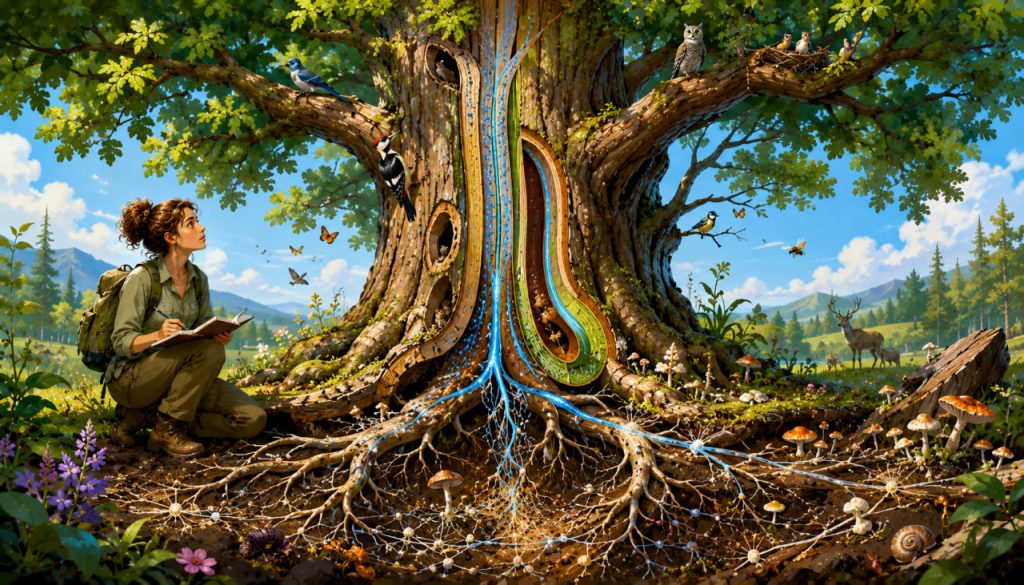
The Root System: The Hidden Half of the Tree
Most people only see the part of a tree above the ground.
Yet the root system is often just as extensive.
Roots perform several critical functions:
- Absorb water
- Collect minerals
- Anchor the tree
- Store nutrients
- Communicate with soil organisms
In some forests, root systems can extend dozens of meters from the trunk.
Fine root hairs dramatically increase surface area, allowing efficient absorption of water and dissolved nutrients.
Trees and Underground Fungal Networks
One of the most fascinating discoveries in modern ecology involves relationships between tree roots and fungi.
Many trees form partnerships called mycorrhizae.
In this relationship:
- Fungi help trees absorb water and nutrients.
- Trees provide sugars produced through photosynthesis.
The fungal threads can connect multiple trees underground.
Some researchers describe these networks as a “wood-wide web” because resources and chemical signals may move through them.
Although trees do not communicate like animals, they participate in remarkably complex ecological interactions.
The Trunk: A Natural Skyscraper
The trunk serves as the tree’s central support structure.
It must withstand:
- Gravity
- Wind
- Snow
- Storms
- Decades or centuries of growth
The strength of wood comes from microscopic cellulose fibers reinforced by lignin, a complex natural polymer.
This combination creates one of nature’s most successful construction materials.
Engineers continue studying wood because of its exceptional balance between strength and weight.
The Tree’s Internal Plumbing System
Inside the trunk lies an extraordinary transportation network.
Two specialized tissues handle movement throughout the tree:
Xylem
Xylem carries water and dissolved minerals upward from the roots.
Remarkably, some trees move water more than 100 meters into the air without mechanical pumps.
Water transport relies on physical forces generated by evaporation from leaves.
Phloem
Phloem transports sugars and other nutrients throughout the tree.
These sugars are produced during photosynthesis and distributed to growing tissues, roots, flowers, and developing fruits.
Together, xylem and phloem form a biological logistics system operating continuously.
Leaves: Millions of Tiny Solar Panels
Leaves are among the most sophisticated biological structures in nature.
Their primary function is photosynthesis.
During this process, trees use:
- Sunlight
- Carbon dioxide
- Water
to produce sugars that fuel growth.
Inside each leaf are microscopic structures called chloroplasts that contain chlorophyll, the green pigment responsible for capturing solar energy.
A mature tree may support hundreds of thousands of leaves working simultaneously.
How Trees Sense Their Environment
Although trees lack brains and nervous systems, they constantly monitor environmental conditions.
Trees can respond to:
- Light levels
- Temperature
- Water availability
- Day length
- Physical damage
- Insect attacks
These responses occur through complex chemical signaling systems.
For example, when insects damage leaves, some trees release airborne compounds that help activate defensive responses in nearby tissues.
Chemical Factories of Nature
Trees manufacture thousands of chemical compounds.
These substances serve many purposes:
- Defense against herbivores
- Protection from disease
- Attraction of pollinators
- UV protection
- Stress management
Many familiar products originate from tree chemistry:
- Pine resin
- Maple syrup
- Cinnamon
- Natural rubber
- Various medicines
Scientists continue discovering new compounds produced by trees.
Trees as Ecosystems
A single mature tree is often an entire ecosystem.
It may support:
- Birds
- Insects
- Mosses
- Fungi
- Mammals
- Microorganisms
An old oak tree, for example, can provide habitat for hundreds of species.
This ecological complexity makes trees essential components of healthy ecosystems.
How Trees Defend Themselves
Trees cannot run away from threats.
Instead, they rely on sophisticated defense mechanisms.
These include:
- Thick bark
- Toxic chemicals
- Resin production
- Rapid wound sealing
- Antimicrobial compounds
Some species can even increase defensive chemical production after detecting insect damage.
These responses help protect the tree throughout its lifetime.
Expert Perspective
Botanist Peter Wohlleben, known for popularizing modern tree ecology, has emphasized that trees are far more dynamic and interconnected than people traditionally assumed.
Research over recent decades has increasingly confirmed that trees actively interact with their environment through complex biological processes rather than functioning as passive organisms.
Why Trees Are More Complex Than They Appear
A tree may look simple because most of its activity occurs at scales invisible to the human eye.
Beneath its bark and roots, countless processes operate continuously:
- Water transport
- Energy production
- Chemical signaling
- Growth regulation
- Environmental sensing
- Ecological interactions
Together, these processes allow a tree to survive for centuries while adapting to changing conditions.
Conclusion
Trees are among the most sophisticated organisms on Earth. Far from being simple wooden structures, they function as integrated biological systems containing advanced transport networks, energy-production mechanisms, environmental sensors, chemical factories, and ecological partnerships.
Every forest is filled with living engineering marvels that quietly perform tasks so complex that scientists are still uncovering new aspects of how they work. The next time you see a tree, you are not looking at a simple plant—you are looking at one of nature’s most remarkable achievements.
Interesting Facts
- Some tree roots can extend farther than the tree is tall.
- Giant sequoias can live for more than 3,000 years.
- A mature tree may move hundreds of liters of water per day.
- Trees produce oxygen through photosynthesis but also consume oxygen through respiration.
- One large tree can support hundreds of species of organisms.
Glossary
- Photosynthesis — The process by which plants convert sunlight into chemical energy.
- Mycorrhizae — Partnerships between fungi and plant roots.
- Xylem — Tissue that transports water upward through a plant.
- Phloem — Tissue that transports sugars and nutrients.
- Chloroplast — A structure inside plant cells where photosynthesis occurs.
- Lignin — A complex substance that strengthens wood and plant tissues.