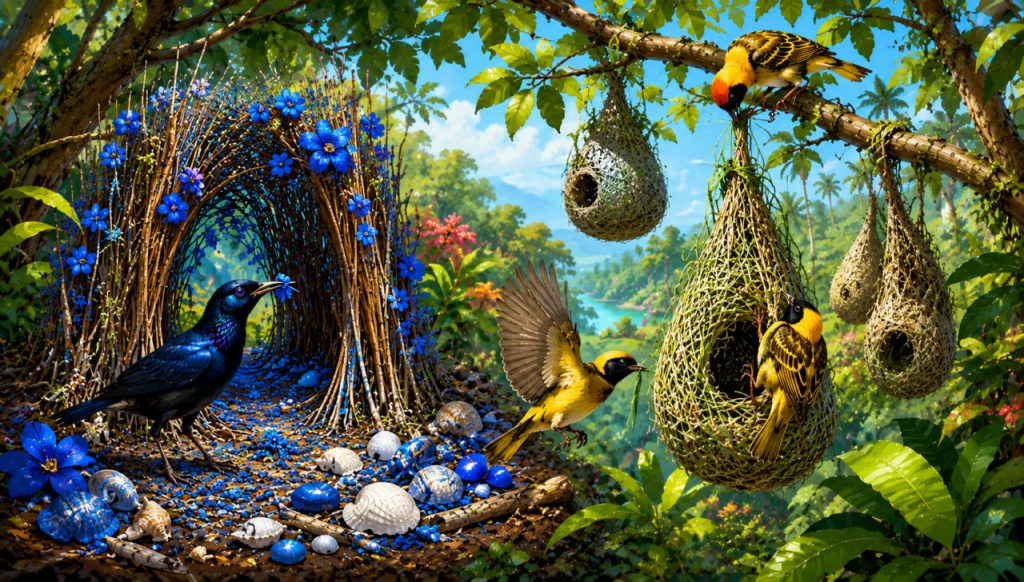
Humans often consider architecture one of the defining achievements of civilization. We design houses, bridges, skyscrapers, and entire cities. Yet long before human architects appeared, birds had already evolved astonishing construction skills. Across the world, different species build nests that range from simple scrapes in the ground to elaborate woven structures that rival human craftsmanship in complexity.
Among the most remarkable avian builders are bowerbirds, famous for constructing decorative display structures, and weaverbirds, known for weaving intricate hanging nests from grass and plant fibers. These birds demonstrate that architecture in nature can be both functional and beautiful.
The study of bird nesting behavior reveals a fascinating combination of instinct, learning, engineering, and evolution.
Why Birds Build Nests
At its most basic level, a nest serves as a safe place for reproduction.
A well-designed nest helps:
- Protect eggs
- Shelter chicks
- Regulate temperature
- Reduce predator risks
- Improve breeding success
Natural selection strongly favors birds that build effective nests.
Over millions of years, this pressure has produced extraordinary diversity in nest architecture.
Simple Nests Can Be Highly Effective
Not all birds construct elaborate structures.
Some species create surprisingly simple nests.
Examples include:
- Shorebirds nesting directly on gravel
- Penguins laying eggs on bare ground
- Some seabirds using rocky ledges
Even these simple approaches can be highly successful when matched to the environment.
The complexity of a nest depends largely on ecological conditions and evolutionary history.
Birds as Natural Engineers
Nest construction requires solving numerous engineering challenges.
Birds must consider:
- Structural stability
- Weight distribution
- Weather resistance
- Ventilation
- Insulation
Without blueprints or formal training, they create solutions that often work remarkably well.
Scientists studying biomechanics frequently analyze bird nests to better understand natural construction strategies.
Weaverbirds: Masters of Living Textiles
Among the greatest avian architects are the weaverbirds of Africa and Asia.
Male weaverbirds construct hanging nests by weaving together:
- Grass blades
- Plant fibers
- Leaves
- Flexible stems
Using only their beaks and feet, they create enclosed structures that can withstand strong winds and heavy rain.
Some nests contain:
- Entrance tunnels
- Separate chambers
- Reinforced support points
The finished product resembles a carefully crafted basket suspended from a branch.
Why Weaverbird Nests Hang
The hanging design offers several advantages.
It helps protect against:
- Snakes
- Monkeys
- Ground predators
Many predators struggle to access nests suspended from thin branches.
The entrance often faces downward, making access even more difficult.
This combination of engineering and defensive design significantly improves nesting success.
The Incredible World of Bowerbirds
While weaverbirds build nests for raising young, bowerbirds of Australia and New Guinea are famous for a different reason.
Male bowerbirds construct structures called bowers.
A bower is not actually a nest.
Instead, it serves as a display arena used to attract females.
These remarkable structures can resemble:
- Archways
- Pavilions
- Decorative corridors
- Small garden displays
The purpose is courtship rather than nesting.
Nature’s Interior Designers
What makes bowerbirds especially fascinating is their attention to decoration.
Males collect colorful objects such as:
- Blue flowers
- Berries
- Feathers
- Shells
- Small stones
Some species strongly prefer specific colors.
The famous satin bowerbird often gathers blue objects because females appear particularly attracted to them.
Researchers have even observed birds collecting human-made items such as bottle caps and pieces of plastic.
Perspective Tricks and Visual Illusions
Some bowerbirds take decoration even further.
Studies have shown that certain species arrange objects according to size to create visual illusions.
Smaller objects are placed closer to the viewing area while larger objects are positioned farther away.
This arrangement alters how females perceive the display.
Such behavior represents one of the most sophisticated examples of non-human aesthetic construction known in nature.
Giant Communal Nests
Not all architectural achievements belong to individual birds.
The sociable weaver of southern Africa builds enormous communal nests.
These structures can:
- House hundreds of birds
- Persist for decades
- Reach several meters in diameter
Entire colonies live within interconnected chambers.
Some communal nests become so large that they resemble natural thatched roofs hanging from trees.
How Birds Learn to Build
For many years scientists believed nest building was entirely instinctive.
Modern research paints a more complex picture.
Evidence suggests that some birds improve their skills through:
- Practice
- Experience
- Observation
Young birds may become better builders over time.
This combination of instinct and learning helps explain the extraordinary sophistication of certain nesting behaviors.
Expert Perspective
Behavioral ecologist John Endler, known for his work on animal signaling and bowerbirds, has emphasized that bowerbird displays represent one of the clearest examples of how sexual selection can drive the evolution of complex structures and behaviors.
His research has helped reveal how female preferences shape architectural creativity in these remarkable birds.
Bird Architecture and Evolution
The diversity of bird nests demonstrates the power of evolution.
Different environments favor different solutions.
Over millions of years, natural selection has produced:
- Ground nests
- Cliff nests
- Floating nests
- Hanging nests
- Underground nests
- Decorative courtship structures
Each design reflects a balance between safety, energy investment, and reproductive success.
What Humans Can Learn from Birds
Bird nests inspire scientists, engineers, and architects.
Researchers study nests for insights into:
- Lightweight construction
- Natural materials
- Structural efficiency
- Passive climate control
Some principles observed in bird architecture are now influencing sustainable design concepts.
Nature often discovers elegant solutions long before humans do.
Conclusion
From the woven masterpieces of weaverbirds to the decorative pavilions of bowerbirds, bird architecture represents one of nature’s most impressive achievements. These structures are far more than simple shelters. They are products of millions of years of evolution, combining engineering, behavior, aesthetics, and survival strategies.
The next time you see a bird carrying a twig, remember that you may be witnessing the work of one of the world’s most skilled natural architects.
Interesting Facts
- Some bowerbirds create optical illusions using carefully arranged decorations.
- Weaverbirds tie knots and weave fibers using only their beaks.
- Sociable weaver nests can house hundreds of birds simultaneously.
- Certain bird nests remain occupied and expanded for decades.
- Some nest structures are strong enough to survive severe storms and intense heat.
Glossary
- Bower — A decorative structure built by male bowerbirds to attract mates.
- Sexual Selection — Evolution driven by preferences related to mating success.
- Biomechanics — The study of mechanical principles in living organisms.
- Communal Nest — A nest shared by multiple individuals or families.
- Behavioral Ecology — The study of how behavior contributes to survival and reproduction.