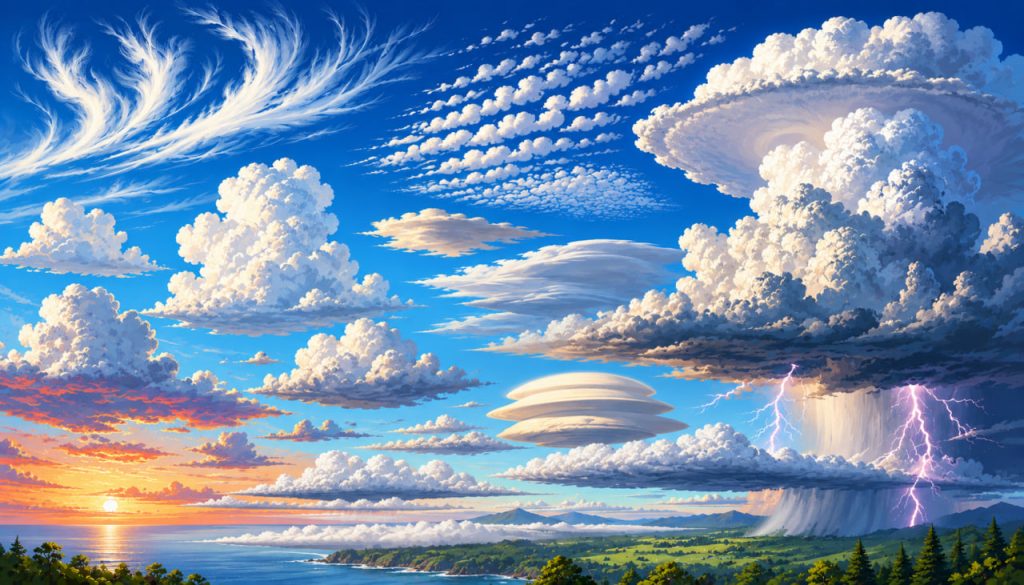
Clouds are among the most familiar features of Earth’s atmosphere. They drift above us every day, creating dramatic sunsets, bringing rain, and shaping weather patterns across the planet. Yet despite their common appearance, clouds are surprisingly complex structures formed by intricate interactions between water vapor, temperature, air pressure, and atmospheric motion.
Meteorologists classify clouds into distinct categories based on their shape, altitude, and formation process. Learning to recognize different cloud types can provide valuable clues about current and future weather conditions.
Far from being random patches of moisture, clouds are organized atmospheric phenomena that reveal the hidden dynamics of the sky.
What Exactly Is a Cloud?
A cloud is a visible collection of tiny water droplets, ice crystals, or both, suspended in the atmosphere.
Clouds form when:
- Warm air rises
- The air cools
- Water vapor condenses
- Tiny droplets or ice crystals develop
Even a small cloud may contain billions of microscopic water particles.
Interestingly, the droplets are so small that they can remain suspended in the air for long periods.
How Scientists Classify Clouds
Modern cloud classification originated with amateur meteorologist Luke Howard in the early nineteenth century.
He introduced a naming system based largely on Latin words.
Many cloud names still use his terminology today.
The main categories include:
- Cirrus
- Cumulus
- Stratus
- Nimbus
Various combinations of these names describe specific cloud types.
High-Level Clouds
High clouds generally form above 6,000 meters (20,000 feet) in temperate regions.
Because temperatures are extremely low at these altitudes, they often contain ice crystals.
Cirrus Clouds
Cirrus clouds are among the easiest to recognize.
They appear as:
- Thin wisps
- Feather-like streaks
- Delicate white threads
These clouds form high in the atmosphere and are composed primarily of ice crystals.
Cirrus clouds often indicate changing weather and may appear before an approaching weather system.
Cirrostratus Clouds
Cirrostratus clouds form thin, transparent layers that can cover much of the sky.
One of their most distinctive features is the creation of halos around the Sun or Moon.
These optical effects occur when light passes through ice crystals suspended within the cloud.
Cirrocumulus Clouds
Cirrocumulus clouds appear as small white patches arranged in rows or ripples.
They sometimes resemble fish scales.
This pattern has earned them the nickname “mackerel sky.”
Although beautiful, they rarely produce precipitation reaching the ground.
Mid-Level Clouds
Middle clouds typically form between 2,000 and 6,000 meters.
They often contain both water droplets and ice crystals.
Altostratus Clouds
Altostratus clouds create gray or bluish sheets covering large portions of the sky.
The Sun may appear as a dim glowing disk through them.
These clouds frequently develop ahead of widespread rain or snow systems.
Altocumulus Clouds
Altocumulus clouds consist of rounded cloud masses arranged in groups or layers.
They often indicate atmospheric instability.
On warm, humid days, altocumulus clouds can sometimes signal the possibility of afternoon thunderstorms.
Low-Level Clouds
Low clouds form below approximately 2,000 meters.
These clouds often consist mainly of liquid water droplets.
Stratus Clouds
Stratus clouds create flat gray layers that may blanket the entire sky.
They resemble fog that has lifted above the ground.
Stratus clouds often produce:
- Mist
- Drizzle
- Light precipitation
Their uniform appearance makes them easy to identify.
Stratocumulus Clouds
Stratocumulus clouds combine characteristics of both stratus and cumulus clouds.
They appear as large rounded cloud elements connected in extensive layers.
Although common, they usually bring little precipitation.
Clouds That Produce Rain
Some cloud types are especially associated with precipitation.
Nimbostratus Clouds
Nimbostratus clouds are thick, dark layers that cover large regions of the sky.
They commonly produce:
- Steady rain
- Snow
- Extended periods of precipitation
Unlike thunderstorms, nimbostratus clouds typically generate continuous rather than intense rainfall.
The Giants of the Atmosphere: Cumulonimbus Clouds
Among all cloud types, none are more impressive than cumulonimbus clouds.
These towering clouds are responsible for:
- Thunderstorms
- Lightning
- Heavy rain
- Hail
- Tornadoes
A fully developed cumulonimbus cloud may extend more than 12 kilometers into the atmosphere.
The top often spreads outward into an anvil shape due to strong upper-level winds.
Fair-Weather Clouds
Not all clouds signal storms.
Cumulus Clouds
Classic puffy white cumulus clouds are often associated with pleasant weather.
They feature:
- Flat bases
- Rounded tops
- Bright white coloration
These clouds form when warm air rises through convection.
Many remain harmless throughout their existence.
However, under favorable conditions they can develop into larger storm-producing clouds.
Rare and Unusual Clouds
The atmosphere occasionally produces spectacular cloud formations.
Examples include:
- Lenticular clouds resembling flying saucers
- Mammatus clouds hanging beneath thunderstorms
- Noctilucent clouds glowing high above the atmosphere
- Kelvin-Helmholtz clouds resembling breaking ocean waves
These unusual formations fascinate meteorologists and photographers alike.
Clouds and Weather Forecasting
Cloud observation remains an important forecasting tool.
Different cloud types reveal information about:
- Atmospheric stability
- Moisture content
- Approaching weather fronts
- Storm development
Experienced meteorologists often combine cloud observations with radar, satellite imagery, and computer models to predict weather patterns.
Expert Perspective
Luke Howard, often called the “father of cloud classification,” transformed meteorology by introducing a systematic naming system that remains the foundation of cloud identification today.
His work allowed scientists worldwide to communicate consistently about atmospheric phenomena and greatly advanced weather science.
Why Clouds Matter
Clouds do much more than create beautiful skies.
They influence:
- Climate regulation
- Rainfall distribution
- Global temperatures
- Water cycles
- Solar energy balance
Without clouds, Earth’s environment would be dramatically different and far less hospitable.
Every cloud represents a visible expression of powerful atmospheric processes occurring above our heads.
Interesting Facts
- A large thunderstorm cloud can weigh millions of kilograms.
- Cirrus clouds consist primarily of ice crystals.
- Lenticular clouds are often mistaken for UFOs.
- Noctilucent clouds form near the edge of space.
- Clouds help regulate Earth’s temperature by reflecting sunlight and trapping heat.
Glossary
- Condensation — The process by which water vapor becomes liquid water.
- Convection — The upward movement of warm air.
- Atmospheric Instability — Conditions that favor rising air and cloud formation.
- Precipitation — Water falling from clouds as rain, snow, sleet, or hail.
- Ice Crystal — Frozen water particle commonly found in high-altitude clouds.
- Meteorologist — A scientist who studies weather and the atmosphere.