Indoor air quality has become an increasingly important topic in modern life. People spend roughly 90% of their time indoors, where air can contain dust, pollen, pet dander, smoke particles, volatile organic compounds, and even microscopic plastic particles. As awareness grows, many homeowners are looking for practical and affordable ways to improve the air they breathe.
Air purification and air ionization are often discussed together because they address different aspects of indoor air quality. Air purifiers physically remove pollutants from the air, while ionizers alter the electrical properties of airborne particles, potentially making them easier to capture or settle out of the air.
While high-end air-cleaning systems can be expensive, advances in technology have made effective solutions accessible to a much wider audience. Understanding how these systems work helps consumers choose options that fit both their needs and budgets.
Why Indoor Air Quality Matters
Indoor air may contain a surprising variety of pollutants.
Common examples include:
- Dust
- Pollen
- Pet dander
- Mold spores
- Smoke particles
- Textile fibers
- Household chemicals
Poor indoor air quality may contribute to:
- Respiratory irritation
- Allergy symptoms
- Reduced comfort
- Increased dust accumulation
Improving indoor air quality can make homes more comfortable and healthier environments.
What Air Purifiers Actually Do
Air purifiers remove particles from the air through filtration.
Most modern systems use one or more technologies:
- Mechanical filtration
- Activated carbon filtration
- Electrostatic filtration
- Ultraviolet treatment
The most effective consumer systems typically include HEPA filters.
HEPA filtration can capture a large percentage of extremely small airborne particles.
Understanding HEPA Filters
HEPA stands for High-Efficiency Particulate Air.
These filters are designed to trap:
- Dust
- Pollen
- Pet allergens
- Fine particulate matter
Many experts consider HEPA filtration the gold standard for household particle removal.
Unlike some technologies that alter particles, HEPA filters physically remove them from circulating air.
What Air Ionization Does
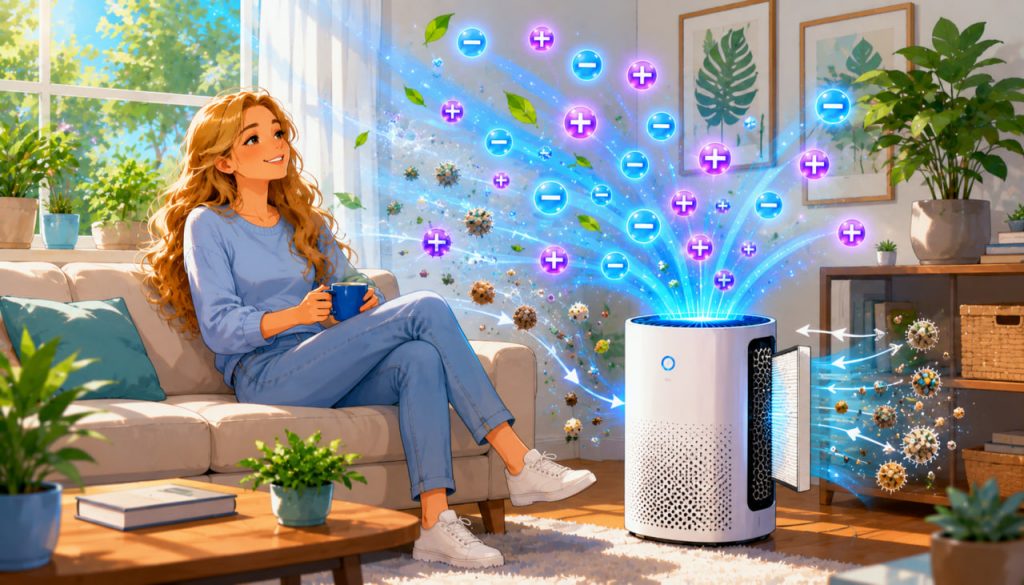
Air ionizers produce charged particles called ions.
These ions attach to airborne particles and influence their behavior.
Possible effects include:
- Charge neutralization
- Particle aggregation
- Increased surface deposition
- Improved filtration efficiency
Ionization may help reduce airborne particle concentrations under certain conditions.
However, ionization alone is generally not considered a complete air-cleaning solution.
The Best Budget Approach: Combining Technologies
For most households, experts recommend combining:
- Ventilation
- Filtration
- Reasonable humidity control
An affordable system often consists of:
- A quality HEPA air purifier.
- Proper ventilation.
- Optional low-ozone ionization.
This combination usually delivers better results than relying on ionization alone.
Why Ventilation Is Still Essential
No air-cleaning device completely replaces fresh outdoor air.
Ventilation helps:
- Remove indoor pollutants
- Reduce carbon dioxide accumulation
- Improve overall air quality
Opening windows when outdoor conditions are favorable remains one of the most cost-effective strategies available.
The Importance of Humidity Control
Humidity affects both comfort and air quality.
Very dry air may:
- Increase static electricity
- Irritate airways
Excessive humidity may encourage:
- Mold growth
- Dust mite populations
Most experts recommend maintaining indoor humidity between approximately 40% and 60%.
Air Purifiers and Microplastic Particles
Researchers are increasingly studying airborne microplastics.
Potential indoor sources include:
- Carpets
- Synthetic clothing
- Upholstery
- Household dust
HEPA filtration appears capable of capturing many airborne microplastic particles.
Ionization may also influence how these particles move through indoor environments.
Choosing an Affordable System
Consumers often assume effective air cleaning requires expensive equipment.
Fortunately, many budget-friendly solutions exist.
Important considerations include:
- True HEPA filtration
- Low maintenance costs
- Appropriate room coverage
- Low noise levels
- Certified safety standards
Higher price does not always guarantee better performance.
Ozone Safety Considerations
One concern regarding some ionizers involves ozone production.
Ozone can irritate:
- Eyes
- Nose
- Throat
- Lungs
When selecting an ionization system, it is important to choose models designed to minimize ozone generation.
Safety certifications can help identify suitable products.
Expert Perspective
Indoor air quality researcher Richard Shaughnessy has emphasized that effective air cleaning should focus on reducing pollutant exposure through proven methods such as filtration, ventilation, and source control. His work highlights that no single technology solves every air-quality problem, and the best results typically come from combining multiple strategies.
Building a Practical Home Air-Cleaning Strategy
A realistic and affordable approach might include:
- Regular cleaning
- HEPA filtration
- Adequate ventilation
- Reasonable humidity control
- Optional ionization
Together, these measures create a more comprehensive indoor air-quality solution.
The Future of Home Air Cleaning
Advances in filtration and ionization technologies continue to improve efficiency while reducing costs.
Researchers are exploring systems capable of:
- Capturing ultrafine particles
- Reducing airborne microplastics
- Improving energy efficiency
- Monitoring air quality in real time
Future home systems may become even more effective and affordable.
Conclusion
Affordable air purification and ionization systems are becoming increasingly accessible for ordinary households. While air ionization can influence particle behavior, the strongest scientific evidence supports the use of HEPA filtration, ventilation, and humidity control as the foundation of healthy indoor air.
For most homes, a balanced combination of these technologies offers the best value. Rather than relying on a single device, homeowners can achieve cleaner and more comfortable air through a thoughtful, evidence-based approach that fits nearly any budget.
Interesting Facts
- Indoor air can sometimes contain higher pollutant concentrations than outdoor air.
- HEPA filters were originally developed during World War II.
- Air ionization occurs naturally near waterfalls and ocean waves.
- Static electricity and airborne particles are closely connected.
- Modern air purifiers can capture particles far smaller than the width of a human hair.
- Researchers are actively studying how indoor environments influence exposure to airborne microplastics.
Glossary
- HEPA Filter — A high-efficiency filter designed to capture extremely small particles.
- Ionization — The creation of electrically charged particles in air.
- Microplastic — A plastic particle smaller than 5 millimeters.
- Ventilation — The exchange of indoor and outdoor air.
- Humidity — The amount of water vapor present in air.
- Particulate Matter — Tiny airborne solid or liquid particles.
- Ozone — A reactive form of oxygen that can irritate the respiratory system.
- Air Purifier — A device that removes contaminants from indoor air.