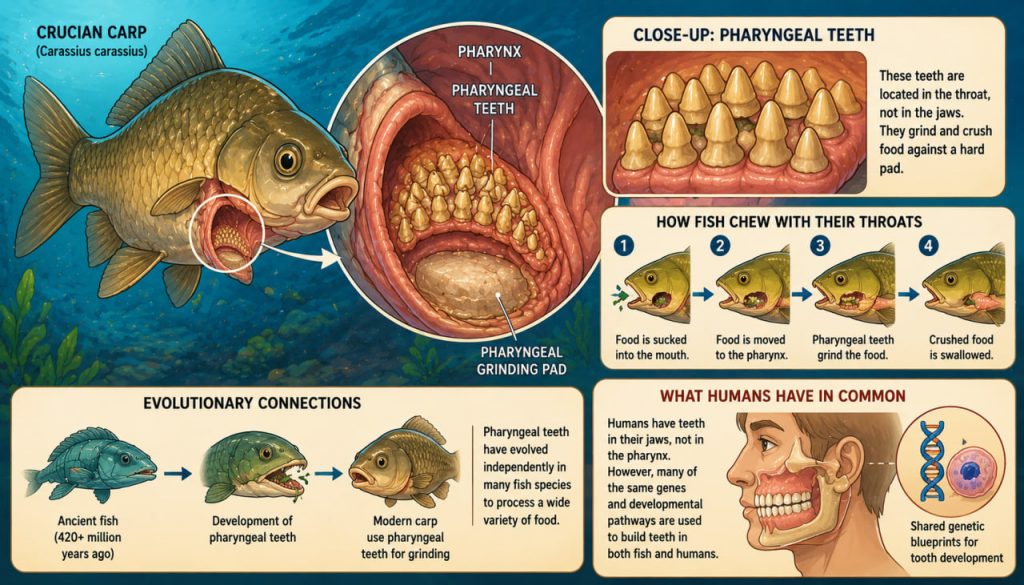
When people think about teeth, they usually imagine the rows of teeth found inside the mouth. However, many fish possess an entirely different kind of dental system hidden deep within the throat. These structures, known as pharyngeal teeth, are among the most fascinating examples of evolutionary adaptation in the animal kingdom.
Species such as carp, crucian carp, goldfish, and many other members of the carp family lack true teeth in their jaws. Instead, they use specialized teeth located in the pharynx—the region behind the mouth and near the throat—to crush, grind, and process food.
Surprisingly, the story of pharyngeal teeth is not just about fish. It also reveals important clues about vertebrate evolution and highlights unexpected anatomical connections between humans and distant aquatic relatives.
What Are Pharyngeal Teeth?
Pharyngeal teeth are tooth-like structures located on modified bones within the pharynx.
Unlike human teeth, which are attached directly to the jaws, pharyngeal teeth sit much farther back in the throat.
When food enters the mouth, it is transported toward the pharynx where these teeth perform the actual chewing.
In species such as crucian carp and common carp, the jaws contain no true teeth at all.
Instead, powerful throat muscles press food against a hardened chewing pad while the pharyngeal teeth grind it into smaller pieces.
In essence, some fish chew with their throats rather than their mouths.
Why Did Fish Evolve Pharyngeal Teeth?
Evolution favors structures that improve survival and feeding efficiency.
Many carp-like fish consume foods that require significant processing, including:
- Seeds
- Aquatic plants
- Insect larvae
- Small crustaceans
- Snails
Hard-shelled prey can be difficult to crush using soft mouth tissues alone.
By moving the chewing apparatus deeper into the throat, these fish evolved an effective solution that allows them to process a wide variety of foods.
Over millions of years, pharyngeal teeth became highly specialized for different diets.
Some species possess broad grinding surfaces, while others have sharp tooth-like projections designed for crushing tougher prey.
A Hidden Dental System
One reason pharyngeal teeth remained poorly understood for centuries is that they are invisible during casual observation.
If you look into the mouth of a carp or goldfish, you will not see teeth.
This led early observers to mistakenly assume that these fish lacked teeth entirely.
Only detailed anatomical studies revealed the sophisticated dental machinery hidden within the throat.
Modern imaging technologies now allow researchers to study these structures in remarkable detail.
The Extraordinary Teeth of Crucian Carp
The crucian carp is one of the best-known examples of a fish relying on pharyngeal teeth.
Its pharyngeal teeth are arranged in specialized rows that function much like grinding tools.
When feeding, the fish uses coordinated muscle movements to move food between the teeth and a hard chewing surface located opposite them.
This system allows crucian carp to crush plant material and break apart hard food items efficiently.
The arrangement is so effective that these fish can exploit food sources unavailable to many competing species.
What Do Humans Have in Common with Fish Teeth?
At first glance, humans and carp seem to have little in common.
Yet developmental biology tells a different story.
Both fish and humans belong to the vertebrate lineage and share many ancient genetic programs that control body development.
Research has shown that similar gene networks help regulate tooth formation across a wide range of vertebrates.
Some of the molecular mechanisms involved in producing human teeth are closely related to those that guide the development of pharyngeal teeth in fish.
This does not mean human teeth and fish pharyngeal teeth are identical.
Rather, it demonstrates that both structures evolved from ancient developmental pathways inherited from common vertebrate ancestors.
Evolution’s Tendency to Reuse Successful Designs
One of the most important principles in evolutionary biology is that nature frequently modifies existing structures rather than inventing entirely new ones.
The genes that control tooth formation appeared hundreds of millions of years ago.
Over time, evolution adapted these genetic tools for different purposes in different species.
As a result:
- Humans developed jaw teeth.
- Sharks evolved multiple rows of replaceable teeth.
- Carp evolved pharyngeal teeth.
- Some vertebrates lost teeth altogether.
Despite these differences, many underlying developmental mechanisms remain surprisingly similar.
Pharyngeal Teeth and Evolutionary Research
Scientists study pharyngeal teeth because they provide valuable insights into how complex anatomical structures evolve.
Researchers can compare:
- Tooth shape
- Developmental genes
- Fossil evidence
- Feeding behavior
These comparisons help reconstruct the evolutionary history of vertebrates.
Pharyngeal teeth have become particularly useful for understanding how small genetic changes can produce major anatomical innovations.
Expert Perspective
Evolutionary biologist Neil Shubin has frequently emphasized that many features found in modern animals reflect modifications of ancient anatomical blueprints inherited from common ancestors.
This concept applies directly to tooth evolution.
“The history of life is written in the structures of living organisms.”
Pharyngeal teeth provide an excellent example of how evolution can reshape inherited biological systems to solve new ecological challenges.
Fossils Reveal an Ancient Story
Evidence suggests that pharyngeal dentitions have existed for tens of millions of years.
Fossilized pharyngeal teeth are often well preserved because tooth tissues are highly resistant to decay.
These fossils help scientists identify extinct fish species and understand how diets changed over evolutionary time.
In some cases, fossil pharyngeal teeth provide more information than other skeletal remains.
They effectively serve as tiny biological records of ancient ecosystems.
Could Humans Ever Develop Pharyngeal Teeth?
The short answer is no.
Modern humans follow a developmental pathway that produces teeth only within the jaws.
However, the shared genetic heritage between fish and humans demonstrates how deeply connected all vertebrate life remains.
The same evolutionary processes that shaped fish throats and human smiles originated from ancient ancestors that lived hundreds of millions of years ago.
Conclusion
Pharyngeal teeth are among the most remarkable examples of evolutionary adaptation. Hidden within the throats of fish such as crucian carp, these specialized structures allow animals to grind and process food without using jaw teeth. Beyond their practical function, they provide scientists with valuable clues about vertebrate evolution and the ancient genetic programs that continue to shape life today.
The next time you see a goldfish or carp, remember that its most important teeth are not in its mouth at all. They are hidden deep within its throat—a reminder that evolution often finds solutions in the most unexpected places.
Interesting Facts
- Carp and goldfish have no true teeth in their jaws.
- Some fish can crush snail shells using their pharyngeal teeth.
- Pharyngeal teeth are commonly used by scientists to identify fish species.
- Fossil pharyngeal teeth can survive for millions of years.
- Similar developmental genes influence tooth formation in both fish and humans.
- Certain fish species continuously replace worn pharyngeal teeth throughout their lives.
Glossary
- Pharynx — The region located behind the mouth and leading toward the digestive system.
- Pharyngeal Teeth — Teeth located within the throat rather than the jaws.
- Vertebrate — An animal possessing a backbone or spinal column.
- Developmental Biology — The study of how organisms grow and form structures during development.
- Dentition — The arrangement and structure of teeth within an organism.
- Evolutionary Adaptation — A trait that improves survival or reproduction through natural selection.