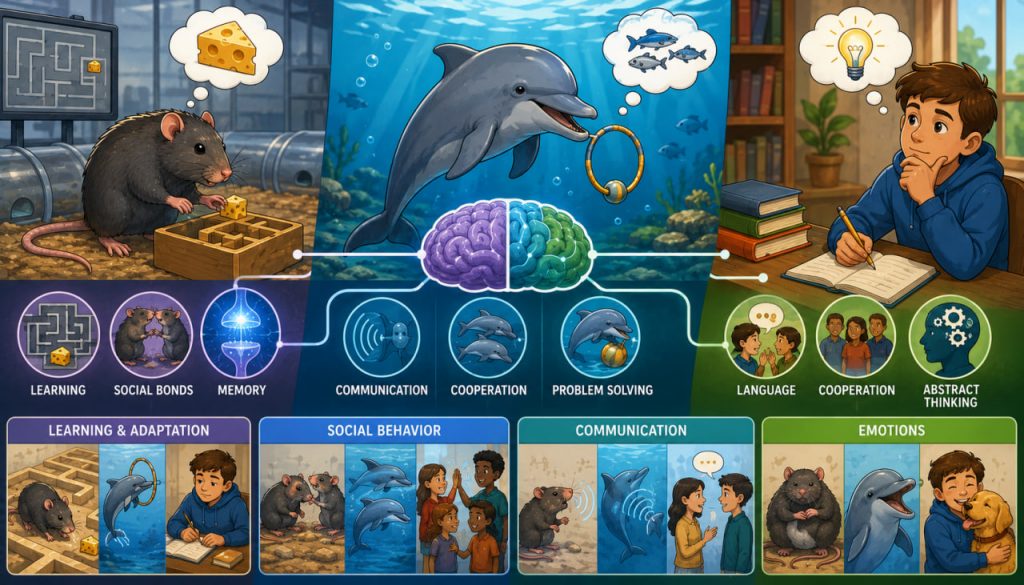
At first glance, rats, dolphins, and humans appear to have little in common. One lives in underground tunnels and city sewers, another inhabits oceans, and the third has built civilizations, cities, and advanced technologies. Yet modern science has revealed that these very different creatures share surprisingly similar behavioral and cognitive foundations.
Comparative psychology—the scientific study of behavior across species—seeks to understand these similarities and differences. By comparing how animals learn, solve problems, communicate, cooperate, and respond to their environments, researchers gain insights into the evolutionary origins of intelligence and behavior.
Far from being completely unique, many human behaviors can be traced back to biological mechanisms shared with other animals.
What Is Comparative Psychology?
Comparative psychology is a branch of behavioral science that examines similarities and differences among species.
Researchers investigate questions such as:
- How do animals learn?
- Can animals solve problems?
- Do animals experience emotions?
- How does social behavior evolve?
- What cognitive abilities are shared across species?
The goal is not to rank animals by intelligence but to understand how behavior develops through evolution.
By studying multiple species, scientists can identify both unique adaptations and common biological principles.
Why Compare Rats, Dolphins, and Humans?
These three species occupy very different ecological niches.
- Rats are highly adaptable terrestrial mammals.
- Dolphins are intelligent marine predators.
- Humans are highly social primates.
Despite these differences, they share a common evolutionary ancestry as mammals.
As a result, many aspects of their nervous systems, learning mechanisms, and social behaviors remain surprisingly similar.
Evolution often modifies existing biological systems rather than inventing entirely new ones.
Learning Through Experience
One of the strongest similarities among rats, dolphins, and humans is their ability to learn from experience.
Learning allows animals to adjust behavior based on past outcomes.
For example:
- Rats learn the location of food sources.
- Dolphins learn hunting techniques.
- Humans learn skills ranging from language to mathematics.
Many learning processes rely on similar neural mechanisms involving reward and reinforcement.
When a behavior leads to a beneficial outcome, the brain strengthens the connections associated with that behavior.
This fundamental principle operates across many species.
Problem-Solving Abilities
All three species demonstrate problem-solving skills.
Laboratory rats can navigate complex mazes and remember efficient routes.
Dolphins can invent novel solutions to challenges and cooperate during hunting.
Humans, of course, exhibit advanced problem-solving capabilities that have led to science, engineering, and technology.
Although the complexity differs dramatically, the underlying ability to evaluate situations and adapt behavior is shared.
Research suggests that problem-solving evolved because it improves survival in changing environments.
Memory and Navigation
Memory plays a crucial role in the lives of rats, dolphins, and humans.
Rats possess excellent spatial memory that helps them locate food and avoid danger.
Dolphins can remember social partners and environmental features over long periods.
Humans rely heavily on memory for learning, planning, and decision-making.
Studies of mammalian brains have identified structures such as the hippocampus that contribute to memory formation across species.
This suggests that important memory systems emerged early in mammalian evolution.
Social Behavior
Perhaps one of the most fascinating similarities involves social interaction.
Rats are often underestimated, but they are highly social animals.
Research has shown that rats:
- Cooperate
- Establish social hierarchies
- Recognize familiar individuals
- Display forms of helping behavior
Dolphins are famous for their complex social structures.
They form alliances, cooperate during hunting, and maintain long-term social relationships.
Humans exhibit the most elaborate social systems known, but many of the building blocks are found throughout the animal kingdom.
Communication Across Species
Communication is another shared feature.
Rats use:
- Vocalizations
- Body language
- Scent signals
Dolphins use:
- Whistles
- Clicks
- Body movements
Humans use spoken language, writing, facial expressions, and countless other forms of communication.
While human language is uniquely complex, the basic need to exchange information is common across species.
Communication improves cooperation, reproduction, and survival.
Do Animals Experience Emotions?
One of the most debated topics in comparative psychology concerns emotions.
Evidence increasingly suggests that many animals experience emotional states.
Rats display behaviors consistent with fear, stress, curiosity, and social bonding.
Dolphins show signs of playfulness, social attachment, and distress.
Humans experience an extraordinarily rich emotional life, but many emotional systems appear to have deep evolutionary roots.
Neuroscientist Jaak Panksepp spent decades studying emotional systems in animals and argued that core emotional circuits are shared among many mammals.
“The roots of human emotions lie deep within the brains of other animals.”
This perspective has significantly influenced modern behavioral science.
Self-Awareness and Intelligence
Some animals demonstrate behaviors suggesting advanced cognition.
Dolphins are among the few non-human species that have passed variations of the mirror self-recognition test, a method used to investigate self-awareness.
Humans excel in abstract reasoning and symbolic thought.
Rats do not show the same level of self-recognition, yet they still demonstrate impressive learning and decision-making abilities.
Comparative psychology emphasizes that intelligence is not a single trait but a collection of specialized abilities shaped by evolution.
What Makes Humans Different?
Despite many similarities, humans possess several distinctive characteristics.
These include:
- Complex language
- Advanced symbolic thinking
- Cumulative culture
- Scientific reasoning
- Large-scale cooperation
Human societies build upon knowledge accumulated across generations.
This cultural transmission dramatically accelerates learning and innovation.
While other animals also transmit information socially, no known species approaches the scale of human cultural complexity.
Why Comparative Psychology Matters
Studying animal behavior helps scientists understand human behavior.
Research involving rats has contributed enormously to neuroscience and learning theory.
Studies of dolphins have expanded understanding of communication and social intelligence.
Comparative psychology provides valuable insights into:
- Evolution
- Brain function
- Learning mechanisms
- Social behavior
- Emotional systems
It reminds us that humans are part of the natural world rather than separate from it.
Conclusion
Comparative psychology reveals that rats, dolphins, and humans share far more than most people realize. Learning, memory, problem-solving, communication, social interaction, and emotional behavior all have deep evolutionary roots. Although humans possess uniquely advanced language and culture, many fundamental aspects of behavior are shared across mammalian species.
By studying these similarities, scientists continue uncovering the biological foundations of intelligence and behavior. The result is a richer understanding not only of animals but also of ourselves.
Interesting Facts
- Rats can learn complex maze layouts and remember them for long periods.
- Dolphins use unique signature whistles that function somewhat like names.
- Mammalian brains share many common structural features despite vast differences in size and complexity.
- Rats have demonstrated forms of helping behavior toward other rats.
- Dolphins are among the few animals that show evidence of mirror self-recognition.
- Comparative psychology has played a major role in understanding learning and memory.
Glossary
- Comparative Psychology — The scientific study of behavior across different species.
- Reinforcement — A process that increases the likelihood of a behavior being repeated.
- Hippocampus — A brain structure involved in memory formation and spatial navigation.
- Mirror Self-Recognition — A test used to investigate whether an animal recognizes its own reflection.
- Cognition — Mental processes involved in learning, memory, reasoning, and decision-making.
- Cultural Transmission — The passing of knowledge or behavior from one generation to another.