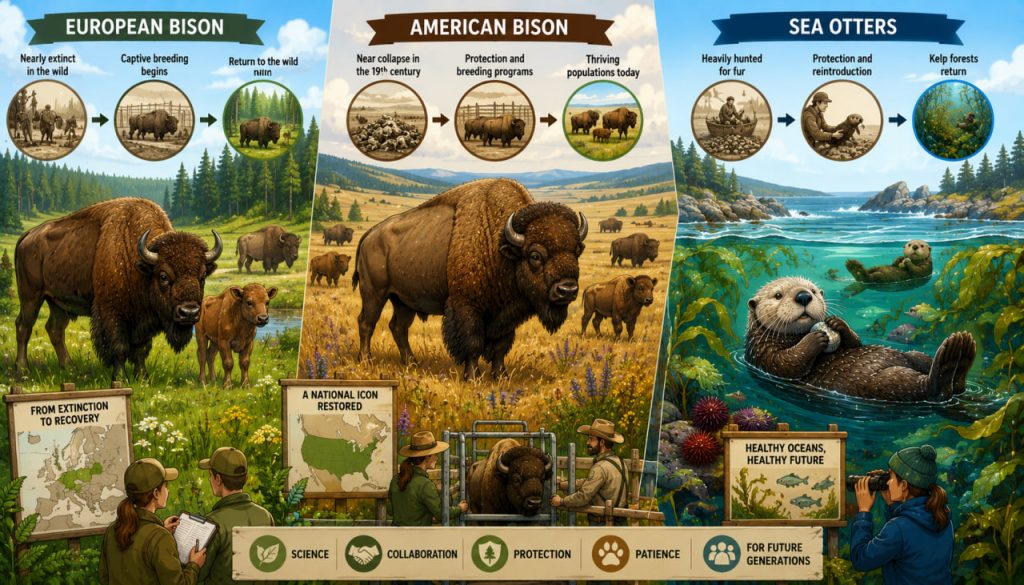
Throughout history, human activity has driven countless species to the brink of extinction. Overhunting, habitat destruction, pollution, and ecosystem disruption have dramatically reduced wildlife populations across the globe. In some cases, animals disappeared entirely from large portions of their native ranges.
However, conservation science has also produced inspiring success stories. One of the most powerful tools available to conservationists is species reintroduction—the deliberate return of animals to areas where they once lived but had disappeared.
The stories of the European bison, American bison, and sea otter demonstrate that even species facing seemingly hopeless declines can recover when science, public support, and long-term conservation efforts work together.
What Is Species Reintroduction?
Species reintroduction is the process of releasing animals into habitats where they historically occurred but have become locally extinct.
The goal is not simply to increase population numbers.
Conservationists aim to restore:
- Ecological balance
- Biodiversity
- Natural food webs
- Ecosystem functions
Successful reintroduction programs require careful planning, including habitat protection, genetic management, disease monitoring, and long-term population tracking.
The ultimate objective is to establish self-sustaining wild populations that no longer depend on constant human intervention.
Why Reintroductions Matter
Every species plays a role within its ecosystem.
When a species disappears, the effects can ripple throughout the environment.
For example:
- Grazers influence plant communities.
- Predators regulate prey populations.
- Herbivores shape landscapes.
- Marine mammals affect ocean ecosystems.
Reintroduction helps restore these natural relationships.
In many cases, bringing back a single species can benefit numerous other organisms.
The Near Extinction of the European Bison
The European bison, also known as the wisent, is Europe’s largest land mammal.
For thousands of years, these massive herbivores roamed forests and grasslands across much of Europe.
By the early 20th century, however, hunting and habitat loss had devastated their populations.
The last wild European bison was killed in 1927.
At that moment, the species became extinct in the wild.
Only a small number survived in zoos and private collections.
The future of the species depended entirely on captive breeding.
Bringing the European Bison Back
Conservationists launched an ambitious breeding program using the remaining animals.
The challenge was enormous.
All living European bison descended from a tiny number of founders, creating concerns about genetic diversity.
Nevertheless, careful management allowed populations to recover.
Beginning in the 1950s, bison were gradually reintroduced into protected areas.
Today, free-ranging European bison once again inhabit parts of:
- Poland
- Belarus
- Lithuania
- Germany
- Romania
- Several other European countries
The species remains conservation-dependent, but its recovery is widely regarded as one of Europe’s greatest wildlife success stories.
The American Bison’s Dramatic Recovery
The American bison once dominated the grasslands of North America.
Historical estimates suggest that tens of millions roamed the continent.
During the 19th century, commercial hunting and habitat changes caused a catastrophic collapse.
By the 1880s, fewer than a thousand animals remained.
Some estimates suggest that the population may have fallen below 500 individuals.
Many experts believed extinction was inevitable.
Saving an American Icon
A combination of private landowners, conservation groups, Indigenous communities, and government agencies helped reverse the decline.
Protected herds were established and breeding programs expanded.
Over time, populations increased dramatically.
Today, hundreds of thousands of bison exist in North America.
While many live in managed herds rather than fully wild populations, the species has escaped extinction.
The recovery of the American bison remains one of the most important conservation achievements in modern history.
Sea Otters: Guardians of Kelp Forests
Sea otters provide a very different example of reintroduction success.
Unlike bison, sea otters are marine mammals that spend much of their lives in coastal waters.
Historically, sea otters inhabited large stretches of the North Pacific.
During the fur trade era, intense hunting nearly eliminated them.
By the early 20th century, only a few small populations survived.
Why Sea Otters Are Ecologically Important
Sea otters are considered a keystone species.
A keystone species has a disproportionately large impact on its ecosystem relative to its abundance.
Sea otters consume sea urchins, which feed on kelp.
Without otters, sea urchin populations can explode and destroy kelp forests.
When otters return, they help restore ecological balance.
Healthy kelp forests provide habitat for numerous marine organisms and support coastal biodiversity.
Reintroducing Sea Otters
Conservationists began relocating sea otters to suitable habitats during the 20th century.
Protected populations expanded in several regions.
Although challenges remain, sea otter numbers have increased significantly in parts of:
- Alaska
- California
- British Columbia
- Washington State
Their recovery has demonstrated how restoring a single species can transform entire ecosystems.
Expert Perspective
Conservation biologist E. O. Wilson frequently emphasized the importance of biodiversity and ecosystem preservation.
His work highlighted a central principle of conservation biology:
“The loss of biodiversity is the folly our descendants are least likely to forgive us.”
The stories of bison and sea otters show that biodiversity loss is not always irreversible if action is taken before it is too late.
Challenges of Modern Reintroduction Programs
Despite many successes, reintroduction remains difficult.
Conservationists must address issues such as:
- Habitat fragmentation
- Climate change
- Human-wildlife conflict
- Genetic bottlenecks
- Disease risks
A genetic bottleneck occurs when a population passes through a period of extremely low numbers, reducing genetic diversity.
Many recovered species continue to require active management and monitoring.
Success often depends on decades of sustained effort.
The Future of Rewilding
Modern conservation increasingly focuses on rewilding.
Rewilding aims to restore natural ecological processes by reintroducing important species and allowing ecosystems to function more naturally.
Projects involving large herbivores, predators, and ecosystem engineers are being explored around the world.
While not every reintroduction succeeds, the growing body of experience provides valuable lessons for future conservation efforts.
Conclusion
The recoveries of the European bison, American bison, and sea otter demonstrate that extinction in the wild does not always have to be permanent. Through captive breeding, habitat protection, scientific management, and public support, conservationists have brought these remarkable species back from the edge of disappearance.
Their stories illustrate the resilience of nature when given the opportunity to recover. They also remind us that protecting biodiversity is not only about saving individual species but about restoring the ecological relationships that sustain entire ecosystems.
Interesting Facts
- Every living European bison descends from a very small number of surviving founders.
- American bison once numbered in the tens of millions across North America.
- Sea otters have the densest fur of any mammal.
- A single sea otter can consume large numbers of sea urchins each day.
- European bison are the heaviest land mammals in Europe.
- Reintroduced species often require years or decades of monitoring before populations become self-sustaining.
Glossary
- Reintroduction — The release of a species into an area where it previously existed but disappeared.
- Biodiversity — The variety of living organisms within an ecosystem or region.
- Keystone Species — A species whose ecological impact is disproportionately large relative to its population size.
- Genetic Bottleneck — A sharp reduction in population size that decreases genetic diversity.
- Rewilding — Conservation efforts aimed at restoring natural ecological processes and species interactions.
- Captive Breeding — The breeding of animals under human management to support conservation goals.