For decades, most cities have operated according to a simple economic model: extract resources, manufacture products, consume them, and eventually throw them away. This approach, often called the linear economy, has fueled economic growth but has also created enormous challenges, including waste accumulation, resource depletion, and environmental pollution.
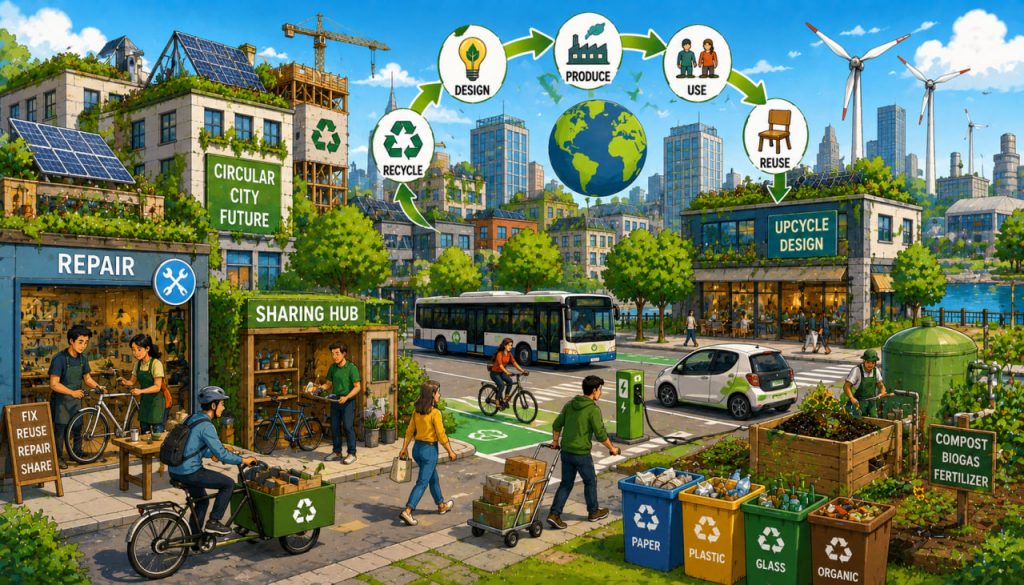
In response, many cities are experimenting with a different approach known as the circular economy. Instead of treating products and materials as disposable, circular systems aim to keep resources in use for as long as possible through reuse, repair, refurbishment, recycling, and innovative design.
While the concept may sound theoretical, numerous cities around the world are already implementing practical circular economy strategies. Their experiences provide valuable lessons about what works, what does not, and how urban areas can become more sustainable.
What Is a Circular Economy?
A circular economy seeks to minimize waste by keeping materials circulating within the economy.
Instead of the traditional model:
- Extract
- Produce
- Consume
- Dispose
the circular approach emphasizes:
- Reduce
- Reuse
- Repair
- Refurbish
- Recycle
The objective is to preserve the value of products and materials for as long as possible.
In a successful circular economy, waste is viewed not as garbage but as a potential resource.
Cities are particularly important because they concentrate people, businesses, infrastructure, and material flows in relatively small areas.
Why Cities Are Ideal for Circular Solutions
Urban areas consume vast quantities of:
- Food
- Water
- Energy
- Construction materials
- Consumer goods
They also generate large amounts of waste.
Because of this concentration, cities can implement circular solutions more efficiently than many rural regions.
Potential benefits include:
- Reduced landfill use
- Lower emissions
- Resource conservation
- Job creation
- Improved resilience
Many municipal governments now include circular economy principles in long-term development plans.
Amsterdam: A Global Circular Economy Pioneer
Amsterdam is widely considered one of the world’s leading circular economy cities.
In 2020, the city formally adopted a comprehensive circular strategy designed to reduce resource consumption while promoting sustainable growth.
Key initiatives include:
- Construction material reuse
- Circular procurement policies
- Repair and sharing programs
- Food waste reduction
Amsterdam encourages developers to reuse building materials whenever possible rather than relying exclusively on newly manufactured products.
The city also supports businesses focused on repairing and refurbishing products instead of replacing them.
Copenhagen: Combining Sustainability and Resource Efficiency
Copenhagen has become internationally recognized for its environmental policies.
The city’s circular initiatives focus on:
- Waste reduction
- Energy recovery
- Sustainable construction
- Resource-efficient infrastructure
Copenhagen’s waste management system integrates recycling with district heating networks.
Materials that cannot be recycled may be used for energy recovery under strict environmental controls.
The city continuously seeks opportunities to extract maximum value from resources before disposal becomes necessary.
Seoul: Turning Food Waste into Resources
Seoul offers one of the most impressive examples of food waste management.
Food waste is a major urban challenge worldwide.
Instead of sending large quantities of food scraps to landfills, Seoul has developed sophisticated collection and processing systems.
Food waste is converted into:
- Animal feed
- Compost
- Biogas
Residents often use smart collection systems that measure waste quantities and encourage reduction.
These programs have dramatically reduced landfill dependence while recovering useful resources.
San Francisco: Ambitious Waste Diversion Goals
San Francisco has long been a leader in waste reduction efforts.
The city implemented comprehensive programs for:
- Recycling
- Composting
- Waste separation
Its goal of achieving near-zero waste attracted international attention.
Although complete elimination of waste remains challenging, San Francisco has demonstrated that high diversion rates are achievable through coordinated policies and public participation.
The city provides a practical example of how behavioral change and infrastructure can work together.
Construction and Demolition Waste
Buildings generate enormous material flows.
Many cities are now focusing on construction waste because materials such as:
- Concrete
- Steel
- Wood
- Glass
often retain significant value after demolition.
Amsterdam and several European cities increasingly require developers to document material usage and encourage future recovery.
This approach treats buildings as temporary material banks rather than permanent waste sources.
Industrial Symbiosis: One Company’s Waste, Another’s Resource
An important circular economy concept is industrial symbiosis.
This occurs when the waste output of one process becomes the input for another.
A famous example exists in Kalundborg.
Although smaller than many major cities, Kalundborg is often cited as one of the world’s best examples of industrial symbiosis.
Companies exchange:
- Heat
- Water
- Industrial by-products
- Energy resources
These exchanges reduce waste while lowering operating costs.
The model has inspired similar initiatives around the world.
Expert Perspective
Sustainability expert Walter R. Stahel is widely regarded as one of the founders of modern circular economy thinking.
For decades, he has argued that extending product lifespans through repair, reuse, and remanufacturing creates economic value while reducing environmental pressures.
His work emphasizes that economic growth does not necessarily require increasing resource consumption.
Many modern urban circular economy programs are influenced by these ideas.
The Role of Digital Technology
Modern cities increasingly use digital tools to support circular systems.
Examples include:
- Smart waste collection
- Material tracking platforms
- Product-sharing applications
- Resource exchange networks
Digital technologies help identify opportunities for reuse and improve efficiency.
As cities become more connected, these systems may become increasingly important components of urban sustainability strategies.
Challenges Facing Circular Cities
Despite encouraging progress, significant challenges remain.
Common obstacles include:
- Existing infrastructure
- Consumer habits
- Regulatory barriers
- Economic incentives
- Market limitations
Many products are still designed primarily for low-cost manufacturing rather than durability or repairability.
Achieving large-scale circularity often requires cooperation among governments, businesses, and consumers.
The transition is therefore gradual rather than immediate.
Circular Economy and Climate Goals
Circular economy strategies can also contribute to climate objectives.
By reducing demand for raw material extraction and manufacturing, cities may lower:
- Energy consumption
- Carbon emissions
- Resource depletion
Many climate action plans now incorporate circular economy principles alongside renewable energy and efficiency measures.
As urban populations continue growing, resource efficiency will become increasingly important.
Interesting Facts
- Amsterdam aims to significantly reduce its use of virgin raw materials by mid-century.
- Seoul recycles the vast majority of its collected food waste.
- Construction materials account for a large share of global resource consumption.
- Industrial symbiosis programs can reduce both costs and waste simultaneously.
- Circular economy principles can create new business opportunities in repair and refurbishment industries.
- Some cities now track material flows similarly to how they track financial flows.
Glossary
- Circular Economy — An economic system designed to keep materials and products in use for as long as possible.
- Linear Economy — A traditional economic model based on extraction, production, consumption, and disposal.
- Industrial Symbiosis — Cooperation between organizations where one entity’s waste becomes another’s resource.
- Waste Diversion — The process of preventing waste from being sent to landfills through recycling, composting, or reuse.
- Biogas — A fuel produced through the decomposition of organic matter.
- Virgin Material — A newly extracted raw material that has not previously been used or recycled.