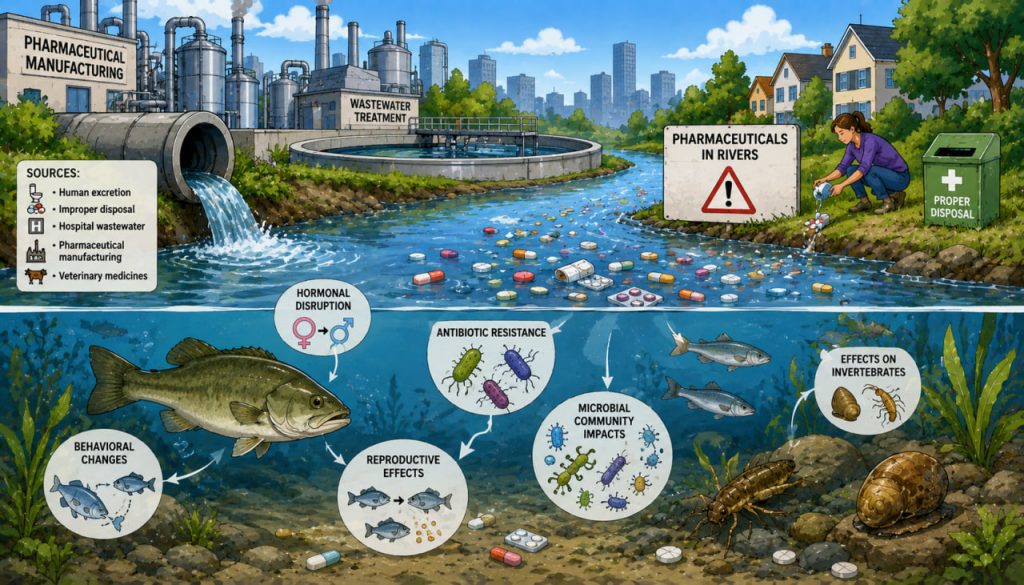
Modern medicine has transformed human life. Antibiotics, painkillers, antidepressants, hormones, and countless other pharmaceuticals have improved health and extended life expectancy around the world. However, a growing environmental challenge has emerged alongside these benefits: pharmaceutical pollution.
Many people assume that medicines disappear after they are consumed. In reality, significant amounts of pharmaceutical compounds eventually enter rivers, lakes, and other freshwater ecosystems. Wastewater treatment plants are not always designed to completely remove these complex chemicals, allowing trace amounts to reach natural environments.
Although concentrations are often extremely low—sometimes measured in parts per trillion—scientists have discovered that even tiny quantities of biologically active substances can influence aquatic organisms. As research expands, pharmaceutical contamination is increasingly recognized as an important environmental issue affecting ecosystems worldwide.
How Pharmaceuticals Enter Rivers
Drug residues can reach aquatic environments through several pathways.
Common sources include:
- Human excretion
- Improper disposal of medications
- Hospital wastewater
- Pharmaceutical manufacturing facilities
- Agricultural runoff from veterinary medicines
After a person takes medication, the body may not fully metabolize the active ingredient.
Some portion can pass through the body unchanged and enter sewage systems.
Wastewater treatment plants remove many contaminants effectively, but pharmaceuticals are often more difficult to eliminate completely.
As a result, small amounts may eventually reach rivers and streams.
Why Small Concentrations Matter
Many pharmaceutical compounds are specifically designed to affect biological systems.
Unlike some pollutants that become harmful only at high concentrations, drugs can produce measurable biological effects at extremely low levels.
For example:
- Hormones influence reproductive systems.
- Antidepressants affect nervous systems.
- Antibiotics affect microorganisms.
- Painkillers influence physiological processes.
Aquatic organisms are often exposed continuously over long periods.
The concern is not usually acute poisoning but subtle biological changes that accumulate over time.
Effects on Fish
Fish are among the most studied organisms in pharmaceutical pollution research.
Numerous studies have identified physiological and behavioral changes associated with exposure to pharmaceutical residues.
Observed effects may include:
- Altered reproduction
- Behavioral changes
- Reduced predator avoidance
- Modified feeding patterns
- Hormonal disruption
Synthetic hormones have attracted particular attention.
Certain estrogen-like compounds can interfere with normal reproductive development in fish.
In some cases, male fish have developed female characteristics after long-term exposure to hormone-containing wastewater.
These effects have raised concerns about population-level consequences in heavily contaminated waterways.
The Impact of Antidepressants
One surprising area of research involves antidepressant medications.
Compounds designed to affect human brain chemistry can also influence aquatic organisms.
Studies suggest that exposure may alter:
- Fish behavior
- Swimming activity
- Risk-taking behavior
- Predator responses
Some exposed fish become unusually bold, potentially increasing their vulnerability to predators.
Others show changes in social interactions and feeding habits.
Although effects vary between species and environments, researchers continue investigating these behavioral impacts.
Antibiotics and Microbial Communities
Antibiotics represent another significant concern.
Rivers contain vast microbial communities that play essential roles in ecosystem health.
These microorganisms help:
- Decompose organic matter
- Recycle nutrients
- Support food webs
When antibiotics enter aquatic environments, they may affect microbial populations.
Perhaps even more concerning is the possibility that environmental antibiotic exposure contributes to the development of antibiotic-resistant bacteria.
Antibiotic resistance is already considered one of the major public health challenges of the twenty-first century.
Effects on Invertebrates
Small aquatic organisms such as insects, crustaceans, and mollusks are also vulnerable.
These species form the foundation of many freshwater food webs.
Pharmaceutical exposure may influence:
- Growth
- Development
- Reproduction
- Feeding behavior
Because many larger animals depend on these organisms for food, disruptions at lower levels of the food web can potentially affect entire ecosystems.
Scientists increasingly emphasize the importance of studying these indirect ecological effects.
Pharmaceutical Manufacturing Hotspots
While pharmaceutical residues are found worldwide, some areas experience particularly high contamination levels.
In regions with pharmaceutical manufacturing facilities, wastewater may contain much higher concentrations of active compounds than typically found in municipal sewage.
Studies have documented locations where antibiotic concentrations in rivers reached levels far above those normally observed in natural environments.
Such hotspots provide valuable opportunities for scientists to study ecological impacts, but they also highlight the importance of effective wastewater management.
Why Wastewater Treatment Is Challenging
Traditional wastewater treatment plants were designed primarily to remove:
- Organic waste
- Nutrients
- Pathogens
- Suspended solids
Many pharmaceuticals were not considered during the design of older treatment systems.
Removing these compounds often requires advanced technologies such as:
- Activated carbon filtration
- Ozonation
- Advanced oxidation processes
- Membrane filtration
While effective, these methods can increase treatment costs.
Many municipalities face the challenge of balancing environmental protection with economic considerations.
Expert Perspective
Environmental scientist Joakim Larsson has conducted extensive research on pharmaceutical pollution and antibiotic contamination in aquatic environments.
His work has helped demonstrate how pharmaceutical manufacturing and wastewater discharges can contribute to environmental exposure and antibiotic resistance risks.
Larsson emphasizes that pharmaceutical pollution represents a global challenge requiring cooperation among governments, industry, healthcare systems, and researchers.
His studies have significantly influenced international discussions regarding pharmaceutical waste management.
Emerging Solutions
Researchers and policymakers are exploring multiple approaches to reduce pharmaceutical pollution.
Potential solutions include:
- Improved wastewater treatment
- Greener drug design
- Better medication disposal programs
- Manufacturing discharge controls
- Enhanced environmental monitoring
Public education also plays an important role.
Many people remain unaware that flushing unused medications down sinks or toilets can contribute to environmental contamination.
Proper disposal programs help reduce unnecessary releases.
The Future of Pharmaceutical Sustainability
The pharmaceutical industry faces a unique challenge.
Society depends heavily on medicines for health and well-being, yet their environmental impacts must also be managed responsibly.
Future innovations may focus on developing drugs that:
- Break down more easily in the environment
- Maintain effectiveness in patients
- Reduce ecological persistence
Advances in environmental chemistry and wastewater engineering may further reduce contamination levels in coming decades.
Interesting Facts
- Pharmaceutical residues have been detected in rivers on every inhabited continent.
- Some compounds are measurable at concentrations of parts per trillion.
- Fish can absorb dissolved pharmaceuticals directly from water through their gills.
- Wastewater treatment plants were not originally designed to remove many modern pharmaceuticals.
- Antibiotics in aquatic environments may contribute to the spread of antibiotic resistance.
- Scientists have detected traces of dozens of different pharmaceutical compounds in some river systems.
Glossary
- Pharmaceutical Pollution — Environmental contamination caused by medicinal compounds entering ecosystems.
- Wastewater Treatment Plant — A facility that removes contaminants from sewage before water is released into the environment.
- Antibiotic Resistance — The ability of bacteria to survive exposure to antibiotics that would normally kill them.
- Hormonal Disruption — Interference with the normal functioning of hormonal systems.
- Microbial Community — A population of microorganisms living within a specific environment.
- Ozonation — A water treatment process that uses ozone to break down contaminants.