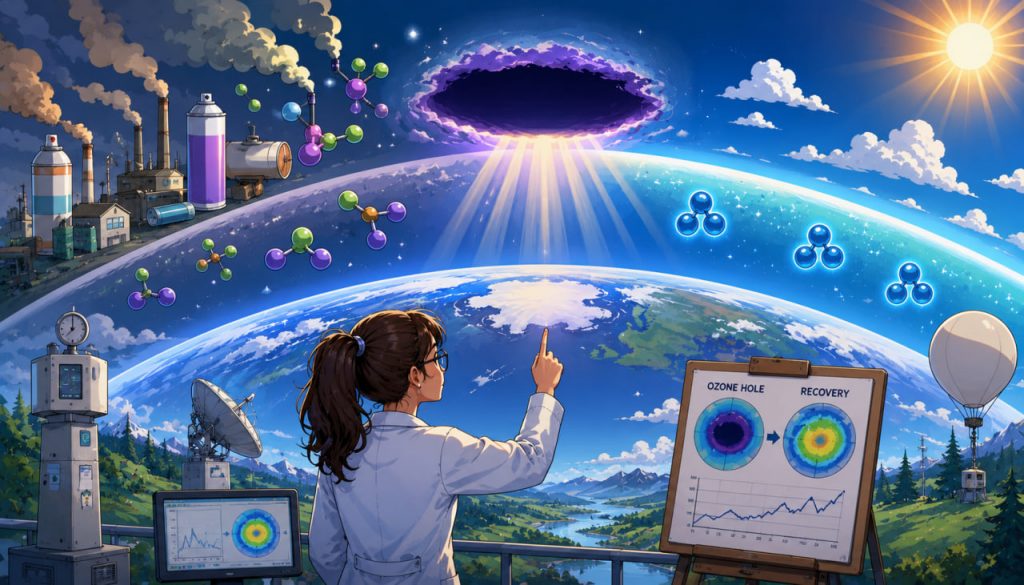
In the 1980s and 1990s, the ozone hole was one of the most widely discussed environmental threats on Earth. News reports warned of rising skin cancer rates, damage to ecosystems, and harmful ultraviolet radiation reaching the planet’s surface. Governments responded with international agreements, industries changed manufacturing processes, and scientists closely monitored the atmosphere.
Today, however, the ozone hole rarely dominates headlines. Climate change, biodiversity loss, and plastic pollution have taken center stage. This raises an important question: Did humanity solve the ozone problem, or have we simply stopped paying attention to it?
The answer is encouraging but more complex than many people realize.
What Is the Ozone Layer and Why Is It Important?
The ozone layer is a region of Earth’s stratosphere located roughly 15 to 35 kilometers above the surface.
It contains relatively high concentrations of ozone (O₃), a molecule made of three oxygen atoms.
This layer acts as a natural shield by absorbing much of the Sun’s harmful ultraviolet (UV-B) radiation.
Without the ozone layer:
- Skin cancer rates would increase dramatically.
- Cataracts and eye damage would become more common.
- Immune system suppression could rise.
- Crop productivity could decline.
- Marine ecosystems could suffer significant damage.
The ozone layer is one of the planet’s most important natural defense systems.
How Did the Ozone Hole Form?
The ozone hole is primarily linked to human-made chemicals known as ozone-depleting substances (ODS).
The most famous of these are chlorofluorocarbons (CFCs), once widely used in:
- Refrigerators
- Air conditioners
- Aerosol sprays
- Foam production
- Industrial solvents
These chemicals were initially considered safe because they were stable and non-toxic near Earth’s surface.
However, once they reached the stratosphere, ultraviolet radiation broke them apart, releasing chlorine and bromine atoms.
These atoms trigger chemical reactions that destroy ozone molecules.
A single chlorine atom can destroy thousands of ozone molecules before becoming inactive.
What seemed like a technological success on Earth became a global atmospheric problem decades later.
The Discovery That Shocked the World
Scientists had suspected ozone depletion for years, but the issue gained worldwide attention in 1985.
Researchers from the British Antarctic Survey discovered a dramatic seasonal reduction in ozone concentrations above Antarctica.
This phenomenon became known as the Antarctic ozone hole.
The discovery shocked both the scientific community and policymakers.
For the first time, there was clear evidence that human activities were altering the atmosphere on a planetary scale.
Public concern grew rapidly because the consequences appeared severe and potentially irreversible.
The Montreal Protocol: One of the Most Successful Environmental Agreements Ever
The global response was unusually fast.
In 1987, countries signed the Montreal Protocol on Substances that Deplete the Ozone Layer.
The agreement established a framework for phasing out ozone-depleting chemicals.
Over time, nearly every country in the world joined the treaty.
The protocol required:
- Gradual elimination of CFCs
- Restrictions on halons
- Reduction of other ozone-depleting substances
- Monitoring and reporting systems
- International cooperation and technology transfer
The United Nations Environment Programme considers the Montreal Protocol one of the most successful environmental agreements in history.
Unlike many environmental challenges, the ozone crisis had a clear cause, available alternatives, and strong international cooperation.
Why Don’t We Hear About the Ozone Hole Anymore?
Several factors explain why the ozone hole receives less media attention today.
The Situation Is Improving
Unlike climate change, ozone depletion is generally moving in a positive direction.
Because most ozone-depleting substances have been phased out, atmospheric concentrations have declined significantly.
As a result, ozone recovery has become measurable.
Climate Change Dominates Environmental News
Climate change affects nearly every aspect of society, making it a constant topic in public discussion.
The ozone issue remains important, but it no longer appears as urgent as it did during the late twentieth century.
The Problem Is Less Visible
People can observe heat waves, droughts, floods, and wildfires directly.
The ozone layer exists high above Earth and cannot be seen without scientific instruments.
This makes it easier for public attention to shift elsewhere.
Have We Actually Solved the Problem?
Not completely.
The good news is that the ozone layer is recovering.
The bad news is that recovery is slow.
Many ozone-depleting substances remain in the atmosphere for decades because they break down very slowly.
According to scientific assessments by the World Meteorological Organization and the United Nations Environment Programme, continued implementation of the Montreal Protocol is expected to allow ozone levels to recover to pre-1980 conditions over much of the world during the coming decades.
Current projections suggest:
- Global ozone recovery around the middle of the 21st century.
- Antarctic ozone recovery later, potentially around the 2060s.
- Continued monitoring remains necessary.
The ozone crisis is not over, but it is one of the few major environmental problems that humanity has successfully reversed.
The Link Between Ozone Depletion and Climate Change
Ozone depletion and climate change are often confused, but they are different phenomena.
Ozone depletion concerns the destruction of stratospheric ozone.
Climate change primarily involves greenhouse gases trapping heat in the lower atmosphere.
However, there are connections.
Many ozone-depleting substances are also powerful greenhouse gases.
Therefore, eliminating CFCs helped both ozone protection and climate mitigation.
Scientists estimate that the Montreal Protocol prevented significant additional global warming by reducing emissions of these potent compounds.
New Challenges and Emerging Risks
Even though progress has been substantial, scientists continue monitoring potential threats.
Challenges include:
- Illegal production of banned chemicals
- New industrial compounds
- Interactions between ozone recovery and climate change
- Changes in atmospheric circulation
- Increasing commercial activity in the upper atmosphere
Researchers are also studying whether future technologies and industrial activities could create unforeseen impacts on atmospheric chemistry.
The lesson of the ozone crisis is clear: environmental problems should be addressed before they become irreversible.
Expert Perspective
Atmospheric scientist Dr. Paul Newman of NASA has frequently highlighted the ozone story as an example of successful science-based policymaking.
His work has emphasized that international cooperation, strong scientific evidence, and practical alternatives allowed countries to act before catastrophic damage occurred.
“The ozone story demonstrates that global environmental problems can be solved when science, industry, and governments work together.”
This perspective is often cited as one of the most hopeful examples in environmental history.
Why the Ozone Layer Still Matters
Even as recovery continues, the ozone layer remains essential for life on Earth.
Ongoing monitoring helps ensure that progress continues and that new threats are identified early.
The ozone story also offers an important lesson for other environmental challenges.
It shows that:
- Scientific research matters.
- International cooperation can work.
- Industry can adapt.
- Environmental policies can produce measurable results.
- Global problems are not always impossible to solve.
The ozone hole may no longer dominate headlines, but it remains one of the most important success stories in modern environmental science.
Interesting Facts
- The ozone hole appears primarily over Antarctica during the Southern Hemisphere spring.
- A single chlorine atom can destroy thousands of ozone molecules.
- The Montreal Protocol has been ratified by every member state of the United Nations.
- Some ozone-depleting substances can remain in the atmosphere for 50 to 100 years.
- Ozone near Earth’s surface can be harmful, while ozone in the stratosphere is protective.
- The ozone layer is thickest near the equator and thinnest near the poles.
- Scientists consider ozone recovery one of the clearest examples of successful global environmental cooperation.
Glossary
- Ozone (O₃) — A molecule composed of three oxygen atoms that absorbs harmful ultraviolet radiation.
- Ozone Layer — A region of the stratosphere containing elevated concentrations of ozone.
- Stratosphere — The atmospheric layer above the troposphere where the ozone layer is located.
- UV-B Radiation — A type of ultraviolet radiation that can damage living tissues.
- CFCs (Chlorofluorocarbons) — Human-made chemicals formerly used in refrigeration, aerosols, and industrial applications.
- Ozone-Depleting Substances (ODS) — Chemicals that contribute to ozone destruction.
- Montreal Protocol — The international agreement designed to phase out ozone-depleting substances.
- Atmospheric Chemistry — The scientific study of chemical processes occurring in Earth’s atmosphere.
- Greenhouse Gas — A gas that traps heat within Earth’s atmosphere.
- Antarctic Ozone Hole — A region of severe seasonal ozone depletion that forms above Antarctica.