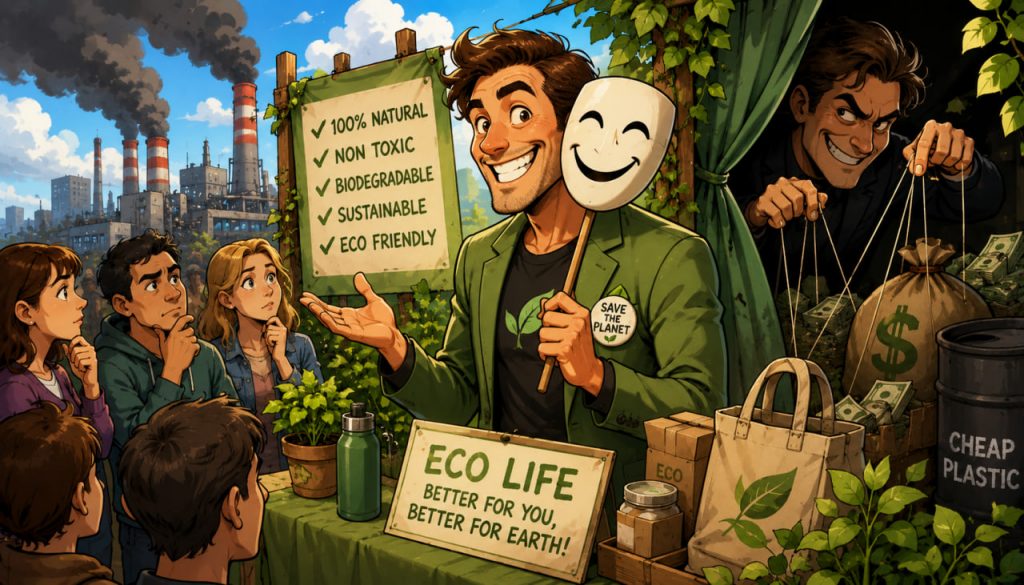
Environmental awareness has become one of the defining trends of the 21st century. Millions of people are trying to reduce waste, consume less plastic, lower their carbon footprint, and live more sustainably. At the same time, businesses have recognized that “green” sells.
This growing demand for environmental solutions has created a booming market for eco-consultants, sustainability influencers, environmental coaches, online courses, and self-proclaimed experts promising to help people “save the planet” while improving their health, finances, or lifestyle.
While many environmental educators provide valuable information, others exploit public concerns for profit. Some use misleading claims, pseudoscience, emotional manipulation, or exaggerated promises to sell expensive products and services.
Understanding the difference between genuine environmental education and green marketing manipulation is becoming an essential skill for modern consumers.
What Is Green Marketing?
Green marketing refers to promoting products, services, or brands based on environmental benefits.
In principle, there is nothing wrong with green marketing.
Companies that genuinely reduce pollution, improve energy efficiency, or use sustainable materials should communicate these achievements.
Problems arise when environmental claims are exaggerated, misleading, or completely false.
This practice is commonly known as greenwashing.
Examples include:
- Products labeled “eco-friendly” without evidence
- Vague sustainability claims
- Misleading carbon-neutral promises
- Exaggerated recycling benefits
- Selective disclosure of environmental information
Greenwashing turns environmental concern into a marketing tool rather than a genuine commitment.
The Rise of Eco-Coaches and Environmental Influencers
Social media has created a new category of environmental educators.
Many provide useful guidance on:
- Waste reduction
- Energy efficiency
- Sustainable consumption
- Home gardening
- Recycling
- Conservation
However, the low barrier to entry means anyone can present themselves as an expert.
Some eco-coaches promote:
- Expensive certification programs
- Miracle environmental products
- Unsupported health claims
- Pseudoscientific detox methods
- Fear-based marketing
- Lifestyle packages with questionable benefits
In many cases, environmental language becomes a sales strategy rather than an educational mission.
Why People Fall for Green Marketing
Green marketing often succeeds because it appeals to powerful emotions.
People want to:
- Protect their families
- Improve their health
- Help the environment
- Reduce guilt
- Make responsible choices
Marketers understand these motivations.
Many campaigns rely on psychological triggers such as:
Fear
Claims that everyday products are secretly toxic or environmentally catastrophic.
Hope
Promises that a simple purchase can dramatically improve the world.
Identity
Suggestions that buying certain products makes someone morally superior or more environmentally conscious.
Urgency
Messages implying immediate action is necessary before disaster occurs.
Strong emotions can sometimes replace critical thinking.
Common Red Flags of Greenwashing
Consumers can protect themselves by recognizing warning signs.
Vague Language
Terms such as:
- Natural
- Green
- Eco-friendly
- Sustainable
- Planet-safe
may sound impressive but often have no legal definition.
Without supporting evidence, such claims mean very little.
No Independent Verification
Trustworthy environmental claims are often supported by:
- Certifications
- Third-party audits
- Scientific studies
- Regulatory compliance
If evidence is absent, skepticism is justified.
One Environmental Benefit Hides Bigger Problems
A company may highlight one positive feature while ignoring major environmental impacts elsewhere.
For example:
- Recyclable packaging paired with wasteful production
- Carbon offsets used to distract from high emissions
- Small donations promoted as major environmental action
Emotional Marketing Without Data
When a campaign relies entirely on emotional storytelling without measurable evidence, consumers should ask more questions.
The Difference Between Education and Sales
A genuine environmental educator typically focuses on:
- Evidence
- Transparency
- Nuance
- Scientific uncertainty
- Practical solutions
A green marketing manipulator often focuses on:
- Personal branding
- Urgency
- Fear
- Simplistic answers
- Expensive products
Environmental problems are usually complex.
Any person claiming to have a single easy solution for climate change, pollution, biodiversity loss, or sustainable living should be approached cautiously.
Real experts often discuss limitations and uncertainties. False experts often claim certainty.
How Science Evaluates Environmental Claims
Scientific research follows strict standards.
Reliable environmental claims should ideally be supported by:
- Peer-reviewed studies
- Transparent methodologies
- Independent verification
- Reproducible results
- Expert consensus
The presence of scientific language alone is not enough.
Words like:
- Quantum
- Natural
- Detoxifying
- Regenerative
- Holistic
- Revolutionary
may sound impressive but do not automatically indicate scientific validity.
Consumers should look for actual evidence rather than scientific-sounding terminology.
The Business of Environmental Anxiety
Environmental concerns are real.
Climate change, pollution, biodiversity loss, and resource depletion are legitimate challenges.
Unfortunately, some businesses profit by amplifying anxiety.
This approach sometimes creates the impression that consumers must purchase increasingly expensive products to be environmentally responsible.
Examples include:
- Luxury “zero-waste” products
- Unnecessary eco-gadgets
- Premium green subscriptions
- Questionable sustainability certifications
- High-priced environmental coaching programs
In reality, some of the most effective environmental actions cost little or nothing.
These include:
- Using less energy
- Driving less
- Reducing food waste
- Repairing products
- Consuming less overall
Environmental responsibility is often more about behavior than shopping.
Expert Perspective
The United Nations Environment Programme and the Organisation for Economic Co-operation and Development have repeatedly emphasized the importance of transparency, credible environmental reporting, and evidence-based sustainability claims.
Experts increasingly warn that greenwashing can undermine public trust and slow genuine environmental progress.
“Consumers need reliable information to make environmentally responsible choices.”
This principle highlights why transparency matters.
Without trustworthy information, it becomes difficult to distinguish meaningful environmental improvements from marketing campaigns.
Questions Every Consumer Should Ask
Before buying an environmentally marketed product or service, consider the following:
- What specific environmental benefit is being claimed?
- Is there independent verification?
- Are measurable results provided?
- What evidence supports the claim?
- Who conducted the research?
- Does the company disclose limitations?
- Is the product solving a real problem or creating a new one?
If clear answers are unavailable, caution is appropriate.
The same questions apply to environmental courses, coaching programs, and sustainability influencers.
Building Real Environmental Literacy
The best defense against greenwashing is education.
Environmentally literate consumers understand that:
- Complex problems rarely have simple solutions.
- Scientific evidence matters.
- Trade-offs exist.
- Perfect sustainability is impossible.
- Incremental improvements can still be valuable.
Rather than searching for miracle products or environmental gurus, people benefit most from learning how environmental systems actually work.
Knowledge creates resilience against manipulation.
The goal is not to become suspicious of every green claim, but to become skilled at separating evidence from marketing.
Interesting Facts
- The term “greenwashing” was first popularized in the 1980s.
- Some environmental labels are independently certified, while others are created entirely by the companies using them.
- Studies show that consumers are often willing to pay more for products marketed as environmentally friendly.
- Many effective environmental actions involve reducing consumption rather than purchasing new products.
- Greenwashing can occur in industries ranging from fashion and food to energy and finance.
- Environmental claims are increasingly regulated in many countries.
- Transparency and third-party verification are considered among the strongest indicators of credible sustainability reporting.
Glossary
- Greenwashing — Misleading environmental claims designed to improve a company’s image without significant environmental benefits.
- Green Marketing — Promotion of products or services based on environmental characteristics.
- Sustainability — Meeting present needs without compromising future generations’ ability to meet their own needs.
- Carbon Footprint — The total greenhouse gas emissions associated with an activity, product, or organization.
- Third-Party Certification — Independent verification of environmental claims by an external organization.
- Peer Review — Scientific evaluation of research by independent experts before publication.
- Environmental Literacy — Understanding environmental systems, challenges, and evidence-based solutions.
- Eco-Coach — A person who advises individuals or organizations on environmentally conscious practices.
- Transparency — Open disclosure of relevant information and evidence.
- Consumer Skepticism — Critical evaluation of marketing claims before accepting them as true.