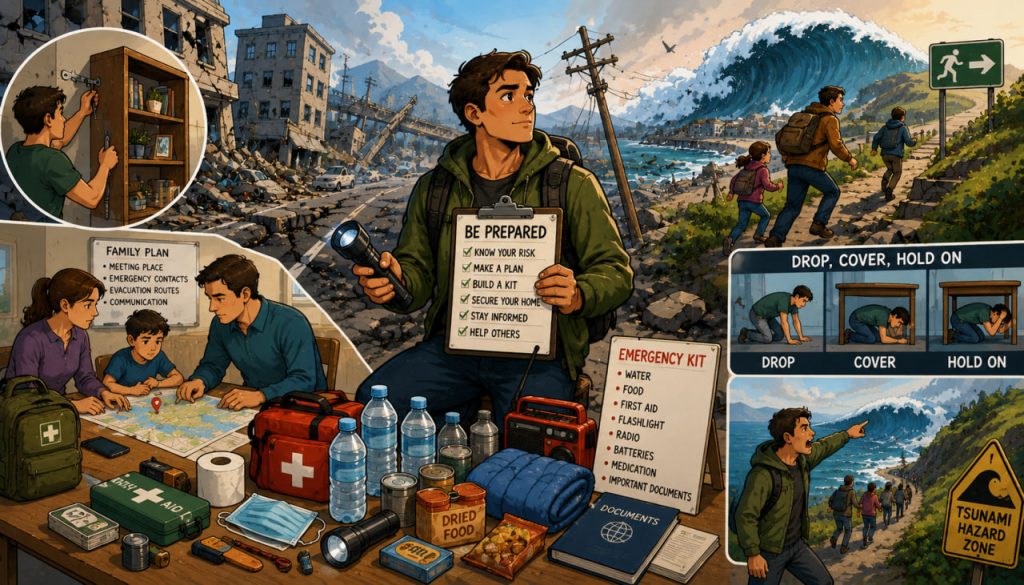
Mega-earthquakes are among the most powerful natural disasters on Earth. Unlike ordinary earthquakes, they can release enormous amounts of energy, trigger tsunamis, destroy infrastructure across entire regions, and affect millions of people simultaneously. Events such as the 2004 Indian Ocean earthquake, the 2011 Tōhoku earthquake in Japan, and the 1960 Valdivia earthquake in Chile demonstrate how devastating these disasters can be.
Although scientists can identify earthquake-prone regions and monitor tectonic activity, there is currently no reliable method to predict the exact time, location, and magnitude of a major earthquake. As a result, preparedness remains the most effective defense.
Understanding how mega-earthquakes occur and how to prepare for them can significantly reduce injuries, fatalities, and economic losses.
What Is a Mega-Earthquake?
A mega-earthquake generally refers to an earthquake with a magnitude of 8.0 or greater.
These events occur when enormous sections of Earth’s crust suddenly slip along tectonic plate boundaries.
Most mega-earthquakes occur in subduction zones, where one tectonic plate moves beneath another.
Examples include:
- Japan’s Pacific coast
- Alaska
- Chile
- Indonesia
- The Pacific Northwest of North America
The largest earthquake ever recorded was the 1960 Valdivia earthquake in Chile, which reached magnitude 9.5.
A magnitude 9 earthquake releases far more energy than a magnitude 8 earthquake. The Richter scale is logarithmic, not linear.
This means each increase in magnitude represents a dramatic increase in energy release.
Why Mega-Earthquakes Are So Dangerous
The shaking itself can be catastrophic, but many secondary effects often cause even greater destruction.
These include:
- Building collapse
- Tsunamis
- Landslides
- Fires
- Dam failures
- Liquefaction
- Transportation disruption
- Long-term power outages
In coastal regions, tsunamis may arrive within minutes after a major offshore earthquake.
This leaves very little time for evacuation.
Infrastructure damage can also isolate communities and delay emergency response efforts.
Know Your Local Risk
The first step in earthquake preparedness is understanding whether you live in a high-risk area.
Factors to investigate include:
- Nearby fault lines
- Historical earthquakes
- Building codes
- Tsunami risk zones
- Soil conditions
- Local emergency plans
Many government geological agencies provide hazard maps showing areas of elevated seismic risk.
Preparation should be based on actual local hazards rather than general assumptions.
A person living near an active fault faces different risks than someone living in a tsunami-prone coastal region.
Strengthen Your Home
One of the most effective ways to reduce earthquake damage is structural reinforcement.
Depending on the building type, improvements may include:
- Foundation anchoring
- Wall reinforcement
- Roof strengthening
- Flexible utility connections
- Seismic retrofitting
Even simple measures can improve safety.
Examples include:
- Securing bookshelves
- Anchoring water heaters
- Fastening cabinets to walls
- Installing safety latches
- Moving heavy objects to lower shelves
Many earthquake injuries occur not because buildings collapse, but because furniture and household objects fall during shaking.
Build an Emergency Supply Kit
After a major earthquake, access to stores, water, electricity, and medical services may be disrupted for days or weeks.
Emergency experts often recommend maintaining supplies sufficient for at least several days.
A basic kit should include:
- Drinking water
- Non-perishable food
- Flashlights
- Batteries
- First-aid supplies
- Prescription medications
- Portable radio
- Power banks
- Hygiene products
- Warm clothing
- Copies of important documents
If you have pets, their needs should also be included.
An emergency kit is most valuable when assembled before a disaster occurs.
Create a Family Emergency Plan
Many families discuss earthquakes only after they happen.
Planning in advance can reduce confusion during an actual emergency.
Important topics include:
- Meeting locations
- Emergency contacts
- Evacuation routes
- School pickup procedures
- Communication alternatives
Cellular networks often become overloaded after major disasters.
Family members should know how to communicate if phones stop working temporarily.
Practicing emergency procedures can improve confidence and response speed.
What to Do During an Earthquake
The advice recommended by emergency management agencies is straightforward:
Indoors
Use the “Drop, Cover, and Hold On” method.
- Drop to the ground.
- Take cover under sturdy furniture.
- Hold on until the shaking stops.
Stay away from:
- Windows
- Glass
- Tall furniture
- Hanging objects
Outdoors
Move away from:
- Buildings
- Utility poles
- Trees
- Bridges
Stay in an open area until shaking ends.
Driving
Pull over safely and stop.
Avoid:
- Bridges
- Tunnels
- Overpasses
- Power lines
Remain inside the vehicle until conditions are safe.
Running during intense shaking often increases injury risk.
Preparing for Tsunamis
If you live near a coastline, tsunami preparedness is essential.
A strong or prolonged earthquake near the coast may be a natural tsunami warning.
Signs include:
- Strong ground shaking
- Sudden retreat of ocean water
- Unusual ocean behavior
- Official tsunami alerts
If a tsunami is possible:
- Move immediately to higher ground.
- Do not wait for confirmation.
- Follow evacuation routes.
- Stay away from beaches and river mouths.
The first wave is not always the largest.
Danger can continue for many hours.
Technology and Early Warning Systems
Several countries now operate earthquake early warning systems.
These systems can provide seconds or, in some cases, tens of seconds of warning before strong shaking arrives.
While brief, this warning can allow people to:
- Move to safer locations
- Stop machinery
- Open fire station doors
- Slow trains
- Protect sensitive equipment
Japan’s earthquake early warning system is one of the most advanced examples currently in operation.
However, even the best systems cannot predict earthquakes days or weeks in advance.
Expert Perspective
The United States Geological Survey (USGS) and many international seismic agencies emphasize that preparedness is the most reliable protection against earthquake disasters.
Because exact prediction remains impossible, experts focus on resilience, planning, and risk reduction.
“Earthquakes don’t kill people; unsafe buildings and infrastructure do.”
This commonly cited principle reflects decades of earthquake research.
Regions with strong building codes often experience far fewer casualties than regions with weaker construction standards, even when earthquake magnitudes are similar.
Recovery Begins Before the Disaster
Successful disaster response often depends on decisions made long before the earthquake occurs.
Prepared communities tend to recover faster because they already have:
- Emergency plans
- Public education programs
- Strong building standards
- Emergency communication systems
- Trained response teams
Individuals who prepare ahead of time also experience lower stress and greater resilience during emergencies.
Earthquake preparedness is not about predicting disasters. It is about reducing their consequences when they inevitably occur.
P.S. Personally, I highly recommend that if you have the opportunity to leave for a safer area, do so. To address this issue on a global scale, we need to unite as a humanity and recognize our collective responsibility for the future of our children.
Interesting Facts
- The largest recorded earthquake was the 1960 Valdivia earthquake in Chile, with a magnitude of 9.5.
- Mega-earthquakes usually occur along tectonic plate boundaries.
- Earthquake early warning systems can sometimes provide several seconds of advance notice.
- Tsunamis can travel across entire oceans at jet-aircraft speeds.
- Some buildings are designed to sway during earthquakes rather than resist movement completely.
- Liquefaction can cause solid ground to behave like a liquid during strong shaking.
- Modern seismic engineering has dramatically reduced earthquake-related fatalities in many countries.
Glossary
- Mega-Earthquake — An extremely large earthquake, typically magnitude 8.0 or greater.
- Magnitude — A measure of the energy released by an earthquake.
- Fault Line — A fracture in Earth’s crust where movement occurs.
- Subduction Zone — A region where one tectonic plate moves beneath another.
- Tsunami — A series of large ocean waves usually caused by underwater earthquakes.
- Liquefaction — A process in which saturated soil temporarily loses strength during shaking.
- Seismic Retrofitting — Structural improvements designed to increase earthquake resistance.
- Earthquake Early Warning System — A system that detects earthquakes and provides short warnings before strong shaking arrives.
- Aftershock — A smaller earthquake occurring after the main event.
- Resilience — The ability of individuals, communities, or infrastructure to recover from disasters.