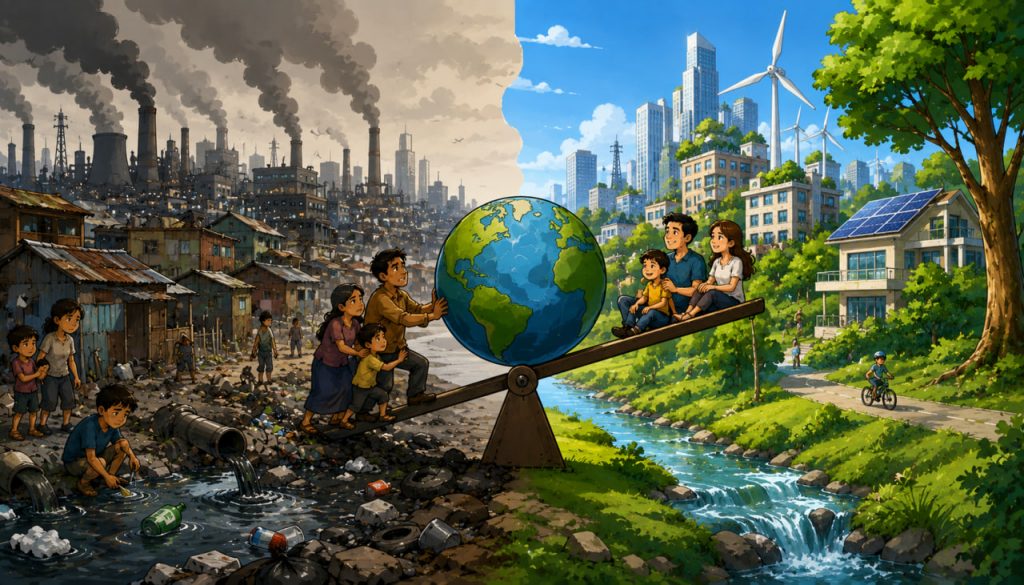
Environmental issues are often presented as purely scientific or technological challenges. Discussions typically focus on carbon emissions, pollution, biodiversity loss, renewable energy, or climate change. However, environmental problems are also deeply connected to social structures. Wealth, education, access to resources, political influence, and economic opportunity all shape how environmental risks are created and distributed.
This relationship is the focus of social ecology, a field that examines the connections between human societies and the natural environment. One of its central ideas is that environmental problems are rarely experienced equally. Instead, social inequality often determines who benefits from environmental resources and who bears the costs of pollution and ecological degradation.
Understanding this connection is essential for creating effective and fair environmental solutions.
What Is Social Ecology?
Social ecology is an interdisciplinary approach that studies how social systems interact with ecological systems.
Rather than viewing environmental problems as isolated natural events, social ecology examines how economic, political, and cultural structures influence environmental outcomes.
Key questions include:
- Who benefits from resource use?
- Who is exposed to pollution?
- Who has access to clean water and green spaces?
- Who can afford protection from environmental risks?
- How do power structures influence environmental decisions?
Social ecology argues that environmental problems cannot be fully solved without addressing social inequalities.
This perspective has become increasingly important as climate change and environmental degradation affect larger portions of the global population.
Environmental Risks Are Not Shared Equally
Although environmental problems affect everyone to some degree, some groups face much greater risks than others.
Lower-income communities are often more likely to live near:
- Industrial facilities
- Landfills
- Major highways
- Polluted waterways
- Hazardous waste sites
- Areas vulnerable to flooding
These locations may have lower property values, making them more affordable but also exposing residents to greater environmental hazards.
Meanwhile, wealthier populations often have greater ability to:
- Relocate from high-risk areas
- Access healthcare
- Purchase cleaner technologies
- Invest in resilient housing
- Influence political decisions
Environmental exposure frequently mirrors economic inequality.
Climate Change and Social Vulnerability
Climate change provides one of the clearest examples of environmental inequality.
Extreme weather events such as:
- Heatwaves
- Floods
- Hurricanes
- Droughts
- Wildfires
often affect disadvantaged communities more severely.
For example:
- Low-income households may lack air conditioning during heatwaves.
- Poor infrastructure can increase flood damage.
- Limited insurance coverage may slow recovery.
- Economic instability can reduce resilience after disasters.
Ironically, many of the communities most vulnerable to climate impacts contribute relatively little to global greenhouse gas emissions.
This creates what researchers often describe as a climate justice challenge.
Environmental Justice: A Growing Movement
The concept of environmental justice emerged in response to concerns that environmental burdens were being distributed unfairly.
Environmental justice seeks to ensure that all people have equal protection from environmental harm regardless of:
- Income
- Ethnicity
- Social status
- Geographic location
The movement emphasizes that clean air, clean water, safe housing, and a healthy environment should not be privileges available only to certain groups.
Many environmental justice campaigns focus on:
- Industrial pollution
- Access to green spaces
- Drinking water quality
- Toxic waste disposal
- Urban planning
- Climate adaptation policies
A sustainable society requires both ecological sustainability and social fairness.
Urban Inequality and Environmental Quality
Cities provide a particularly visible example of the connection between inequality and environmental conditions.
Residents of wealthier neighborhoods often enjoy:
- More parks
- Better tree coverage
- Cleaner air
- Better public transportation
- Improved waste management
In contrast, disadvantaged areas may experience:
- Higher temperatures due to urban heat islands
- Greater traffic pollution
- Limited access to recreation
- Poor infrastructure
- Reduced investment
Tree cover alone can significantly influence urban temperatures.
Research has shown that neighborhoods with fewer trees can experience substantially higher temperatures during extreme heat events.
As climate change increases heatwave frequency, these differences become increasingly important.
Access to Environmental Resources
Environmental inequality is not only about exposure to harm.
It also involves unequal access to environmental benefits.
Examples include:
- Clean drinking water
- Public parks
- Natural landscapes
- Recreational opportunities
- Healthy food systems
- Renewable energy technologies
For example, rooftop solar panels can reduce electricity costs and emissions, but installation expenses may prevent lower-income households from benefiting.
Similarly, organic foods and environmentally certified products are often more expensive, limiting accessibility.
Environmental benefits frequently follow the same economic patterns as other social advantages.
Global Inequality and Environmental Impacts
Environmental inequality also exists between nations.
Many developing countries face challenges such as:
- Deforestation
- Air pollution
- Water contamination
- Resource extraction
- Waste imports
At the same time, wealthier countries often consume a disproportionate share of global resources.
This has led to debates about environmental responsibility and fairness.
Some researchers argue that environmental sustainability cannot be achieved without considering international inequalities in:
- Consumption
- Resource use
- Technology access
- Economic development
These discussions play an important role in international climate negotiations.
How Inequality Can Worsen Environmental Problems
Inequality can make environmental challenges harder to solve in several ways.
Reduced Public Trust
People may resist environmental policies if they believe costs are distributed unfairly.
Limited Access to Solutions
Cleaner technologies may remain inaccessible to lower-income populations.
Political Imbalances
Groups with greater economic influence may shape environmental policies in their favor.
Short-Term Survival Priorities
Individuals struggling with poverty often must prioritize immediate needs over long-term environmental considerations.
This does not mean disadvantaged communities care less about the environment.
Rather, economic constraints can limit available choices.
Expert Perspective
American environmental scholar Robert Bullard, often called the father of environmental justice research, has emphasized the importance of recognizing the unequal distribution of environmental risks.
His work helped demonstrate that environmental hazards frequently affect marginalized communities disproportionately.
“Environmental protection and social justice are inseparable.”
This perspective has influenced environmental policy discussions around the world.
Increasingly, policymakers recognize that environmental solutions are more effective when they also address social equity.
Building a More Equitable Environmental Future
Many experts argue that successful environmental policies should include social considerations from the beginning.
Potential approaches include:
- Investing in vulnerable communities
- Expanding access to renewable energy
- Improving public transportation
- Increasing urban green spaces
- Strengthening disaster preparedness
- Supporting affordable housing in safe locations
- Improving environmental monitoring
These measures can reduce both environmental risks and social inequalities simultaneously.
The goal is not simply to protect ecosystems, but also to ensure that environmental benefits and burdens are shared more fairly across society.
Long-term sustainability depends not only on technological innovation but also on creating more equitable social systems.
Interesting Facts
- The environmental justice movement gained international attention during the late twentieth century.
- Urban trees can lower local temperatures by several degrees during heatwaves.
- Low-income communities are often more vulnerable to climate-related disasters.
- Access to green spaces has been linked to improved physical and mental health.
- Environmental inequality exists both within countries and between countries.
- Some cities now use environmental justice mapping tools when planning infrastructure projects.
- Climate adaptation measures are increasingly incorporating social vulnerability assessments.
Glossary
- Social Ecology — The study of relationships between social systems and environmental systems.
- Environmental Justice — The principle that all people deserve equal protection from environmental harm.
- Climate Justice — A framework that examines fairness in the causes and impacts of climate change.
- Urban Heat Island — A city area that experiences higher temperatures than surrounding regions due to human development.
- Social Inequality — Unequal distribution of resources, opportunities, or power within society.
- Environmental Risk — The possibility of harm resulting from environmental conditions or hazards.
- Sustainability — Meeting present needs without compromising future generations’ ability to meet their own needs.
- Climate Adaptation — Actions taken to reduce vulnerability to climate-related impacts.
- Green Space — Parks, gardens, forests, and other vegetated areas within human environments.
- Resilience — The ability of individuals or communities to withstand and recover from environmental challenges.