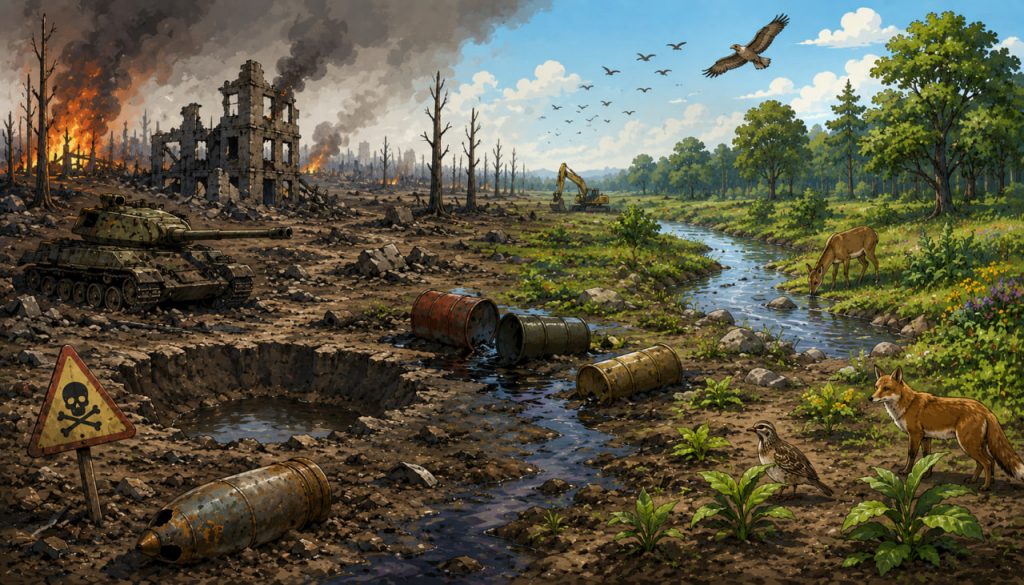
War is often discussed in terms of human casualties, economic losses, and geopolitical consequences. However, armed conflicts also leave lasting scars on the natural environment. Forests are destroyed, rivers become polluted, wildlife habitats disappear, and agricultural lands can remain contaminated for decades after the fighting ends.
Environmental damage caused by war is not a modern phenomenon. Throughout history, military campaigns have transformed landscapes, depleted natural resources, and altered ecosystems. However, modern warfare introduces additional risks through advanced weaponry, industrial infrastructure damage, chemical contamination, and large-scale land disturbance.
Understanding the ecological consequences of war is becoming increasingly important as environmental recovery is recognized as a critical component of post-conflict reconstruction.
Why War Is an Environmental Issue
Military conflicts affect the environment through both direct and indirect mechanisms.
Direct impacts include:
- Explosions
- Fires
- Land destruction
- Chemical releases
- Infrastructure damage
Indirect impacts include:
- Population displacement
- Resource overexploitation
- Breakdown of environmental regulations
- Illegal logging and hunting
- Abandonment of land management systems
Environmental damage often continues long after military operations have ended.
In some cases, ecosystems may require decades to recover.
Soil Damage During Armed Conflicts
Soil is one of the most vulnerable environmental components during warfare.
Explosions and heavy military equipment can physically disrupt soil structure.
Common effects include:
- Soil compaction
- Erosion
- Crater formation
- Loss of fertile topsoil
- Reduced agricultural productivity
Tank movements, fortification construction, and repeated shelling can significantly alter landscapes.
When topsoil is lost, recovery becomes difficult because fertile soil forms extremely slowly under natural conditions.
Some estimates suggest that creating a few centimeters of healthy topsoil may require hundreds of years.
Chemical Contamination of Land
One of the most serious environmental consequences of war involves chemical pollution.
Military activities can introduce numerous contaminants into soils and groundwater.
Potential pollutants include:
- Fuel and oil products
- Heavy metals
- Explosive residues
- Industrial chemicals
- Burned materials
- Construction debris
Heavy metals such as lead, copper, zinc, and other elements may accumulate in affected areas.
These contaminants can enter:
- Crops
- Groundwater
- Rivers
- Food chains
Contaminated soils may remain hazardous long after active fighting ends.
Environmental monitoring is often necessary before damaged land can safely return to agricultural use.
Forest Destruction and Habitat Loss
Forests frequently suffer during military conflicts.
Trees may be removed for:
- Fuel
- Construction materials
- Defensive positions
- Visibility improvement
Additionally, fires caused by explosions can devastate large areas.
The loss of forests creates cascading ecological effects:
- Reduced biodiversity
- Increased erosion
- Altered water cycles
- Habitat fragmentation
- Higher carbon emissions
Wildlife populations often decline rapidly when habitats are disrupted.
Some species may abandon affected regions entirely.
Effects on Wildlife
Animals rarely escape the consequences of armed conflict.
Noise, explosions, vehicle activity, and habitat destruction can alter behavior and migration patterns.
Wildlife may experience:
- Direct mortality
- Stress-related impacts
- Habitat loss
- Food shortages
- Reproductive disruption
Protected areas are not always spared.
National parks and conservation zones can become battlefields or military corridors.
Certain species are particularly vulnerable because they require large territories or stable ecosystems.
The ecological effects of war extend far beyond visible physical destruction.
Water Pollution and Aquatic Ecosystems
Rivers, lakes, wetlands, and groundwater systems can also be heavily affected.
Damage to industrial facilities, pipelines, storage tanks, and wastewater systems may release pollutants into aquatic environments.
Potential consequences include:
- Fish kills
- Oxygen depletion
- Toxic contamination
- Drinking water shortages
- Wetland degradation
Water pollution can spread environmental damage far beyond the immediate conflict zone.
Contaminants transported downstream may affect ecosystems and human communities hundreds of kilometers away.
Climate and Air Quality Impacts
Large-scale military operations can influence air quality and atmospheric conditions.
Sources of emissions include:
- Vehicle fleets
- Aircraft operations
- Fires
- Explosions
- Damaged industrial infrastructure
Smoke from burning facilities can contain:
- Particulate matter
- Toxic compounds
- Greenhouse gases
In extreme cases, prolonged fires may contribute to regional air pollution episodes.
Although the environmental impact varies depending on conflict scale and duration, warfare often generates substantial emissions.
Land Mines and Unexploded Ordnance
One of the most persistent environmental legacies of war is unexploded ordnance.
Land mines and unexploded munitions can remain active for decades.
Their presence creates multiple challenges:
- Prevents agricultural use
- Restricts conservation activities
- Endangers wildlife
- Delays ecosystem restoration
- Limits infrastructure development
Large areas of otherwise productive land may remain inaccessible until costly clearance operations are completed.
Environmental recovery often depends on successful demining efforts.
Can Nature Recover After War?
In many cases, ecosystems demonstrate remarkable resilience.
Natural recovery processes may include:
- Vegetation regrowth
- Wildlife recolonization
- Soil stabilization
- Water quality improvement
However, recovery speed depends on:
- Damage severity
- Contamination levels
- Climate conditions
- Restoration efforts
- Land management practices
Some damaged ecosystems recover within years.
Others may require decades or even centuries.
The most challenging situations involve extensive contamination or permanent landscape alterations.
Expert Perspective
Canadian environmental scientist Arthur H. Westing, one of the pioneers in studying war-related environmental damage, emphasized that environmental destruction should be recognized as a significant consequence of armed conflict rather than merely a secondary effect.
His research demonstrated that ecological damage can influence human well-being long after hostilities cease.
“Environmental degradation caused by war often persists long after peace agreements are signed.”
This observation remains highly relevant today as environmental restoration becomes an increasingly important part of post-conflict recovery.
Environmental Restoration After Conflict
Modern reconstruction efforts increasingly include ecological rehabilitation.
Common restoration measures include:
- Soil remediation
- Reforestation
- Wetland restoration
- Water treatment
- Wildlife conservation
- Pollution monitoring
- Land mine removal
International organizations, governments, and environmental groups often work together to assess environmental damage and develop recovery plans.
Successful restoration not only benefits ecosystems but also supports agriculture, public health, and economic development.
Healthy environments are often essential for long-term peace and stability because communities depend on clean water, fertile soil, and natural resources for recovery.
Interesting Facts
- Some battlefields from the First World War still contain unexploded ordnance more than a century later.
- Forest fires triggered by military activities can sometimes be detected by satellites.
- Certain wildlife populations temporarily increase in abandoned conflict zones due to reduced human activity.
- Soil contamination from warfare may persist for decades.
- Wetlands are particularly vulnerable to pollution caused by damaged industrial infrastructure.
- Environmental restoration is increasingly included in modern peacebuilding programs.
- Some former military areas have later become important wildlife refuges after restoration efforts.
Glossary
- Soil Compaction — Compression of soil that reduces air spaces and limits plant growth.
- Topsoil — The upper, most fertile layer of soil that supports most plant life.
- Heavy Metals — Metallic elements that can become toxic at elevated concentrations.
- Habitat Fragmentation — The division of natural habitats into smaller, isolated areas.
- Ecosystem — A community of living organisms interacting with their environment.
- Remediation — The process of removing or neutralizing environmental contamination.
- Biodiversity — The variety of living organisms within a particular ecosystem.
- Unexploded Ordnance (UXO) — Explosive military devices that failed to detonate as intended.
- Reforestation — The process of restoring forests through tree planting or natural regeneration.
- Environmental Restoration — Actions aimed at repairing damaged ecosystems and ecological functions.