Modern agriculture faces a growing list of challenges. Farmers must produce enough food for a rising global population while dealing with soil degradation, biodiversity loss, water shortages, climate change, and increasing production costs. Traditional farming systems often separate crop cultivation from forestry, treating trees as obstacles rather than valuable assets.
However, an increasingly popular approach known as agroforestry demonstrates that trees and agricultural crops can work together instead of competing. By integrating trees, shrubs, livestock, and crops into the same system, agroforestry can improve productivity, protect the environment, and increase farm resilience.
As concerns about sustainable agriculture continue to grow, agroforestry is attracting attention from researchers, policymakers, and farmers around the world.
What Is Agroforestry?
Agroforestry is a land-use system that deliberately combines trees with agricultural crops or livestock on the same piece of land.
Unlike conventional agriculture, which often removes trees to maximize planting space, agroforestry views trees as productive components of the farming system.
Examples include:
- Fruit trees growing alongside crops
- Timber trees planted around fields
- Livestock grazing among trees
- Windbreaks protecting farmland
- Shade-grown coffee and cocoa systems
The goal is to create interactions that benefit both agriculture and the environment.
Agroforestry seeks to mimic natural ecosystems while maintaining agricultural productivity.
Why Trees Can Benefit Crops
At first glance, trees may seem like competitors for sunlight, water, and nutrients.
However, when properly managed, trees can provide numerous advantages.
Soil Protection
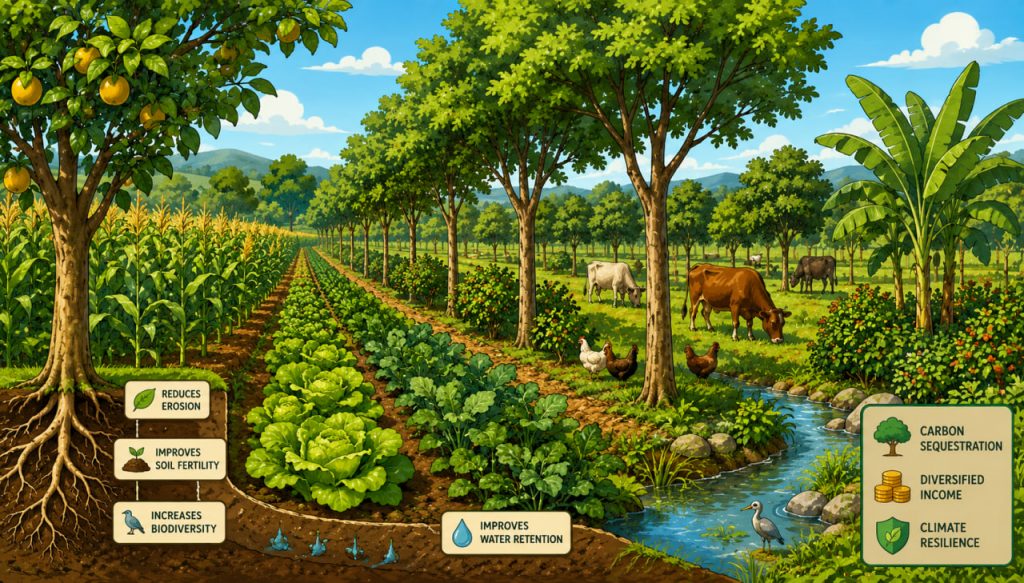
Tree roots stabilize soil and reduce erosion caused by wind and rain.
This is particularly valuable in regions vulnerable to land degradation.
Improved Soil Fertility
Some tree species, particularly legumes, can fix atmospheric nitrogen and enrich soil fertility.
Fallen leaves also contribute organic matter that improves soil structure.
Water Retention
Tree roots help improve water infiltration and reduce surface runoff.
As a result, soils often retain moisture more effectively.
Microclimate Regulation
Trees can moderate temperature extremes.
Shade reduces heat stress on crops during hot periods while decreasing water loss through evaporation.
A well-designed agroforestry system often creates more stable growing conditions than open-field agriculture.
Common Types of Agroforestry Systems
Agroforestry includes several distinct approaches depending on local conditions and farming goals.
Alley Cropping
Rows of trees are planted between strips of agricultural crops.
The trees may provide:
- Timber
- Fruits
- Nuts
- Biomass
Meanwhile, crops continue to grow between the tree rows.
Silvopasture
This system combines trees, forage plants, and livestock.
Animals benefit from shade and shelter, while trees provide additional income sources.
Windbreaks and Shelterbelts
Trees planted along field boundaries reduce wind speed.
Benefits include:
- Reduced soil erosion
- Improved crop protection
- Lower moisture loss
- Increased habitat for wildlife
Forest Farming
High-value crops are cultivated beneath existing forest canopies.
Examples include:
- Mushrooms
- Medicinal plants
- Specialty herbs
This approach allows productive use of forested land while preserving tree cover.
Agroforestry and Climate Change
Climate change is making agricultural production increasingly unpredictable.
Heatwaves, droughts, storms, and shifting rainfall patterns create new risks for farmers.
Agroforestry can improve resilience in several ways.
Carbon Sequestration
Trees absorb carbon dioxide from the atmosphere and store carbon in wood, roots, and soil.
This helps reduce greenhouse gas concentrations.
Drought Resistance
Deep-rooted trees can access water unavailable to many crops.
Improved soil structure also enhances water storage capacity.
Reduced Temperature Stress
Shaded environments can protect crops from extreme heat events.
As climate conditions become more variable, these protective effects become increasingly valuable.
Agroforestry is often viewed as both a climate adaptation and climate mitigation strategy.
Economic Benefits for Farmers
Environmental sustainability alone is rarely sufficient to convince farmers to adopt new systems.
Economic performance matters.
Agroforestry offers several potential financial advantages.
Diversified Income
Farmers may harvest:
- Fruits
- Nuts
- Timber
- Fuelwood
- Medicinal products
This reduces dependence on a single crop.
Reduced Input Costs
Improved soil fertility and water management may reduce expenditures on:
- Fertilizers
- Irrigation
- Erosion control
Risk Reduction
Diversified systems are often less vulnerable to market fluctuations and weather-related crop failures.
A poor harvest in one component may be offset by production from another.
Supporting Biodiversity
Modern agricultural landscapes often contain limited habitat for wildlife.
Agroforestry can help restore biodiversity by providing:
- Nesting sites
- Food resources
- Migration corridors
- Pollinator habitat
Birds, insects, mammals, and beneficial microorganisms frequently benefit from increased tree cover.
Pollinators are particularly important.
Many agricultural crops depend on pollinating insects for optimal yields.
By creating more diverse habitats, agroforestry can support these valuable species.
Challenges and Limitations
Despite its advantages, agroforestry is not suitable for every situation.
Challenges include:
Initial Investment
Tree establishment requires time, labor, and financial resources.
Delayed Returns
Timber and some fruit trees may take years before generating income.
Management Complexity
Combining multiple biological systems requires careful planning.
Farmers must understand:
- Tree species selection
- Crop compatibility
- Water requirements
- Spacing arrangements
Competition Risks
Poorly designed systems can create excessive competition for light, water, or nutrients.
Success depends heavily on proper management.
Expert Perspective
Agroforestry researcher Dr. Dennis Garrity, former Director General of the World Agroforestry Centre, has long advocated for integrating trees into agricultural landscapes.
His work has highlighted how agroforestry can improve food security while restoring degraded ecosystems.
“Trees on farms can help farmers increase productivity, improve resilience, and restore environmental health.”
This perspective reflects a growing consensus among agricultural scientists that sustainable farming systems often benefit from greater ecological diversity.
The Future of Agroforestry
As governments and agricultural organizations search for solutions to climate change and food security challenges, agroforestry is receiving increasing attention.
New technologies are helping farmers design and manage integrated systems more effectively.
These include:
- Satellite monitoring
- Precision agriculture tools
- Soil mapping technologies
- Climate modeling systems
Research continues to identify optimal combinations of tree species, crops, and management practices for different environments.
Many experts believe agroforestry will play an increasingly important role in sustainable agriculture during the coming decades.
Rather than viewing agriculture and forestry as separate industries, agroforestry demonstrates how productive landscapes can support both food production and ecological health simultaneously.
Interesting Facts
- Agroforestry has been practiced for thousands of years in many traditional farming cultures.
- Some shade-grown coffee systems support significantly more biodiversity than conventional plantations.
- Trees can help reduce wind speeds across farmland by more than 50% under certain conditions.
- Agroforestry systems often store more carbon than conventional agricultural fields.
- Deep tree roots can access nutrients unavailable to many annual crops.
- Silvopasture can improve animal welfare by providing shade during hot weather.
- The World Agroforestry Centre conducts research in dozens of countries worldwide.
Glossary
- Agroforestry — A land-use system that combines trees with crops or livestock.
- Silvopasture — An agroforestry practice integrating trees, forage plants, and grazing animals.
- Alley Cropping — Growing crops between rows of trees or shrubs.
- Carbon Sequestration — The process of capturing and storing atmospheric carbon dioxide.
- Nitrogen Fixation — The conversion of atmospheric nitrogen into forms usable by plants.
- Windbreak — A row of trees or shrubs planted to reduce wind speed.
- Biodiversity — The variety of living organisms within an ecosystem.
- Microclimate — Localized climatic conditions that differ from surrounding areas.
- Soil Erosion — The removal of soil by wind, water, or other natural forces.
- Forest Farming — The cultivation of crops beneath an existing forest canopy.