Paper is one of humanity’s most important inventions. It enabled the spread of education, science, literature, and commerce, shaping modern civilization. Despite the rise of digital technologies, global demand for paper products remains enormous. Packaging, hygiene products, books, office supplies, and food containers continue to rely heavily on paper-based materials.
However, paper production comes with significant environmental costs. Pulp and paper mills consume vast amounts of wood, water, and energy while generating waste and emissions that can affect ecosystems and human communities. As concerns about sustainability grow, researchers and industries are increasingly exploring alternatives to traditional paper production.
Understanding both the environmental impact of pulp and paper mills and the potential substitutes for paper is essential for building a more sustainable future.
What Are Pulp and Paper Mills?
Pulp and paper mills are industrial facilities that convert wood and other fibrous materials into paper products.
The process generally involves:
- Harvesting raw materials
- Producing pulp
- Removing lignin and impurities
- Forming paper sheets
- Drying and finishing
Most modern paper is made from wood obtained from managed forests.
Common tree species include:
- Pine
- Spruce
- Birch
- Eucalyptus
The industry operates on a massive scale. Millions of tons of paper are produced annually to meet global demand.
Paper manufacturing supports numerous industries but also places significant pressure on natural resources.
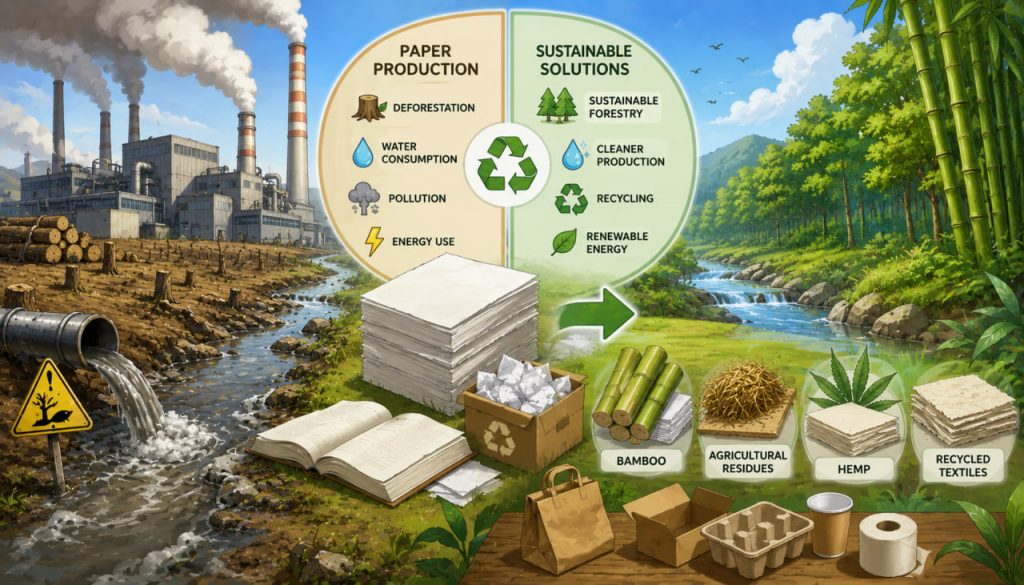
The Problem of Deforestation
One of the most visible environmental concerns associated with paper production is forest harvesting.
Historically, unsustainable logging practices contributed to:
- Habitat destruction
- Biodiversity loss
- Soil erosion
- Carbon emissions
Today, many countries require sustainable forestry practices, and a large proportion of industrial wood comes from managed plantations.
However, challenges remain.
In regions with weak environmental oversight, forest harvesting may still contribute to ecosystem degradation.
Forests provide critical ecological services, including:
- Carbon storage
- Water regulation
- Wildlife habitat
- Climate stabilization
The sustainability of paper production depends heavily on responsible forest management.
Water Consumption and Pollution
Paper manufacturing is highly water-intensive.
Large mills may use millions of liters of water each day during pulp processing, washing, and paper formation.
Wastewater generated by mills can contain:
- Organic matter
- Suspended solids
- Chemical residues
- Nutrients
- Processing by-products
Historically, untreated discharges caused severe pollution in rivers and lakes.
Modern facilities increasingly employ advanced treatment technologies, but environmental risks remain where treatment systems are inadequate.
Water pollution can affect:
- Fish populations
- Aquatic ecosystems
- Drinking water quality
- Recreational water use
As freshwater resources become more valuable globally, reducing industrial water consumption is becoming a major priority.
Air Pollution and Greenhouse Gas Emissions
Paper production also affects air quality.
Potential emissions include:
- Carbon dioxide
- Sulfur compounds
- Nitrogen oxides
- Particulate matter
Older mills were particularly known for unpleasant odors associated with sulfur-based pulping processes.
Although modern pollution-control technologies have significantly reduced emissions, paper manufacturing still requires substantial energy inputs.
Energy consumption contributes to greenhouse gas emissions, especially when fossil fuels are used.
Many companies are now investing in:
- Renewable energy
- Biomass systems
- Energy-efficient equipment
- Carbon reduction strategies
These measures help improve the environmental performance of paper production.
Waste Generation
Paper manufacturing creates various waste streams.
These may include:
- Sludge
- Bark residues
- Ash
- Chemical by-products
- Rejected fibers
Proper waste management is essential to minimize environmental impacts.
Some waste materials can be repurposed for:
- Energy production
- Composting
- Construction materials
- Agricultural applications
The goal is to move toward a circular economy in which waste becomes a resource rather than a disposal problem.
Recycling: A Partial Solution
Paper recycling has become one of the most successful recycling systems worldwide.
Benefits include:
- Reduced landfill use
- Lower demand for virgin wood
- Reduced energy consumption
- Lower water use
- Decreased greenhouse gas emissions
However, recycling has limitations.
Paper fibers degrade each time they are recycled.
After several recycling cycles, fibers become too short and weak for further use.
As a result, new virgin fibers must continually enter the production system.
Recycling significantly reduces environmental impacts but cannot completely eliminate the need for raw materials.
Alternatives to Traditional Paper
Researchers and manufacturers are exploring numerous alternatives to reduce dependence on conventional wood-based paper.
Agricultural Residues
Materials such as:
- Wheat straw
- Rice straw
- Sugarcane bagasse
- Corn stalks
can be processed into paper products.
These materials utilize agricultural waste that might otherwise be discarded or burned.
Bamboo
Bamboo grows much faster than most commercial tree species.
Its rapid growth and high fiber yield make it an attractive renewable resource.
Hemp
Industrial hemp produces strong fibers suitable for papermaking.
Historically, hemp paper was widely used before wood pulp became dominant.
Recycled Textiles
Old cotton and textile waste can be converted into specialty paper products.
This approach reduces both textile waste and demand for virgin fibers.
Can Digital Media Replace Paper?
Many people assume digital technologies will eventually eliminate paper.
The reality is more complex.
Digital systems reduce demand for certain paper products such as:
- Newspapers
- Office documents
- Printed correspondence
However, they also create new environmental challenges.
These include:
- Data center energy use
- Electronic waste
- Device manufacturing impacts
- Resource extraction
Furthermore, e-commerce has increased demand for paper-based packaging.
As a result, global paper consumption has not disappeared despite widespread digitalization.
Expert Perspective
Environmental scientist Vaclav Smil, known for his research on materials and industrial systems, has emphasized that sustainable resource management requires understanding the entire life cycle of products rather than focusing on individual materials alone.
His work highlights that environmental impacts must be evaluated comprehensively.
“There are no completely impact-free materials—only different trade-offs.”
This principle is particularly relevant when comparing paper with alternative materials such as plastics, digital technologies, or emerging bio-based products.
The Future of Sustainable Paper Production
The future of the paper industry will likely involve a combination of strategies.
These include:
- Sustainable forestry
- Increased recycling
- Alternative fiber sources
- Cleaner manufacturing technologies
- Water conservation
- Renewable energy adoption
Researchers are also developing advanced cellulose-based materials capable of replacing plastics in some applications.
These innovations could transform paper from a traditional communication medium into a key component of sustainable manufacturing.
The challenge is not necessarily to eliminate paper, but to produce and use it in ways that minimize environmental impacts while preserving its many societal benefits.
Interesting Facts
- A mature tree can produce thousands of sheets of paper depending on species and size.
- Bamboo can grow more than a meter per day under ideal conditions.
- Paper is among the most widely recycled materials globally.
- Cellulose, the primary component of paper, is the most abundant organic polymer on Earth.
- Some modern packaging materials combine recycled paper with biodegradable coatings.
- Industrial hemp can produce usable fiber much faster than many tree species.
- E-commerce growth has increased demand for paper-based packaging despite digitalization.
Glossary
- Pulp — A mixture of cellulose fibers used to manufacture paper.
- Cellulose — A natural structural polymer found in plant cell walls.
- Lignin — A substance that provides rigidity to plants and is removed during many pulping processes.
- Bagasse — Fibrous residue left after sugarcane stalks are crushed.
- Sustainable Forestry — Forest management practices that maintain ecological health while allowing resource use.
- Biomass Energy — Energy generated from organic materials such as wood residues or agricultural waste.
- Circular Economy — An economic model focused on minimizing waste and maximizing resource reuse.
- Industrial Hemp — A non-intoxicating variety of hemp grown for fiber and industrial applications.
- Greenhouse Gas — A gas that contributes to the warming of Earth’s atmosphere.
- Wastewater Treatment — The process of removing contaminants from industrial or municipal water before release into the environment.