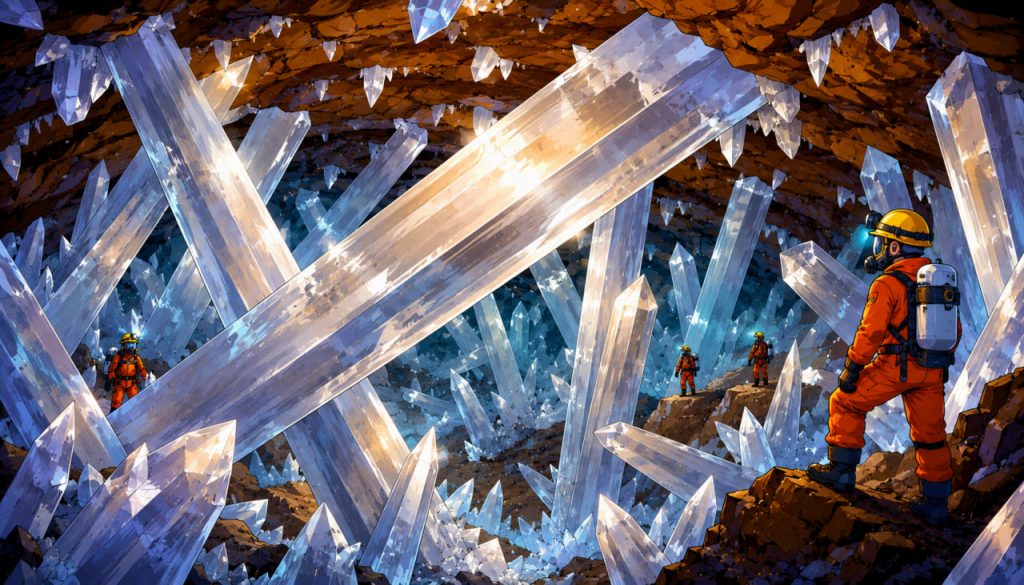
Hidden nearly 300 meters (980 feet) beneath the Chihuahuan Desert in northern Mexico lies one of the most astonishing natural wonders ever discovered—the Cave of the Crystals in the Naica Mine. Inside this extraordinary chamber, enormous transparent gypsum crystals stretch across the cave like giant glass pillars, with some measuring more than 11 meters (36 feet) in length and weighing up to 55 tons.
Discovered accidentally by miners in 2000, the cave immediately fascinated geologists and mineralogists worldwide. Scientists soon realized they had uncovered one of the most remarkable crystal formations on Earth. The Giant Crystals of Naica offer an unparalleled glimpse into geological processes that unfolded slowly over hundreds of thousands of years under highly stable underground conditions.
What Is the Cave of the Crystals?
The Cave of the Crystals is a natural underground chamber located within the Naica Mine in Chihuahua, Mexico.
Unlike ordinary caves formed by flowing water, this chamber is filled with gigantic crystals of selenite, a transparent variety of the mineral gypsum.
The cave measures approximately:
- Around 30 meters (98 feet) long
- About 10 meters (33 feet) wide
- Roughly 10 meters (33 feet) high
Every surface is covered by spectacular crystals growing in multiple directions, creating an almost surreal landscape.
Many scientists consider the Cave of the Crystals to be one of the most beautiful mineral formations ever discovered on Earth.
How Were the Giant Crystals Formed?
The enormous crystals formed through an exceptionally rare combination of geological conditions.
Millions of years ago, volcanic activity heated groundwater beneath the Naica region.
This hot groundwater became saturated with dissolved minerals, especially calcium sulfate.
For an extremely long period, the underground water remained remarkably stable at temperatures close to 58°C (136°F).
These conditions allowed gypsum crystals to grow extraordinarily slowly.
Unlike rapidly formed crystals, which remain small, the Naica crystals experienced uninterrupted growth over hundreds of thousands of years.
The result was the formation of crystals unlike anything else known on Earth.
Why Did They Become So Large?
Crystal size depends heavily on environmental stability.
Several unique factors contributed to the enormous dimensions of the Naica crystals:
- Constant temperature
- Extremely slow crystal growth
- Mineral-rich groundwater
- Minimal geological disturbance
- Nearly saturated chemical conditions
Scientists estimate that some crystals may have taken hundreds of thousands of years to reach their present size.
Because growth occurred so gradually, crystal defects remained minimal, allowing exceptionally clear and massive structures to develop.
The Naica Cave demonstrates what nature can create when geological conditions remain almost perfectly stable for immense periods of time.
One of the Most Extreme Environments on Earth
Although visually breathtaking, the Cave of the Crystals is one of the most dangerous natural environments ever explored.
Before the mine was drained, the chamber remained completely submerged beneath hot groundwater.
After pumping removed the water, researchers gained temporary access.
Inside the cave, conditions are extreme:
- Air temperature around 45–58°C (113–136°F) depending on location
- Humidity approaching 100%
- Very limited evaporation of sweat
These conditions make it extremely difficult for the human body to cool itself.
Without specialized cooling suits and breathing equipment, a person could suffer life-threatening heat stress within minutes.
Scientific expeditions therefore require extensive safety precautions and carefully limited exposure times.
Scientific Importance of the Cave
The Cave of the Crystals provides researchers with valuable information about:
- Crystal growth
- Mineral formation
- Hydrothermal systems
- Geological timescales
- Ancient groundwater chemistry
By studying tiny fluid inclusions trapped inside the crystals, scientists can reconstruct the environmental conditions under which they formed.
These microscopic pockets preserve ancient water that has remained sealed inside the crystals for hundreds of thousands of years.
Some researchers have even investigated microorganisms preserved within these inclusions, providing insight into life surviving in extreme underground environments.
A Delicate Natural Wonder
Once the pumping systems keeping the mine dry are turned off, groundwater gradually begins refilling the underground chambers.
Scientists believe this process is actually beneficial for preserving the crystals.
When submerged, the crystals remain protected from:
- Dust accumulation
- Physical damage
- Temperature fluctuations
- Human interference
Because the cave is so fragile, public access is not permitted.
Nearly all scientific work is conducted under carefully controlled conditions to minimize disturbance.
Protecting this extraordinary geological treasure remains a high priority for researchers.
Similar Crystal Caves Around the World
Although Naica contains the largest known gypsum crystals, smaller crystal caves exist elsewhere.
Examples include:
- Cave of the Swords (also in Naica)
- Gypsum caves in Spain
- Crystal-bearing caves in Italy
- Mineral caverns in Romania
However, none approach the sheer scale of the Naica crystals.
The Cave of the Crystals remains unique because of the combination of crystal size, clarity, and exceptional preservation.
Its discovery significantly expanded scientists’ understanding of how giant mineral crystals can develop.
Expert Perspective
Spanish geologist Dr. Juan Manuel García-Ruiz, one of the world’s leading experts on the Naica crystals, has spent years studying their formation.
His research demonstrated that the crystals grew under exceptionally stable hydrothermal conditions maintained near the transition temperature between the minerals anhydrite and gypsum. According to García-Ruiz, this rare combination of chemistry, temperature, and time allowed the crystals to achieve dimensions that are unmatched anywhere else on Earth.
His work has become a cornerstone of modern mineralogy and continues to guide research into crystal growth under natural conditions.
Why the Naica Crystals Continue to Fascinate Scientists
The Giant Crystals of Naica remind us that Earth’s interior still holds extraordinary surprises.
Although discovered only recently, they represent geological processes operating silently for hundreds of thousands of years beneath the surface.
Future studies of the cave may improve our understanding of:
- Crystal formation
- Underground ecosystems
- Hydrothermal geology
- Planetary mineral formation
- Extreme environments
Scientists also view Naica as a valuable natural analogue for studying crystal growth on other planetary bodies where similar hydrothermal conditions may once have existed.
The Cave of the Crystals remains one of the most spectacular examples of the patience and power of geological time.
Interesting Facts
- Some Naica crystals exceed 11 meters (36 feet) in length.
- The largest crystals weigh an estimated 55 tons.
- The cave was discovered accidentally by miners in 2000.
- Temperatures inside the cave can exceed 45°C (113°F) with nearly 100% humidity.
- Before mining operations lowered the groundwater, the cave remained completely flooded.
- The crystals are composed of selenite, a transparent variety of gypsum.
- The Cave of the Crystals is closed to tourism to protect its fragile environment.
Glossary
- Gypsum — A soft sulfate mineral composed of calcium sulfate dihydrate.
- Selenite — A transparent, high-quality crystalline variety of gypsum.
- Hydrothermal System — A geological system where hot, mineral-rich water circulates through underground rocks.
- Crystal Growth — The gradual process by which atoms or molecules arrange themselves into an ordered crystalline structure.
- Fluid Inclusion — A microscopic pocket of ancient liquid trapped inside a growing crystal.
- Anhydrite — A calcium sulfate mineral that transforms into gypsum under suitable temperature and water conditions.
- Mineralogy — The scientific study of minerals, their composition, structure, and formation.
- Hydrothermal Cave — A cave formed or significantly influenced by hot mineral-rich groundwater rather than ordinary surface water.