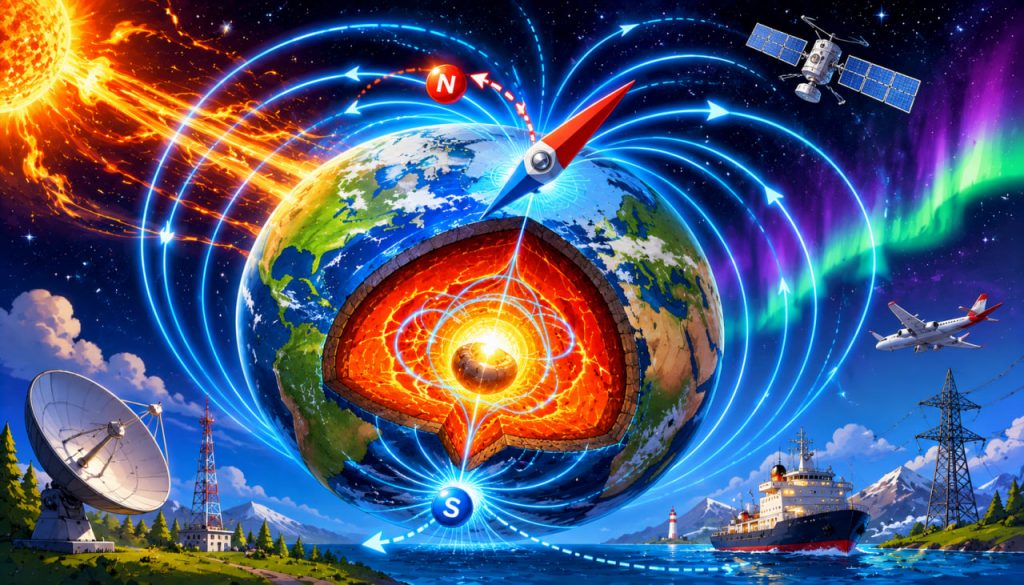
Earth’s magnetic field is one of the planet’s most remarkable natural features. Invisible yet essential, it protects life from harmful solar radiation, guides migratory animals across continents, and enables modern navigation systems to function. However, unlike the geographic North and South Poles, Earth’s magnetic poles are constantly moving. In recent decades, scientists have observed that the magnetic North Pole has been drifting faster than expected, raising questions about whether this movement signals a larger change.
Although headlines sometimes suggest that shifting magnetic poles could lead to catastrophic consequences, the scientific reality is more nuanced. Pole movement is a natural process that has occurred throughout Earth’s history. Understanding why it happens—and what it actually means—helps separate scientific fact from popular misconceptions.
What Are Earth’s Magnetic Poles?
Earth behaves like a giant magnet, producing an invisible magnetic field that extends thousands of kilometers into space.
The magnetic poles are the locations where this magnetic field points vertically downward (North Magnetic Pole) or upward (South Magnetic Pole).
Unlike the geographic poles, which are fixed by Earth’s rotation, magnetic poles continuously shift because the magnetic field itself changes over time.
The magnetic poles are not anchored to Earth’s surface—they are generated deep inside the planet.
As a result, they wander naturally across the Arctic and Antarctic regions.
How Is Earth’s Magnetic Field Generated?
Earth’s magnetic field originates nearly 3,000 kilometers (1,860 miles) beneath the surface within the liquid outer core.
This outer core consists primarily of molten iron and nickel.
As these electrically conductive liquids move because of heat escaping from Earth’s interior and the planet’s rotation, they generate powerful electric currents.
These currents create Earth’s magnetic field through a process known as the geodynamo.
Because the flow of molten metal is constantly changing, the magnetic field also changes over time.
This dynamic system explains why Earth’s magnetic poles never remain in one location permanently.
Why Are the Magnetic Poles Moving?
The movement of the magnetic poles is driven by changes in the flow of molten iron inside the outer core.
Scientists cannot observe the core directly, but measurements from satellites, ground observatories, and mathematical models reveal that the magnetic field evolves continuously.
The magnetic North Pole has moved for centuries, but its speed increased significantly during the late 20th century.
In recent decades, it has migrated from northern Canada toward Siberia at speeds that at times exceeded 50 kilometers (31 miles) per year, although its rate of motion has varied in recent years.
Researchers believe this acceleration is linked to changing patterns of liquid iron flow beneath Earth’s surface.
Why Does the Magnetic Field Matter?
Earth’s magnetic field forms a protective region known as the magnetosphere.
This invisible shield deflects much of the charged particle radiation emitted by the Sun.
Without this protection:
- More solar particles would reach Earth’s atmosphere.
- Satellites would experience greater radiation exposure.
- Astronauts would face increased risks in space.
- Radio communications could become more vulnerable during solar storms.
- Power grids could experience stronger geomagnetic disturbances.
The magnetic field is one of the key reasons Earth’s surface remains a hospitable environment for life.
Could the Magnetic Poles Reverse?
One of the most fascinating aspects of Earth’s magnetic field is that it has completely reversed many times throughout geological history.
During a magnetic reversal, magnetic north becomes magnetic south, and vice versa.
Geological evidence preserved in ancient volcanic rocks shows that hundreds of reversals have occurred over the past several hundred million years.
The most recent complete reversal, known as the Brunhes–Matuyama reversal, occurred approximately 780,000 years ago.
Importantly, reversals do not happen overnight.
Current evidence suggests they unfold gradually over thousands of years rather than days or months.
Would a Magnetic Reversal Be Dangerous?
A common misconception is that a magnetic reversal would immediately cause global catastrophe.
Current scientific evidence does not support this idea.
During a reversal, the magnetic field may temporarily weaken and become more complex before strengthening again with opposite polarity.
Potential effects could include:
- More frequent auroras at lower latitudes.
- Increased radiation exposure for satellites.
- Greater challenges for spacecraft electronics.
- More frequent updates to navigation systems.
- Higher vulnerability of some electrical infrastructure during intense solar storms.
However, there is no evidence that previous magnetic reversals caused mass extinctions or the collapse of life on Earth.
Many reversals occurred while plants and animals continued to thrive.
How Scientists Monitor the Magnetic Field
Earth’s magnetic field is continuously measured using a global network of instruments.
Researchers rely on:
- Ground-based magnetic observatories
- Ocean measurements
- Airborne surveys
- Satellite missions
- Computer simulations
The European Space Agency’s Swarm mission, launched in 2013, consists of three satellites specifically designed to measure Earth’s magnetic field with exceptional precision.
These observations help scientists understand changes occurring deep within the planet’s outer core.
Accurate magnetic models are essential for updating navigation systems used by aircraft, ships, smartphones, and scientific research.
Animals That Depend on Earth’s Magnetic Field
Many animals possess an extraordinary ability known as magnetoreception, allowing them to detect Earth’s magnetic field.
Species believed to use magnetic navigation include:
- Sea turtles
- Migratory birds
- Salmon
- Sharks
- Whales
- Some insects
Scientists continue studying how animals adapt as the magnetic field slowly changes.
Current evidence suggests these species can adjust to gradual shifts in magnetic conditions over time.
Expert Perspective
Geophysicist Dr. Richard Holme of the University of Liverpool, a leading expert on Earth’s magnetic field, has emphasized that the movement of the magnetic poles is a normal consequence of the dynamic processes occurring within Earth’s liquid outer core.
According to Holme, although the recent rapid drift of the magnetic North Pole is scientifically intriguing, there is no evidence that it signals an imminent catastrophic magnetic reversal. Instead, it provides valuable insight into the complex behavior of the geodynamo that generates Earth’s magnetic field.
Research from organizations such as the British Geological Survey (BGS) and the European Space Agency (ESA) supports this understanding, showing that magnetic field variations are a natural part of Earth’s long-term evolution.
Why Understanding Magnetic Pole Movement Matters
Although magnetic pole movement is not considered an immediate threat, it remains an important area of scientific research.
Understanding these changes helps improve:
- Satellite operations
- GPS correction models
- Aviation navigation
- Maritime navigation
- Space weather forecasting
- Geophysical research
As new satellite missions and computer models become increasingly sophisticated, scientists continue refining their understanding of the invisible magnetic shield that protects our planet.
The movement of Earth’s magnetic poles reminds us that even the seemingly solid Earth is a dynamic world, constantly changing deep beneath our feet.
Interesting Facts
- Earth’s magnetic field extends tens of thousands of kilometers into space, forming the magnetosphere.
- The magnetic North Pole has moved hundreds of kilometers over the past century.
- The last complete magnetic pole reversal occurred about 780,000 years ago.
- Magnetic reversals have happened hundreds of times during Earth’s geological history.
- Aurora borealis and aurora australis occur when charged solar particles interact with Earth’s magnetic field.
- The European Space Agency’s Swarm satellites continuously monitor changes in Earth’s magnetic field.
- Some migratory birds can detect magnetic field variations with astonishing sensitivity.
Glossary
- Magnetic Pole — A point where Earth’s magnetic field is directed vertically into or out of the planet.
- Geodynamo — The process by which the motion of molten iron in Earth’s outer core generates the magnetic field.
- Outer Core — Earth’s liquid layer composed mainly of iron and nickel that surrounds the solid inner core.
- Magnetosphere — The region surrounding Earth where its magnetic field protects the planet from charged particles emitted by the Sun.
- Magnetic Reversal — A geological event during which Earth’s magnetic north and south poles switch places.
- Magnetoreception — The ability of certain animals to detect Earth’s magnetic field for navigation.
- Geomagnetic Storm — A disturbance in Earth’s magnetic field caused by increased solar activity.
- Space Weather — Conditions in space influenced by the Sun, including solar flares and streams of charged particles that can affect satellites, communications, and power systems.