Earthquakes are among the most destructive natural disasters on Earth. Unlike hurricanes or floods, they often strike without warning, releasing enormous amounts of energy in just a few seconds. While people cannot prevent earthquakes, modern engineering has shown that well-designed buildings can dramatically reduce the risk of collapse and save countless lives.
Today, earthquake-resistant construction combines advanced materials, flexible structural design, and strict building codes to help homes withstand powerful ground shaking. Whether you live in a high-risk seismic zone or simply want to improve your home’s safety, understanding the principles of earthquake-resistant design can make a significant difference.
Why Do Buildings Collapse During Earthquakes?
Many people assume that earthquakes destroy buildings simply because the ground shakes.
In reality, buildings collapse when they cannot safely absorb and distribute the powerful forces created by rapid ground movement.
During an earthquake:
- The ground moves horizontally and vertically.
- Buildings continue moving because of inertia.
- Walls, beams, and foundations experience enormous stress.
- Weak connections may fail.
- Structural instability can develop rapidly.
The goal of earthquake engineering is not to prevent movement but to allow buildings to move safely without collapsing.
What Makes a House Earthquake-Resistant?
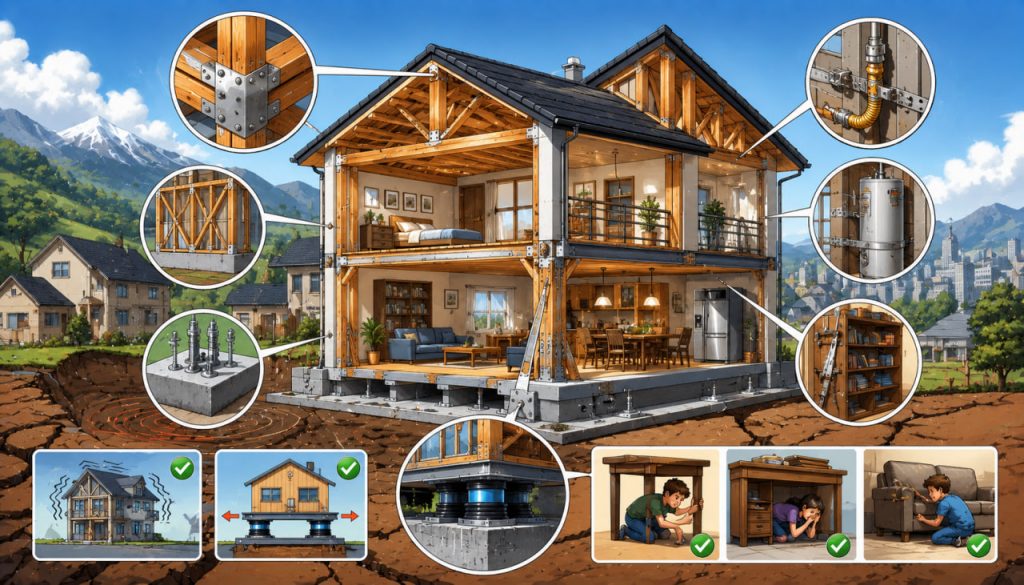
Modern earthquake-resistant homes are designed to be both strong and flexible.
Instead of resisting every force with rigid materials alone, engineers create structures that can absorb and dissipate seismic energy.
Key design principles include:
- Strong foundations
- Continuous load paths
- Flexible framing
- Reinforced walls
- Proper roof connections
- Balanced structural layout
These features work together to reduce the likelihood of catastrophic structural failure.
The Importance of a Strong Foundation
Every earthquake-resistant home begins with a properly designed foundation.
The foundation anchors the building securely to the ground while helping distribute seismic forces evenly.
Engineers often strengthen foundations by using:
- Reinforced concrete
- Steel reinforcement bars (rebar)
- Anchor bolts
- Deep footings where appropriate
In some regions, foundations are specifically engineered according to local soil conditions because soft soils can amplify earthquake shaking.
Flexible Structures Perform Better
One of the biggest advances in earthquake engineering is recognizing that flexibility often improves safety.
A completely rigid building may crack or fail under sudden stress.
Instead, modern structures are designed to bend slightly while remaining intact.
Common techniques include:
- Steel frames
- Engineered timber systems
- Reinforced concrete with ductile detailing
- Cross-bracing systems
- Shear walls
These components allow buildings to deform without suffering major structural damage.
Base Isolation: Letting the Ground Move Beneath the Building
One of the most impressive earthquake-protection technologies is base isolation.
Instead of attaching a building rigidly to its foundation, engineers place special bearings or flexible isolators between the structure and the ground.
During an earthquake:
- The ground moves.
- The isolators absorb much of the motion.
- The building experiences significantly reduced shaking.
Base isolation is commonly used in:
- Hospitals
- Museums
- Government buildings
- Emergency response centers
- Some modern residential buildings
Although more expensive than conventional construction, it provides exceptional protection in high-seismic regions.
Energy Dissipation Systems
Some buildings use devices that function much like automobile shock absorbers.
Known as seismic dampers, these systems absorb part of the earthquake’s energy before it reaches the structure.
Types include:
- Hydraulic dampers
- Friction dampers
- Viscous dampers
- Metallic yielding dampers
These technologies reduce vibrations and help protect both the structure and its occupants.
Making an Existing Home Safer
Many older homes were built before modern seismic standards existed.
Fortunately, several improvements can significantly reduce earthquake risk.
Homeowners should consider:
- Bolting the house to its foundation
- Reinforcing crawl spaces
- Strengthening cripple walls where applicable
- Securing chimneys
- Reinforcing masonry structures
- Installing flexible utility connections
Inside the home, simple safety measures are equally important.
Secure:
- Bookshelves
- Cabinets
- Water heaters
- Refrigerators
- Large televisions
- Heavy mirrors
Preventing furniture from falling can greatly reduce injuries during strong shaking.
Choosing Safe Building Materials
Different construction materials behave differently during earthquakes.
Generally:
Wood
- Lightweight
- Flexible
- Performs well in many earthquakes
Steel
- Strong
- Highly ductile
- Excellent for absorbing seismic energy
Reinforced Concrete
- Extremely strong when properly reinforced
- Widely used worldwide
Unreinforced Masonry
- Brittle
- Vulnerable to collapse
- One of the highest-risk construction types during major earthquakes
Modern building codes often require additional reinforcement whenever masonry is used in seismic regions.
Why Building Codes Matter
Building codes are based on decades of scientific research and lessons learned from past earthquakes.
Countries with advanced seismic building standards—including Japan, New Zealand, Chile, and parts of the United States—have demonstrated that well-designed buildings can survive earthquakes that would have devastated older structures.
Importantly, building codes do not guarantee that a structure will remain undamaged. Instead, they are primarily intended to prevent collapse and protect human life, even during severe shaking.
Following current seismic regulations is one of the most effective ways to reduce earthquake risk.
Expert Perspective
Earthquake engineering pioneer Professor Jack P. Moehle of the University of California, Berkeley, has emphasized that successful seismic design focuses on controlled structural behavior rather than absolute rigidity. His research has helped shape modern international building standards by demonstrating how properly detailed reinforced concrete structures can withstand major earthquakes while protecting occupants.
Organizations such as the Earthquake Engineering Research Institute (EERI) and the U.S. Geological Survey (USGS) also stress that combining strong building codes with proper construction practices is one of the most effective strategies for reducing earthquake-related fatalities and economic losses.
Preparing Beyond Construction
Even the safest house should be part of a broader earthquake preparedness plan.
Families should:
- Prepare emergency supplies
- Know how to shut off gas and electricity if necessary
- Practice earthquake safety drills
- Identify safe shelter locations inside the home
- Keep important documents protected
Combining sound engineering with good emergency planning provides the highest level of protection.
As cities continue growing in seismically active regions, advances in engineering, materials science, and structural design will play an increasingly important role in making homes safer for future generations.
Interesting Facts
- Modern skyscrapers can sway over one meter (3 feet) during strong earthquakes without collapsing.
- Japan is one of the world’s leading countries in earthquake-resistant engineering.
- Base isolation systems can reduce seismic forces on some buildings by more than 50%, depending on the earthquake and design.
- Wood-frame houses often perform surprisingly well because of their flexibility and relatively low weight.
- Some modern buildings use tuned mass dampers—large moving weights that help reduce vibrations during earthquakes and strong winds.
- Engineers study earthquake damage worldwide to improve future building designs.
- Properly secured furniture can significantly reduce injuries during moderate and strong earthquakes.
Glossary
- Earthquake-Resistant Design — Engineering methods that allow buildings to withstand seismic forces while minimizing the risk of collapse.
- Base Isolation — A construction technique that separates a building from ground motion using flexible bearings or isolators.
- Seismic Damper — A device that absorbs earthquake energy to reduce structural vibrations.
- Shear Wall — A reinforced wall designed to resist horizontal forces generated during earthquakes.
- Ductility — The ability of a material or structure to bend and deform without breaking.
- Reinforced Concrete — Concrete strengthened with embedded steel reinforcement bars (rebar) to improve its strength and flexibility.
- Load Path — The continuous route through which structural forces are transferred safely from the roof to the foundation.
- Seismic Retrofit — The process of upgrading an existing building to improve its performance during earthquakes.