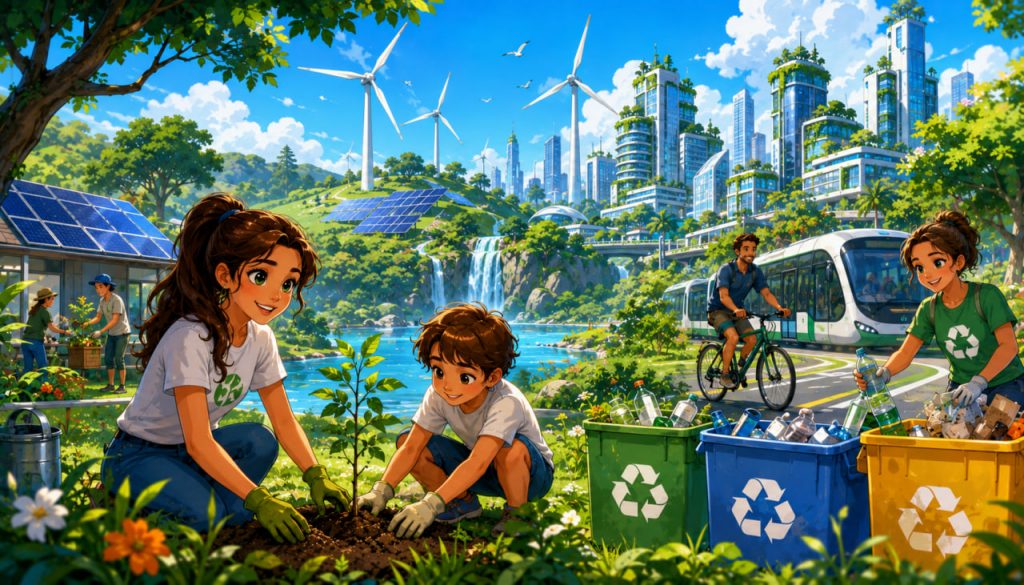
If artificial intelligence were asked how to restore the planet’s ecology, it would not recommend one dramatic action. It would recommend a system-wide strategy: clean energy, smarter cities, healthier food systems, restored ecosystems, less waste, and better environmental laws working together.
Modern environmental science describes today’s crisis as interconnected. Climate change, biodiversity loss, pollution, waste, food systems, water use, and resource extraction all influence one another. UNEP calls this the triple planetary crisis: climate change, nature and biodiversity loss, and pollution and waste.
The main AI-style recommendation would be simple: stop treating ecology as a separate issue and start designing economies, cities, agriculture, and energy systems around planetary health.
First Priority: Cut Fossil Fuel Dependence
The fastest way to reduce environmental damage is to replace coal, oil, and gas with cleaner energy sources. Fossil fuels drive a major share of greenhouse gas emissions and also contribute to air pollution, which is linked to millions of premature deaths every year. WHO reports that the combined effects of outdoor and household air pollution are associated with about 6.7 million premature deaths annually.
AI would recommend accelerating:
- Solar and wind power
- Battery storage
- Modern electrical grids
- Heat pumps
- Energy-efficient buildings
- Clean public transport
- Industrial electrification
Renewables are already expanding quickly. The International Energy Agency reported that renewable electricity is expected to grow faster in more than 80% of countries between 2025 and 2030 than during the previous five-year period, although grids, financing, and supply chains remain major challenges.
The cleanest energy is not only renewable energy, but also energy we do not waste.
Make Cities Greener and Cooler
More than half of humanity lives in cities, so urban design has enormous ecological impact.
AI would recommend turning cities into low-carbon, nature-rich living systems instead of concrete heat traps.
Practical solutions include:
- More trees and urban forests
- Green roofs
- Protected bike lanes
- Reliable public transport
- Walkable neighborhoods
- Better building insulation
- Rain gardens and permeable surfaces
- Urban cooling corridors
Greener cities reduce heat stress, improve air quality, absorb stormwater, support biodiversity, and make daily life healthier.
Instead of designing cities around cars, the smarter model is to design them around people, shade, clean mobility, and local nature.
Restore Forests, Wetlands, Grasslands, and Oceans
Nature is not decoration. It is infrastructure.
Forests store carbon, wetlands filter water, mangroves protect coastlines, grasslands support pollinators, and oceans regulate climate. When ecosystems collapse, people lose food security, clean water, flood protection, and natural climate stability.
IPBES has warned that around one million species may be threatened with extinction, with major drivers including land-use change, exploitation of organisms, climate change, pollution, and invasive species.
AI would recommend large-scale ecosystem restoration, including:
- Reforestation with native species
- Protection of old-growth forests
- Wetland recovery
- River restoration
- Marine protected areas
- Wildlife corridors
- Soil regeneration
- Pollinator-friendly farming
Restoring ecosystems is often cheaper than repairing the damage caused by their destruction.
Fix Food Systems Without Blaming Farmers
Agriculture feeds humanity, but the modern food system also creates major pressure on land, water, climate, and biodiversity.
FAO reports that agrifood systems account for about one-third of total human-caused greenhouse gas emissions, including emissions from farming, land-use change, supply chains, retail, consumption, and food disposal.
AI would recommend a balanced approach:
- Support farmers financially during ecological transitions.
- Reduce food waste.
- Improve soil health.
- Use water more efficiently.
- Protect forests from agricultural expansion.
- Encourage more plant-rich diets.
- Reduce overuse of synthetic fertilizers and pesticides.
- Expand regenerative and precision agriculture.
This does not mean forcing everyone into one diet. It means making healthier, lower-impact food easier, cheaper, and more available.
A sustainable food system must protect both nature and the people who produce our food.
Reduce Waste and Build a Circular Economy
The planet cannot handle endless extraction, production, consumption, and disposal.
UNEP’s Global Waste Management Outlook 2024 warns that municipal solid waste could grow from 2.1 billion tonnes in 2023 to 3.8 billion tonnes by 2050 without urgent action.
AI would strongly recommend shifting from a throwaway economy to a circular economy, where products are designed to last longer, be repaired, reused, recycled, or safely returned to nature.
The priorities are clear:
- Ban or reduce unnecessary single-use products.
- Make repair easier and cheaper.
- Design packaging for reuse.
- Improve recycling systems.
- Compost organic waste.
- Hold producers responsible for product life cycles.
- Reduce overconsumption.
Food loss and waste alone accounts for an estimated 8–10% of global greenhouse gas emissions, while also worsening food insecurity and damaging ecosystems.
Use AI as a Tool, Not as a Substitute for Action
Artificial intelligence can help ecology, but it cannot replace political will, public participation, and real investment.
AI can support:
- Climate modeling
- Deforestation monitoring
- Smart energy grids
- Precision agriculture
- Wildlife tracking
- Pollution detection
- Disaster forecasting
- Waste sorting systems
- Efficient logistics
For example, satellite data combined with machine learning can detect changes in forests, farms, water bodies, and renewable energy infrastructure much faster than traditional monitoring alone.
But AI also consumes energy and resources. That means AI should be used where it produces clear environmental benefits, not as a fashionable label for every project.
Expert Perspective
Professor Johan Rockström, one of the leading scientists behind the planetary boundaries framework, has helped popularize the idea that humanity must remain within Earth’s “safe operating space.” The framework identifies key Earth-system limits, including climate change, biodiversity, land use, freshwater, nutrient cycles, and pollution.
Recent research has found that several planetary boundaries have already been crossed, meaning humanity is pushing Earth systems beyond safer levels of stability.
This expert view fits perfectly with an AI-based recommendation: do not solve climate, food, water, waste, and biodiversity separately. Solve them as one connected planetary system.
What Individuals Can Do Right Now
Systemic change matters most, but individual choices still create demand, culture, and political pressure.
The most useful personal actions include:
- Use less energy at home.
- Eat more plant-rich meals.
- Waste less food.
- Buy fewer unnecessary products.
- Choose durable goods.
- Walk, cycle, or use public transport when possible.
- Support local ecological projects.
- Vote for science-based environmental policies.
- Plant native species.
- Avoid littering and unnecessary plastic.
The goal is not perfect eco-living. The goal is millions of people making better choices while governments and businesses change the systems around them.
What Governments and Businesses Must Do
AI would place the biggest responsibility on institutions with the most power.
Governments can set clean-energy standards, protect ecosystems, fund public transport, regulate pollution, support farmers, and redesign waste systems.
Businesses can reduce emissions, eliminate unnecessary packaging, design repairable products, protect supply chains from deforestation, and publish transparent environmental data.
The most effective ecological strategy combines:
- Strong laws
- Green investment
- Scientific monitoring
- Public education
- Fair economic incentives
- International cooperation
Planetary recovery becomes realistic when ecological responsibility is built into normal economic decision-making.
P.S. We can build a wonderful future together – we just need to not be lazy and transform ourselves for the better to do our best to help those in need and society…
Interesting Facts
- The ozone layer shows that global environmental cooperation can work: coordinated international action helped reduce ozone-depleting substances and supported gradual recovery.
- Trees cool cities not only by providing shade but also through evapotranspiration, releasing water vapor that helps lower surrounding temperatures.
- Wetlands are among the most effective natural systems for filtering water and storing carbon.
- Food waste is not just a household issue; it happens across farms, transport, retail, restaurants, and homes.
- Some cities are now using AI-powered systems to optimize traffic lights, reduce congestion, and lower transport emissions.
- A circular economy does not simply mean recycling more; it means designing waste out of the system from the beginning.
Glossary
- Triple Planetary Crisis – The interconnected global crisis of climate change, biodiversity loss, and pollution.
- Circular Economy – An economic model that keeps products and materials in use for as long as possible through reuse, repair, recycling, and smarter design.
- Biodiversity – The variety of living organisms, including plants, animals, fungi, microorganisms, and ecosystems.
- Renewable Energy – Energy from naturally replenished sources such as sunlight, wind, hydropower, and geothermal heat.
- Regenerative Agriculture – Farming practices designed to improve soil health, biodiversity, water retention, and ecosystem resilience.
- Planetary Boundaries – Scientifically defined limits that describe the safe operating space for humanity within Earth’s natural systems.
- Ecosystem Restoration – The process of helping damaged ecosystems recover their natural structure, function, and biodiversity.
- Greenhouse Gases – Gases such as carbon dioxide, methane, and nitrous oxide that trap heat in the atmosphere and contribute to climate change.