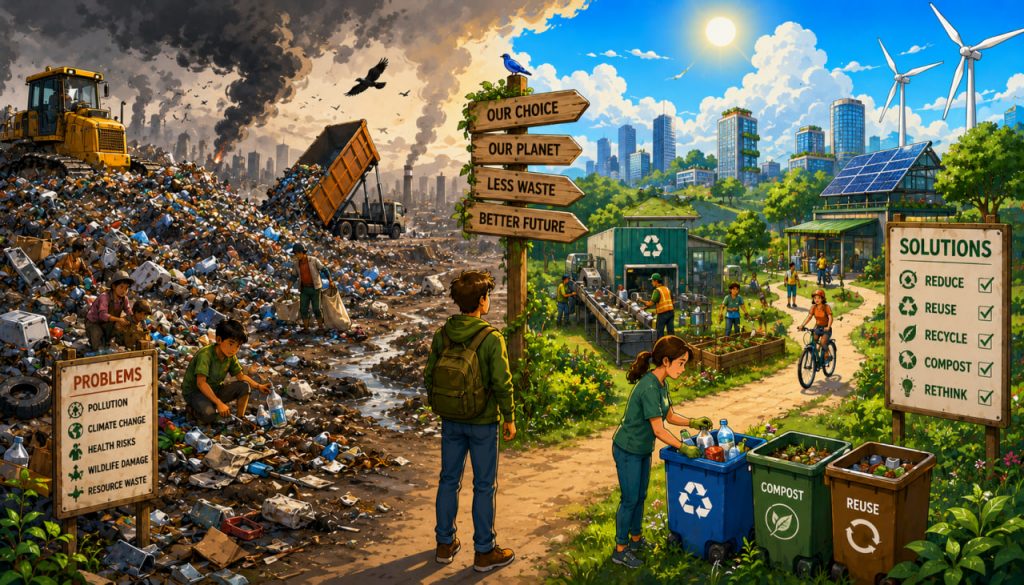
Landfills and uncontrolled dumps have become one of the world’s most visible environmental problems. Every day, cities generate enormous quantities of food waste, packaging, broken products, construction debris, electronics, and other discarded materials.
Some of this waste is recycled, composted, or treated. Much of it is still buried, openly dumped, or burned.
The scale is growing rapidly. The United Nations Environment Programme estimates that global municipal solid-waste generation could rise from 2.1 billion tonnes in 2023 to 3.8 billion tonnes by 2050 unless production and consumption patterns change.
Landfills are not only a problem of appearance or unpleasant odors. Poorly managed waste contributes to climate change, air and water pollution, ecosystem damage, disease risks, and major economic losses.
How Much Waste Does the World Produce?
Recent World Bank data indicate that the world generated approximately 2.56 billion tonnes of municipal solid waste in 2022, reaching a level that earlier projections had not expected until 2030.
Waste generation is increasing because of:
- Population growth
- Urbanization
- Rising incomes
- Disposable products
- Excessive packaging
- Short product lifespans
- Limited repair and reuse
- Growing food consumption
The problem is especially serious where cities expand faster than collection services, recycling facilities, regulations, and sanitary landfills.
According to UNEP, roughly 25% of global waste is left uncollected, while about 39% is not managed in controlled facilities.
This means that hundreds of millions of tonnes may end up in streets, rivers, informal dumps, open fires, or poorly controlled disposal sites.
Sanitary Landfills and Open Dumps Are Not the Same
A modern sanitary landfill is an engineered facility.
Waste is placed in controlled sections, compacted, covered, and separated from surrounding soil by protective barriers. Systems may collect polluted liquid and landfill gas, while monitoring wells help detect environmental problems.
The U.S. Environmental Protection Agency describes modern landfills as carefully located, designed, operated, and monitored facilities for solid-waste disposal.
An open dump is very different.
Waste may be deposited directly onto bare ground without liners, gas collection, leachate treatment, daily cover, or reliable control over hazardous materials. Fires, animals, insects, unstable waste slopes, and informal scavenging are common.
World Bank reporting indicates that around one-third of global waste is either openly dumped or left uncollected. In low-income countries, only a very small share receives formal treatment.
Sanitary landfills reduce environmental risks, but open dumps expose nearby communities and ecosystems directly to them.
Landfills and Climate Change
Organic waste such as food scraps, paper, wood, and garden material decomposes differently inside a landfill than it does in an oxygen-rich compost pile.
Deep inside compacted waste, oxygen becomes limited. Microorganisms then break down organic matter anaerobically, producing methane and carbon dioxide.
Methane is a powerful greenhouse gas. It can continue escaping from waste sites for decades after rubbish has been buried.
Some sanitary landfills collect methane through wells and pipes. The gas can be burned in a flare, used to generate electricity, or upgraded into fuel.
However, gas-collection systems do not capture every emission. Open dumps may have little or no collection infrastructure at all.
Preventing food waste, separating organic materials, composting, and anaerobic digestion can reduce methane more effectively than burying organic matter and attempting to recover the gas later.
Air Pollution From Burning Waste
Open burning is common where regular waste collection is unavailable or disposal sites become overloaded.
People may burn rubbish to reduce its volume, recover metals, clear space, or eliminate odors. Fires can also start accidentally inside dumps and continue underground.
Burning mixed waste can release:
- Fine particulate matter
- Carbon monoxide
- Toxic organic compounds
- Heavy metals
- Dioxins and furans
- Climate-warming pollutants
The World Health Organization warns that exposure to pollution from open waste burning can contribute to coughing, skin irritation, respiratory disease, and other harmful outcomes. Burning can occur at large dumps, small local sites, households, and even along streets.
Children, older people, waste workers, and residents with existing respiratory or cardiovascular illnesses may be particularly vulnerable.
Water and Soil Contamination
Rainwater passing through decomposing rubbish produces a polluted liquid called leachate.
Leachate can contain dissolved organic material, ammonia, salts, metals, chemicals, and microorganisms. In an engineered landfill, it is collected and treated.
At an open dump, the liquid may flow directly into surrounding soil, groundwater, streams, lakes, or coastal waters.
WHO guidance states that improper waste disposal can harm health through contamination of water, soil, and air. Poor collection can also block drainage systems and contribute to environmental and marine pollution.
Blocked drains are particularly dangerous during heavy rainfall because they can worsen urban flooding. Floodwater may then spread waste, sewage, chemicals, and disease-causing organisms through populated areas.
Plastic Escapes Far Beyond the Dump
Plastic waste can remain in the environment for decades or centuries.
Lightweight bags, wrappers, foam, and packaging are easily carried from disposal sites by wind and rain. They enter farmland, rivers, beaches, and oceans.
Larger plastic objects gradually break into smaller fragments rather than disappearing completely. These particles can be consumed by animals and spread through food webs.
The World Bank estimates that nearly 29% of global plastic waste—around 93 million tonnes annually—is mismanaged.
Landfills are therefore connected to marine plastic pollution even when they are located far from the coast.
Human Health and Social Inequality
Waste problems rarely affect all communities equally.
Poorer neighborhoods are more likely to be located near dumps, landfills, transfer stations, incinerators, or polluted industrial zones. Residents may experience truck traffic, noise, smoke, insects, odors, and contaminated water.
Millions of informal waste pickers recover plastic, metal, paper, and other materials from waste streams. Their work provides valuable recycling services and income, but conditions can be extremely dangerous.
Risks include:
- Cuts and crushing injuries
- Smoke exposure
- Medical waste
- Toxic chemicals
- Heavy machinery
- Fires and explosions
- Infectious materials
- Unstable waste slopes
Closing open dumps without providing alternative employment can also remove the income of vulnerable families. Effective reforms therefore need social protection, safer jobs, equipment, training, and integration of informal recyclers into official systems.
The Economic Cost Is Enormous
Waste pollution creates costs that do not always appear in municipal sanitation budgets.
UNEP estimated the direct global cost of waste management at around $252 billion in 2020. When health damage, pollution, and climate effects were included, the total reached approximately $361 billion. Under inadequate action, annual costs could approach $640 billion by 2050.
These costs include medical treatment, lost productivity, flood damage, polluted land, greenhouse-gas emissions, environmental cleanup, and resources wasted through disposal.
At the same time, reusable products, metals, nutrients, plastics, paper, and energy are lost when mixed waste is buried or burned.
A landfill filled with recoverable materials represents both an environmental burden and an economic failure.
Expert Perspective
UNEP’s Global Waste Management Outlook 2024 argues that the world must move beyond simply collecting and disposing of waste. It recommends a lifecycle approach based on preventing waste, redesigning products, expanding reuse, and building a circular economy.
The report estimates that ending uncontrolled disposal, reducing waste generation, and increasing recovery could transform waste management from a growing expense into a system capable of producing substantial net economic benefits by 2050.
The central expert message is clear: better landfills are necessary, but preventing unnecessary waste is far more powerful than managing it after it has already been created.
What Can Be Done About the Global Landfill Problem?
Countries first need universal and reliable waste collection. Without collection, recycling targets and disposal regulations have little practical effect.
The next priority is closing uncontrolled dumps and replacing them with regulated facilities that manage leachate, methane, fires, and hazardous materials.
Cities can further reduce landfill dependence through:
- Separate collection of food and garden waste
- Composting and anaerobic digestion
- Deposit-return systems
- Repair and reuse programs
- Construction-material recovery
- Recycling infrastructure
- Producer responsibility laws
- Restrictions on unnecessary disposable products
- Pay-as-you-throw pricing
- Public procurement of reusable goods
The World Bank supports projects involving expanded collection, dump closure, landfill-gas management, waste separation, recycling, organic-waste diversion, and stronger local governance.
No single technology will solve the crisis. The strongest systems combine prevention, collection, reuse, recycling, biological treatment, safe disposal, enforcement, and public participation.
Interesting Facts
- Global municipal waste could reach 3.8 billion tonnes annually by 2050.
- Around one-quarter of the world’s waste is not collected.
- Waste buried today may continue producing methane for decades.
- Landfill fires can burn below the surface and be difficult to extinguish.
- Closed landfills can sometimes become parks, wildlife areas, or solar-energy sites.
- Organic waste is a major source of landfill methane.
- Wind can transport lightweight plastic many kilometers from a dump.
- Open burning can release pollutants that affect both climate and human health.
- One-third of global waste is estimated to be uncollected or openly dumped.
- A circular-economy approach could reduce environmental damage while creating economic value.
Glossary
- Municipal Solid Waste — Everyday waste produced by households, businesses, institutions, and public services.
- Landfill — A site where waste is placed and permanently contained.
- Sanitary Landfill — An engineered landfill designed to control pollution, gas, liquid, and operational risks.
- Open Dump — An uncontrolled waste-disposal site without adequate environmental safeguards.
- Leachate — Contaminated liquid formed when water passes through waste.
- Landfill Gas — Gas created by decomposing waste, consisting mainly of methane and carbon dioxide.
- Methane — A powerful greenhouse gas produced when organic materials decompose without oxygen.
- Open Burning — Burning waste outdoors without effective emission controls.
- Waste Picker — A person who collects recyclable or reusable materials from discarded waste.
- Anaerobic Digestion — Controlled decomposition of organic material without oxygen, producing biogas and fertilizer-like digestate.
- Waste Diversion — Keeping materials away from landfill through prevention, reuse, recycling, or biological treatment.
- Producer Responsibility — A policy requiring manufacturers to help finance or manage products after consumers discard them.
- Circular Economy — A system designed to keep products and materials in use while minimizing waste and resource extraction.
- Microplastic — A very small plastic particle created intentionally or through the breakdown of larger plastic objects.
- Waste Hierarchy — A preferred order of waste management: prevention, reuse, recycling, recovery, and safe disposal.