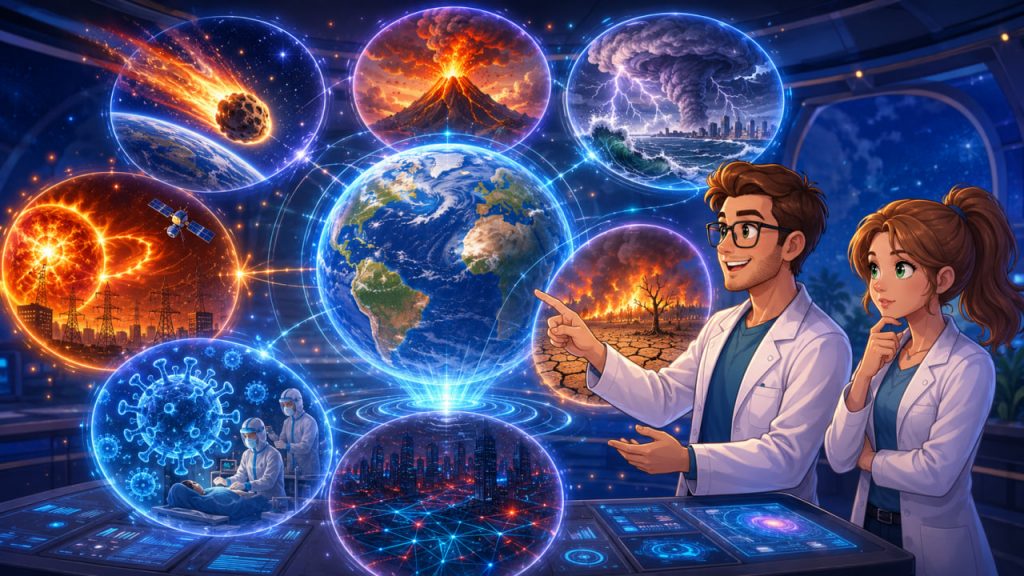
The phrase “doomsday” suggests the sudden destruction of the entire planet. In reality, scientists usually discuss a broader category called global catastrophic risks: events capable of causing worldwide disruption, enormous loss of life, or the collapse of critical systems.
Some scenarios arise from nature, including asteroid impacts, extreme volcanic eruptions, and severe solar storms. Others are created or amplified by human activity, such as nuclear war, engineered pandemics, climate change, and unsafe use of powerful technologies.
Most credible global catastrophes would not literally destroy Earth. Their danger lies in damaging food production, healthcare, energy, communication, government, and international cooperation at the same time.
What Makes a Disaster Global?
A local disaster affects one community or region. A global catastrophe crosses borders and disrupts systems on several continents.
Its consequences may spread through:
- Food and energy shortages
- Financial-market disruption
- International conflict
- Supply-chain failure
- Mass migration
- Healthcare collapse
- Communication outages
- Environmental damage
Modern civilization is highly connected. This creates efficiency, but it also allows problems to travel rapidly.
A drought in one major agricultural region, for example, may raise food prices elsewhere. A semiconductor shortage can affect vehicles, hospitals, communication equipment, and national infrastructure.
The most dangerous scenarios are often cascades in which one crisis triggers several others.
Nuclear War and Nuclear Winter
Nuclear war remains one of the clearest human-made global catastrophe scenarios.
The immediate effects would include blast waves, thermal radiation, fires, and radioactive fallout. A conflict involving major arsenals could destroy cities and overwhelm medical services.
The longer-term danger could extend beyond the attacked countries. Smoke from widespread urban fires might enter the upper atmosphere, reduce sunlight, cool the climate, and damage agricultural production. This proposed effect is known as nuclear winter.
SIPRI warned in 2025 that a new nuclear arms race was emerging as arms-control systems weakened and nuclear forces continued to modernize. Its experts emphasized the danger of escalation, disinformation, and catastrophic miscalculation.
A nuclear conflict does not need to involve every weapon on Earth to create international consequences. Disrupted harvests, trade, transport, finance, and political stability could spread the damage far beyond the war zone.
A Naturally Emerging Pandemic
A future pandemic could begin when an animal pathogen adapts to humans or when an existing human disease develops dangerous new characteristics.
The most concerning pathogen would combine several traits:
- Efficient person-to-person transmission
- Significant illness or mortality
- Transmission before symptoms appear
- Limited existing immunity
- Difficulty detecting early cases
Modern air travel can move an infection between continents before health authorities fully understand it.
The World Health Organization considers pandemic preparedness an urgent global priority and works on surveillance, laboratory capacity, emergency planning, vaccines, diagnostics, and international coordination.
In 2025, WHO member states adopted the Pandemic Agreement to improve cooperation and access to medical products during future health emergencies.
A pandemic becomes especially destructive when biological risk combines with misinformation, weak healthcare systems, political distrust, and shortages of medicines or protective equipment.
Engineered Pathogens and Biological Weapons
Biotechnology provides enormous benefits in medicine, agriculture, and environmental science. However, advanced biological knowledge can also be misused.
A deliberately released pathogen could target people, livestock, or crops. The United Nations Office for Disarmament Affairs notes that biological weapons may cause widespread illness, agricultural losses, food shortages, environmental harm, fear, and social disruption.
An engineered outbreak could be difficult to distinguish initially from a natural epidemic. This uncertainty might delay response and increase tension between governments.
The Biological Weapons Convention prohibits the development, production, and stockpiling of biological and toxin weapons.
Risk reduction depends on laboratory security, responsible research practices, rapid disease surveillance, international investigation, and medical systems capable of responding to both natural and deliberate outbreaks.
Extreme Climate Change
Climate change differs from an asteroid strike because it develops over decades rather than arriving on one day.
Human activity has already caused approximately 1.1°C of global surface warming relative to 1850–1900 during the 2011–2020 period. The IPCC reports that risks increase with every additional increment of warming.
Possible consequences include:
- More dangerous heat
- Drought and water shortages
- Coastal flooding
- Stronger rainfall extremes
- Crop losses
- Ecosystem decline
- Wildfire risk
- Population displacement
Climate change alone is unlikely to make the entire planet uninhabitable in the foreseeable future. Its global catastrophic potential comes from interacting pressures.
Simultaneous crop failures, regional conflict, infrastructure damage, migration, disease, and economic instability could place severe stress on governments and international institutions.
Climate risks can still be reduced through rapid emissions cuts, ecosystem protection, resilient infrastructure, adaptation, and improved disaster planning.
Asteroid or Comet Impact
Large asteroid impacts are rare, but they can be devastating.
An impactor may produce blast damage, intense heat, earthquakes, tsunamis, and airborne dust. A sufficiently large collision could alter the global climate and reduce agricultural production.
NASA continuously searches for and tracks near-Earth objects. Its Sentry system scans current asteroid observations for possible Earth impacts during the next 100 years.
NASA describes asteroid impacts as low-probability but potentially high-consequence events. Many potentially hazardous objects remain undiscovered, especially at smaller sizes.
Unlike many global risks, asteroid impacts may be preventable with enough warning. NASA’s DART mission demonstrated that a spacecraft could deliberately alter the orbit of a small asteroid through a kinetic impact.
Planetary defense depends primarily on discovering a dangerous object years or decades before it arrives.
A Massive Volcanic Eruption
Ordinary volcanic eruptions are usually regional disasters. Extremely large explosive eruptions could have broader effects.
Ash can destroy buildings, contaminate water, damage machinery, and make air travel dangerous. Sulfur gases reaching the stratosphere can form reflective particles that temporarily cool the climate.
USGS explains that a giant Yellowstone-style eruption would cause severe regional ashfall and could produce changes in global climate lasting years or possibly longer. It also stresses that such an event is exceptionally unlikely in any given human lifetime.
The main global risk would not come from lava covering the planet. It would arise from reduced sunlight, disrupted harvests, aviation problems, infrastructure damage, and international food shortages.
Volcano monitoring can provide warnings of unrest, but scientists cannot stop a major eruption.
Severe Solar Storms
The Sun occasionally releases powerful eruptions of plasma and magnetic energy.
When directed toward Earth, these events can create geomagnetic storms. Strong storms may disrupt satellites, radio communication, navigation systems, aviation, and electrical grids.
NOAA explains that geomagnetic disturbances can affect GPS, high-frequency radio, satellites, pipelines, and power infrastructure.
A severe solar storm would not directly kill most people. Its danger would come from technological dependence.
Extended power failures could interfere with:
- Water treatment
- Refrigeration
- Healthcare
- Banking
- Fuel distribution
- Telecommunications
- Transport
- Food supply
Satellites and solar-monitoring spacecraft can provide warnings, giving infrastructure operators time to take protective action. However, warning periods may be limited.
Artificial Intelligence and Systemic Technological Risk
Artificial intelligence can improve science, medicine, emergency response, energy management, and productivity. It can also create new risks when deployed without adequate testing, oversight, or security.
Current concerns include cyberattacks, automated misinformation, unsafe military decision-making, concentration of power, failures in critical infrastructure, and loss of effective human control over increasingly capable systems.
The United Nations’ Independent International Scientific Panel on AI reported in 2026 that AI capabilities are developing faster than many risk-management methods. It identified uncertainty about how advanced systems may behave outside controlled conditions as a major governance challenge.
AI catastrophe scenarios remain more uncertain than established threats such as nuclear weapons or pandemics. It would therefore be misleading to claim that a specific AI-driven disaster is inevitable.
The practical response is stronger evaluation, transparency, cybersecurity, human oversight, international cooperation, and restrictions on particularly dangerous uses.
Global Food-System Collapse
Food shortages can arise from several catastrophes rather than from one independent cause.
A major volcanic eruption, nuclear winter, severe climate extremes, crop disease, energy disruption, war, or trade breakdown could reduce food production and distribution.
Modern agriculture depends on:
- Fuel
- Fertilizer
- Electricity
- Machinery
- Irrigation
- Transport
- Stable trade
- Digital systems
Even when enough food exists globally, political conflict and transport disruption can prevent it from reaching the people who need it.
Food-system resilience requires crop diversity, protected seed collections, emergency reserves, alternative foods, reliable trade agreements, and agricultural systems adapted to extreme conditions.
Cascading Infrastructure Failure
A single event may become catastrophic when it spreads through interconnected infrastructure.
For example, a cyberattack or solar storm could damage electricity networks. Power loss could then disrupt water pumps, mobile networks, hospitals, traffic control, payment systems, and fuel stations.
A prolonged outage could create shortages and civil disorder even without directly destroying physical infrastructure.
This is why resilience planning focuses on backup power, manual controls, spare equipment, decentralized systems, emergency communication, and the ability to restore essential services quickly.
Civilization is most vulnerable when efficiency has removed every backup and every margin of safety.
Expert Perspective
The IPCC emphasizes that climate risks become increasingly complex and difficult to manage when multiple hazards occur together. Risks can cascade across sectors and regions, especially when climate impacts combine with inequality, conflict, or weak institutions.
NASA planetary-defense specialist Amy Mainzer has similarly described asteroid impacts as rare but consequential hazards for which early detection is essential.
Experts in different fields repeatedly reach the same broad lesson: humanity cannot eliminate every threat, but monitoring, prevention, cooperation, and preparation can greatly reduce the damage.
Which Scenario Is Most Likely?
There is no scientifically reliable countdown to a single “doomsday.”
Different risks have different probabilities, timelines, and levels of uncertainty.
Climate-related disruption and new pandemics are more plausible within ordinary planning horizons than a civilization-ending asteroid or super-eruption. Nuclear war is avoidable but could escalate rapidly through political decisions or miscalculation.
AI-related global catastrophe is uncertain, but the technology is developing quickly enough to justify serious preventive governance.
The greatest overall danger may be a combination: climate stress, conflict, disease, misinformation, and infrastructure failure occurring together.
Interesting Facts
- Earth has experienced five widely recognized mass-extinction events in its geological history.
- Most asteroids entering Earth’s atmosphere are too small to reach the ground.
- NASA operates a dedicated Planetary Defense Coordination Office.
- A solar storm caused a roughly nine-hour power outage in Quebec in 1989.
- Large volcanic eruptions can cool Earth temporarily rather than warm it.
- Global seed banks preserve crop diversity for future emergencies.
- Methane remains in the atmosphere for less time than carbon dioxide but has a strong warming effect.
- Biological weapons can target crops and livestock as well as humans.
- A catastrophe does not need to kill everyone to cause the collapse of global systems.
- Early warning is one of the most effective forms of disaster protection.
Glossary
- Global Catastrophic Risk — A threat capable of causing severe damage across much of the world.
- Existential Risk — A risk that could permanently destroy humanity’s long-term potential or cause human extinction.
- Nuclear Winter — Hypothetical global cooling caused by smoke from large nuclear-war fires entering the upper atmosphere.
- Pandemic — An epidemic spreading across multiple countries or continents.
- Engineered Pathogen — A microorganism deliberately modified through biotechnology.
- Biological Weapon — A disease-causing organism or toxin deliberately used to harm humans, animals, or plants.
- Near-Earth Object — An asteroid or comet whose orbit brings it relatively close to Earth.
- Planetary Defense — Detection, tracking, and possible deflection of objects that could strike Earth.
- Super-Eruption — An exceptionally large explosive volcanic eruption with widespread consequences.
- Geomagnetic Storm — A disturbance in Earth’s magnetic environment caused by activity from the Sun.
- Critical Infrastructure — Essential systems such as electricity, water, healthcare, transport, and communications.
- Cascading Failure — A process in which failure in one system triggers failures in connected systems.
- Resilience — The ability to resist, adapt to, and recover from disruption.
- Food Security — Reliable access to sufficient, safe, and nutritious food.
- Risk Mitigation — Measures taken to reduce the probability or consequences of a harmful event.