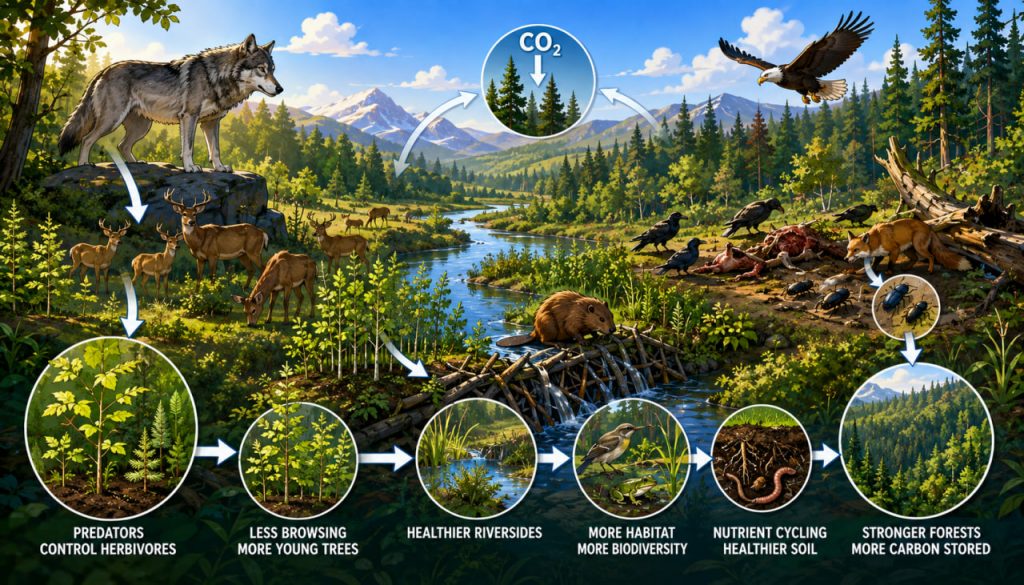
Predators are often portrayed as animals that simply hunt and kill. In reality, wolves, lynx, big cats, birds of prey, and other carnivores can influence entire landscapes.
By regulating herbivores, changing prey behavior, limiting smaller predators, and providing food for scavengers, predators help maintain the ecological conditions that allow young trees and shrubs to survive.
This chain of effects is known as a trophic cascade. It explains why protecting predators can support forest regeneration, biodiversity, riverbanks, soils, and even carbon storage.
Healthy forests depend not only on trees and rainfall, but also on balanced relationships between predators, herbivores, plants, and decomposers.
Predators Control Pressure From Herbivores
Deer, elk, moose, and other large herbivores are natural parts of forest ecosystems. They browse leaves, shoots, bark, and seedlings and can help shape vegetation.
Problems arise when herbivore populations become too numerous or remain concentrated in the same places for long periods.
Young trees are particularly vulnerable. Repeated browsing may prevent seedlings from growing beyond the reach of animals. Even when mature trees remain standing, the next generation of forest can gradually disappear.
Research on vegetation restoration has shown that herbivores can strongly reduce plant recovery, particularly in degraded ecosystems. A global analysis published in Science found that herbivory substantially limited vegetation abundance at restoration sites.
Predators help reduce this pressure by hunting herbivores and keeping their populations closer to levels that the habitat can support.
The “Landscape of Fear” Changes Animal Behavior
Predators influence prey even when no animal is killed.
Herbivores become more alert when predators are present. They may avoid exposed riverbanks, dense cover, narrow valleys, or other locations where escape is difficult.
They also tend to move more frequently instead of feeding continuously in one small area.
This behavioral influence is sometimes called the landscape of fear. Experimental research has shown that fear of large carnivores can alter where ungulates spend time, producing effects that pass through the food web.
As grazing and browsing pressure becomes more dispersed, young trees gain periods in which they can grow.
Predators therefore protect vegetation through both direct predation and changes in herbivore behavior.
How Trophic Cascades Support Forest Regeneration
A trophic cascade occurs when changes at one level of a food web affect organisms at lower levels.
A simplified forest cascade may look like this:
- Predators influence deer or elk.
- Herbivores browse fewer seedlings in sensitive locations.
- Willow, aspen, oak, and other plants regenerate more successfully.
- More vegetation provides habitat for birds, insects, and small mammals.
- Roots stabilize soil and stream banks.
- Leaf litter feeds fungi and soil organisms.
The process is not identical in every forest. Climate, hunting, fire, water availability, livestock, human activity, and the number of herbivores all affect the outcome.
However, scientific research increasingly shows that restoring top-down ecological interactions can support vegetation recovery. A 2023 study highlighted by Science found that predator reintroduction may help restore vegetation by reducing the effects of herbivores.
Wolves and Forest Recovery in Yellowstone
Yellowstone National Park is the best-known example of predators influencing vegetation.
Wolves were reintroduced to the park in 1995 after being absent for decades. Elk form a major part of the Yellowstone wolf diet, especially during winter.
Following wolf restoration, researchers observed changes in elk numbers, distribution, and behavior. In some locations, willows and aspens began growing taller, suggesting that reduced browsing contributed to vegetation recovery.
The National Park Service notes that correlations have been observed between wolf presence and increased willow growth, although the strength of the effect varies across Yellowstone’s complex landscape.
Rainfall, groundwater, beavers, bears, human hunting, and weather also influence the ecosystem. Wolves are therefore not the only cause of forest change, but they restored an important ecological force that had been missing.
Predators Can Help Beavers Return
When willows and other riverside plants recover, beavers receive more food and building material.
Beaver dams slow streams, create ponds, retain water, and support wetlands. These wetlands can provide habitat for fish, amphibians, waterfowl, insects, and mammals.
Research has also shown that wolves can influence wetland creation through their effects on prey and beavers. One study demonstrated that wolf predation altered where beavers established wetlands by changing prey availability and ecosystem conditions.
This reveals an important ecological sequence:
Predators influence herbivores, vegetation supports beavers, and beavers reshape water systems.
The final result may extend far beyond the original predator-prey interaction.
Stronger Vegetation Protects Soil and Water
Forests are more than collections of trunks and leaves. Their roots hold soil together, reduce erosion, filter water, and slow surface runoff.
When herbivores remove too much vegetation from riverbanks, exposed soil can wash into streams. Channels may become wider, warmer, and less stable.
If shrubs and young trees return, their roots help reinforce the banks. Overhanging vegetation creates shade, while fallen leaves and branches provide food and shelter for aquatic organisms.
Predators can therefore indirectly contribute to cleaner water, more stable streams, and healthier floodplains.
These benefits are especially valuable during droughts and heavy rainfall, when well-vegetated landscapes are better able to retain water and resist erosion.
Predators Regulate Smaller Carnivores
Large predators also influence medium-sized predators known as mesopredators.
When apex predators disappear, foxes, raccoons, coyotes, or other adaptable carnivores may increase in number or expand their range. This phenomenon is called mesopredator release.
Growing mesopredator populations can place additional pressure on birds, reptiles, eggs, and small mammals.
Large carnivores may reduce or displace these smaller predators, helping preserve a more balanced food web. The recovery of top predators can therefore benefit species that are not directly connected to trees but remain essential to forest biodiversity.
For example, birds and small mammals may distribute seeds, control insects, and provide food for other wildlife.
Predator Kills Feed the Wider Forest Community
A carcass left by a wolf, cougar, or other predator becomes a temporary center of biological activity.
Ravens, eagles, foxes, beetles, flies, and numerous scavengers consume the remains. Bacteria and fungi break down material that is left behind.
Nutrients eventually return to the soil, where they can support plant growth.
Predators may also provide scavengers with food during winter or other periods when resources are scarce. Their kills distribute energy through the ecosystem rather than benefiting only the predator itself.
A single act of predation can feed dozens of organisms and transfer nutrients across the landscape.
Predators May Support Carbon Storage
Growing forests remove carbon dioxide from the atmosphere and store carbon in wood, roots, and soil.
When excessive herbivory prevents tree regeneration, the forest may store less carbon over time. By reducing browsing pressure, predators can indirectly help woody vegetation survive and mature.
The strength of this effect differs between ecosystems, but the principle is important: animals can influence the carbon cycle by changing vegetation.
Predator conservation should therefore be viewed not only as wildlife protection but also as part of broader ecosystem restoration.
Expert Perspective
Ecologist Jens-Christian Svenning and his colleagues describe trophic rewilding as the restoration of top-down ecological interactions through the return of important animals. Their research emphasizes that trophic cascades provide a major scientific framework for understanding how large animals influence vegetation and ecosystem processes.
The central lesson is that forests cannot always be restored by planting trees alone.
Long-term recovery often requires rebuilding the ecological relationships that allow those trees to survive.
Why Predator Protection Requires Careful Management
The return of predators can create challenges for livestock owners, hunters, and communities living near wild habitats.
Successful conservation may require livestock-guarding animals, secure nighttime enclosures, compensation programs, wildlife corridors, public education, and rapid responses to repeated conflicts.
Predators also need enough connected habitat to find prey, reproduce, and avoid dangerous encounters with people.
Protecting carnivores without protecting their habitat is rarely sufficient. Forest restoration must therefore combine predator conservation with responsible land use, community cooperation, and long-term monitoring.
Interesting Facts
- Predators can influence plants without directly interacting with them.
- The fear of predators may change where and when herbivores feed.
- Young seedlings are often more vulnerable to browsing than mature trees.
- Wolf kills provide food for birds, mammals, insects, fungi, and microorganisms.
- Recovering riverside vegetation can create better conditions for beavers.
- Beaver wetlands can store water and support many species.
- Large predators may prevent medium-sized carnivores from becoming overly abundant.
- Trophic cascades can occur in forests, grasslands, rivers, oceans, and coastal ecosystems.
- Forest recovery after predator restoration may take years or decades.
- Planting trees is less effective when uncontrolled herbivores repeatedly eat the seedlings.
Glossary
- Predator — An animal that hunts and consumes other animals.
- Herbivore — An animal that feeds mainly on plants.
- Apex Predator — A predator occupying the highest level of a food web, with few or no natural predators.
- Trophic Cascade — A chain of ecological effects that moves through several levels of a food web.
- Browsing — Feeding on leaves, shoots, bark, and woody vegetation.
- Forest Regeneration — The growth of new trees that replace older or lost forest.
- Landscape of Fear — Changes in prey behavior and habitat use caused by the perceived risk of predation.
- Mesopredator — A medium-sized predator occupying a level below an apex predator.
- Mesopredator Release — An increase in smaller predators following the decline or disappearance of larger predators.
- Riparian Zone — Vegetated land beside a river, stream, or other body of water.
- Scavenger — An organism that consumes dead animals.
- Rewilding — The restoration of natural processes, habitats, and missing species.
- Trophic Rewilding — The restoration of ecological interactions by returning influential animals to an ecosystem.
- Carbon Sequestration — The capture and long-term storage of carbon in vegetation, soils, oceans, or geological formations.