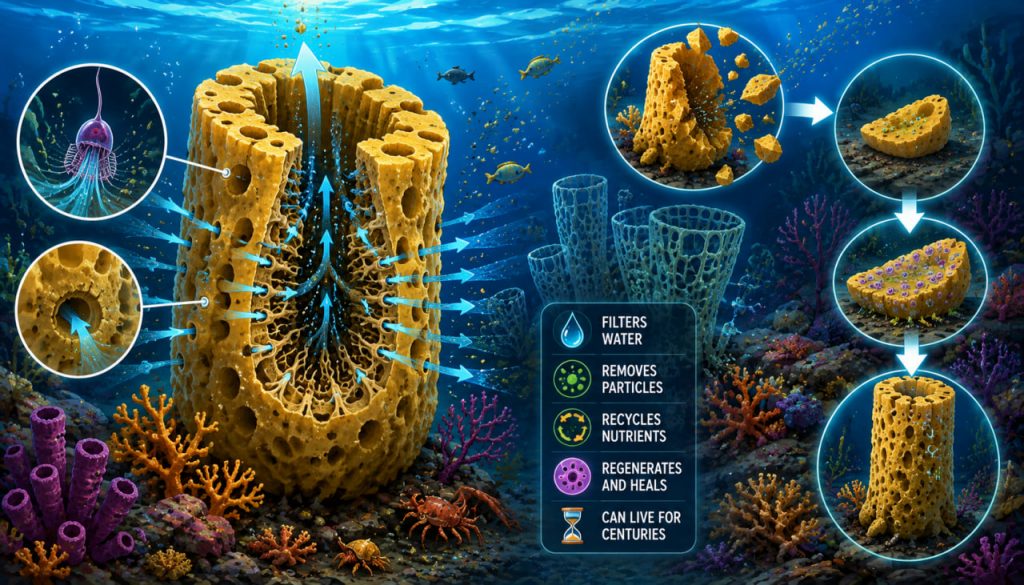
Marine sponges may look like simple, motionless objects attached to the seafloor, but they are among the most remarkable animals on Earth. They have no brain, heart, lungs, or conventional digestive system. Instead, their bodies operate as living filtration networks capable of processing enormous volumes of seawater.
Some deep-sea and glass sponge species can survive for centuries. Their unusual cellular organization also allows many sponges to repair severe injuries, reorganize displaced cells, and sometimes rebuild functional body structures from small fragments.
Sponges are not literally immortal, but their slow metabolism, continuous cell renewal, flexible body organization, and exceptional regenerative abilities can give certain species extraordinary lifespans.
What Exactly Is a Marine Sponge?
Sponges belong to the animal phylum Porifera, a name meaning “pore bearer.” Their bodies contain thousands or millions of tiny openings through which water enters.
Unlike most animals, sponges do not have true organs. Their bodies are composed of specialized cells embedded within a flexible supporting material called the mesohyl.
Most species are fixed permanently to rocks, reefs, shells, or other hard surfaces. Although an adult sponge cannot swim away from danger, it continuously interacts with the surrounding ocean through water circulation.
There are several major groups of sponges, including demosponges, calcareous sponges, and glass sponges. Glass sponges build delicate skeletons from silica and are especially common in cold, deep marine environments.
How Sponges Filter Water
A sponge functions like a highly efficient biological pump.
Water enters through microscopic pores called ostia and travels through a system of canals and chambers. These chambers are lined with specialized cells called choanocytes.
Each choanocyte has a moving flagellum surrounded by a collar of fine structures. The beating flagella create a current that pulls water through the sponge.
The collar captures bacteria, microscopic algae, organic particles, and other suspended material. Nutrients are then engulfed and digested inside individual cells.
Filtered water leaves through one or more larger openings called oscula.
Some sponges can filter tens or even more than 100 litres of water per hour for every litre of sponge tissue, although filtration rates vary substantially among species and environmental conditions.
Instead of searching for food, a sponge brings an almost continuous stream of food and oxygen through its own body.
Why Sponge Filtration Matters to the Ocean
Sponges remove bacteria, plankton, organic debris, and extremely small particles from seawater.
This filtration can improve water clarity and transfer suspended nutrients into forms that other organisms can use. Waste products released by sponges may feed microbes, algae, and animals living nearby.
Sponges also participate in nutrient cycling. They process carbon, nitrogen, silicon, and other elements, helping move material between the water column and the seafloor.
On coral reefs, sponge activity can retain dissolved organic matter that might otherwise leave the ecosystem. This transformed material can later become food for detritivores and other reef organisms.
Large sponge communities therefore function as living infrastructure, influencing water chemistry, food webs, and nutrient availability.
The Unusual Architecture Behind Regeneration
Most animals depend on highly organized tissues and organs. Damage to a vital organ can be fatal because its specialized structure is difficult to replace.
Sponges are organized differently.
Many of their cells retain considerable flexibility and can change function when required. Mobile cells within the mesohyl transport nutrients, remove waste, produce skeletal material, and participate in repair.
After injury, cells migrate toward the damaged area. They close wounds, rebuild canals, restore feeding chambers, and recreate the outer protective layer.
Some sponge cells can transform into other cell types through processes known as dedifferentiation and transdifferentiation. This cellular adaptability is one reason sponge regeneration is so powerful.
Research on Porifera has made sponges important models for studying the evolution of regeneration, cellular ageing, and the transition between highly renewable and more limited somatic tissues.
Can a Sponge Rebuild Itself From Separated Cells?
Classic experiments demonstrated that cells from certain sponge species can be mechanically separated and later reassemble.
Initially, the cells form clusters. They then sort themselves according to type, establish internal organization, rebuild water canals, and eventually create functional sponge-like structures.
Scientists call some of these three-dimensional cellular aggregates primmorphs.
This ability does not mean that every isolated sponge cell can always produce a complete adult. Success depends on the species, cell composition, environmental conditions, and experimental method.
Nevertheless, the phenomenon reveals how little sponge identity depends on a fixed body plan.
A sponge behaves less like a machine made from permanently assigned parts and more like a cooperative cellular community capable of reorganizing itself.
Are Sponges Truly Immortal?
The word “immortal” is scientifically misleading.
Sponges can die from disease, starvation, extreme temperature, pollution, sediment burial, destructive fishing, predation, or physical damage. Some shallow-water species live only a few years.
However, certain slow-growing deep-sea species may survive for centuries.
A NOAA guide reports that the glass sponge Acanthascus dawsoni may live for more than 200 years, while another glass sponge, Aphrocallistes vastus, can survive for over a century.
Age estimates are difficult because sponges usually lack obvious annual growth rings. Researchers may estimate age using growth rates, body size, skeletal analysis, radiocarbon methods, or observations of organisms growing on structures of known age.
Studies of Caribbean reef sponges also show that not all large sponges are ancient. Some species can grow to substantial sizes within only several years, demonstrating that size alone is an unreliable measure of age.
Why Some Sponges Can Live So Long
Several biological and environmental factors may support extreme longevity.
Deep-sea sponges often live in cold, stable environments. Low temperatures can slow metabolism and reduce the rate of many chemical reactions associated with cellular damage.
Many species grow extremely slowly and invest energy in maintenance rather than rapid movement or reproduction.
Sponges also renew cells continuously. Damaged or ageing cells can be removed and replaced without reconstructing an entire complex organ.
Their modular structure provides another advantage. Losing one section does not necessarily destroy the whole animal. Surviving tissue may continue filtering water and gradually regenerate.
Some sponge cells also maintain telomerase activity. Telomerase helps preserve telomeres, the protective structures at chromosome ends that become shorter during repeated cell division in many animals. Sponge research has therefore contributed to scientific investigations of cellular longevity and senescence.
Glass Sponges: Ancient Architects of the Deep
Glass sponges produce skeletons made from silica, the same basic material found in glass.
Their skeletal elements, called spicules, can join into intricate lattice-like frameworks. These structures are strong, lightweight, and capable of remaining on the seafloor after the sponge dies.
In some regions, generations of glass sponges have formed extensive reef structures.
Living glass sponge reefs discovered off the coast of British Columbia are built on foundations thousands of years old. NOAA reports that these approximately 9,000-year-old reefs were discovered in 1987 after scientists had believed this type of reef had disappeared from the planet millions of years ago.
The reefs provide habitat and shelter for fish, crustaceans, and other marine organisms.
The reef itself may be ancient even though individual living sponges are younger than the complete structure.
Sponges and Their Microbial Partners
A sponge is not always a single biological entity acting alone.
Many species host large communities of bacteria, archaea, fungi, and other microorganisms. In some sponges, microbes can account for a substantial part of the organism’s total mass.
These microorganisms may help process nutrients, produce defensive chemicals, recycle waste, or perform photosynthesis in shallow illuminated waters.
The sponge provides shelter and a continuous flow of seawater, while microbial partners contribute metabolic abilities that the animal does not possess independently.
This partnership is sometimes described as a sponge holobiont: the sponge and its associated microorganisms functioning as an ecological unit.
Why Powerful Regeneration Does Not Make Sponges Invulnerable
A sponge may recover from a small cut or partial breakage, but severe disturbance can still destroy it.
Bottom trawling, anchors, mining equipment, and sediment movement can crush sponge structures or remove them from the seafloor.
Deep-sea species are particularly vulnerable because their slow growth means damaged habitats may require decades or centuries to recover. NOAA describes slow growth, exceptional longevity, and infrequent recruitment as characteristic of many deep-sea coral and sponge ecosystems.
Regeneration also requires energy. A sponge exposed to repeated injury, pollution, oxygen shortage, or prolonged temperature stress may be unable to repair itself.
Exceptional biological resilience should never be confused with protection from unlimited environmental damage.
Expert Perspective
Marine biologists increasingly study sponges as models of whole-body regeneration and cellular plasticity.
Their ability to rebuild functional structures from fragments and cellular aggregates offers clues about how the earliest multicellular animals coordinated cell identity, wound repair, and tissue organization.
Research has also connected sponges with investigations into telomerase, biomaterials, regenerative medicine, and the evolutionary origins of ageing.
The deeper scientific lesson is that sophisticated biological performance does not always require a brain or conventional organs. A decentralized network of adaptable cells can maintain a living animal for astonishing periods.
Interesting Facts
- Sponges are animals, even though they have no brain, heart, or muscles like those of most familiar animals.
- Most sponges feed by filtering microscopic material from seawater.
- Some deep-sea glass sponges may live for more than 200 years.
- Glass sponge skeletons are made primarily from silica.
- Living glass sponge reefs off British Columbia grow on reef structures estimated to be about 9,000 years old.
- Certain sponge cells can change their roles during regeneration.
- Some sponge fragments can attach to a new surface and continue growing.
- Not every sponge is a filter feeder; scientists have identified more than 150 species of carnivorous deep-sea sponges.
- Sponge-associated microorganisms can help process nutrients and produce biologically active compounds.
- A sponge’s canal system can reorganize after damage to restore water flow.
Glossary
- Porifera — The animal phylum containing all sponges.
- Ostia — Microscopic pores through which water enters a sponge.
- Osculum — A larger opening through which filtered water leaves the sponge.
- Choanocyte — A flagellated sponge cell that generates water currents and captures food.
- Flagellum — A whip-like cellular structure that produces movement or fluid flow.
- Mesohyl — The flexible internal material containing mobile cells, skeletal elements, and fibres.
- Spicule — A microscopic skeletal structure made from silica or calcium carbonate.
- Primmorph — A three-dimensional aggregate of sponge cells used in regeneration and laboratory research.
- Dedifferentiation — The process by which a specialized cell returns to a less specialized state.
- Transdifferentiation — The conversion of one specialized cell type into another.
- Telomere — A protective structure at the end of a chromosome.
- Telomerase — An enzyme that helps maintain telomeres during cell division.
- Senescence — The gradual biological deterioration associated with ageing.
- Holobiont — A host organism together with the community of microorganisms living in or on it.
- Filter Feeder — An animal that obtains food by removing suspended particles from water.