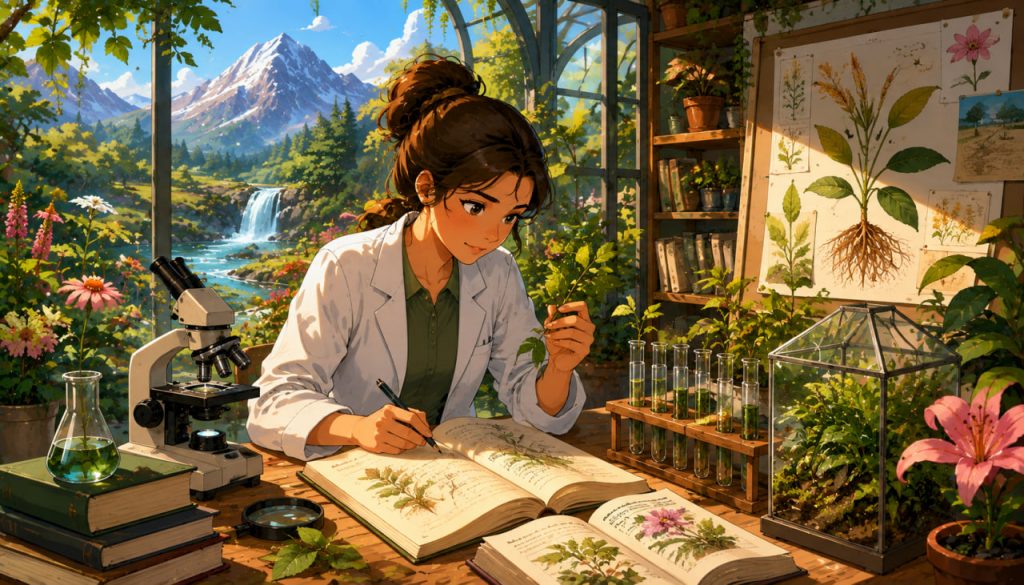
Botany is the scientific study of plants—the organisms that shape landscapes, feed civilizations, regulate ecosystems, and supply materials used in medicine, construction, clothing, and industry.
It is far more than the study of flowers or the identification of trees. Modern botanists investigate plant cells, genetics, reproduction, evolution, chemistry, ecology, diseases, and responses to climate change.
Understanding plants is essential because nearly every terrestrial food chain and human society ultimately depends on them.
What Is Botany?
Botany, also called plant science, examines the form, function, development, diversity, reproduction, evolution, and practical uses of plants, as well as their interactions with the biosphere.
Traditional botany focused heavily on describing and classifying plants. Modern research also uses molecular biology, genetics, satellite imagery, computer modeling, chemistry, and advanced microscopy.
Depending on the research question, botany may include the study of:
- Trees, shrubs, and flowering plants
- Ferns, mosses, and liverworts
- Conifers and cycads
- Algae
- Plant-associated microorganisms
- Fungi in certain historical or applied contexts
Botany overlaps with agriculture, forestry, ecology, medicine, genetics, environmental science, and biotechnology.
Why Plants Are Essential to Life
Plants capture energy from sunlight and convert it into chemical energy through photosynthesis.
This process supports most food webs. Herbivores obtain energy by eating plants, while predators depend indirectly on the vegetation consumed by their prey.
Plants also release oxygen, absorb carbon dioxide, influence water cycles, stabilize soils, create habitats, and moderate local climates.
Human societies rely on plants for:
- Food and animal feed
- Timber and paper
- Fibers such as cotton and flax
- Oils, spices, and beverages
- Medicines and pharmaceutical compounds
- Rubber, dyes, resins, and fuels
The United States Botanic Garden notes that people depend on plants for food, clothing, shelter, energy, medicine, and many other critical resources.
Botany helps us understand not only how plants survive, but how human civilization survives through them.
Plant Anatomy and Morphology
Plant anatomy examines internal structures, while morphology focuses on external form.
The major organs of many plants include roots, stems, leaves, flowers, fruits, and seeds.
Roots anchor the plant, absorb water and minerals, store nutrients, and interact with fungi and soil microorganisms.
Stems support leaves and reproductive structures. They also contain vascular tissues that transport substances through the plant.
Leaves are usually the principal sites of photosynthesis. Their shape, thickness, surface texture, and internal structure reflect adaptation to different environments.
Flowers contain reproductive structures in flowering plants. After fertilization, parts of the flower may develop into fruits containing seeds.
Botanists compare these characteristics when identifying plants and investigating evolutionary relationships.
How Photosynthesis Works
During photosynthesis, plants use light energy to convert carbon dioxide and water into energy-rich carbohydrates. Oxygen is released as a by-product.
This process occurs mainly in chloroplasts, cellular structures containing chlorophyll and other pigments.
The carbohydrates produced through photosynthesis can be:
- Used immediately for energy
- Converted into starch for storage
- Incorporated into cellulose
- Transported to growing tissues
- Used to produce oils, proteins, and other compounds
Photosynthesis does not mean that plants obtain all their material from sunlight. They also require water and mineral nutrients, including nitrogen, phosphorus, potassium, magnesium, and iron.
How Plants Transport Water and Sugar
Plants contain two principal vascular tissues: xylem and phloem.
Xylem transports water and dissolved minerals primarily from roots toward leaves. Water movement is driven partly by evaporation from leaf surfaces, a process called transpiration.
Phloem distributes sugars and other organic compounds from sources, such as mature leaves, to growing or storage tissues.
These transport systems allow a tall tree to connect underground roots with leaves exposed to sunlight high above the ground.
Plants also regulate gas exchange through microscopic pores called stomata. Opening stomata allows carbon dioxide to enter, but it also causes water loss.
Plant survival often depends on balancing carbon acquisition with water conservation.
Plant Reproduction
Plants reproduce sexually, asexually, or through both methods.
In flowering plants, pollen carries male reproductive cells. Pollination occurs when pollen reaches a compatible flower, often with the help of insects, birds, wind, or other animals.
After fertilization, seeds develop. Fruits may protect those seeds and help spread them through wind, water, or animals.
Plants can also reproduce without seeds. New individuals may grow from runners, bulbs, tubers, rhizomes, roots, stems, or fragments.
Gardeners use this ability when propagating plants from cuttings or dividing established specimens.
Asexual reproduction can rapidly produce genetically similar plants. Sexual reproduction creates greater genetic variation, which may help populations adapt to diseases and environmental change.
Plant Classification and Scientific Names
Plant taxonomy is the science of identifying, describing, naming, and classifying plants.
Common names can vary between languages and regions. The same name may refer to several unrelated species, while one species may have many local names.
Scientific naming reduces this confusion.
A species is generally identified by a two-part Latinized name. The first word is the genus, and the second is the specific epithet. For example, the scientific name of cultivated rice is Oryza sativa.
Botanists study leaf arrangement, flower structure, fruits, seeds, anatomy, chemistry, and DNA when determining how plants are related.
Kew’s Plants of the World Online currently provides access to approximately 1.45 million global plant names and hundreds of thousands of detailed records and images.
Herbaria and Botanical Gardens
A herbarium is a scientific collection of preserved plant specimens.
Plants are collected, pressed, dried, labeled, and stored so researchers can study them for decades or even centuries. Labels may record location, date, habitat, collector, and other valuable information.
Herbarium specimens help scientists:
- Confirm species identities
- Track historical distributions
- Document flowering times
- Study environmental changes
- Compare plant populations
- Describe previously unknown species
Botanical gardens maintain living collections for research, conservation, education, and public display. The United States Botanic Garden, for example, maintains tens of thousands of plants representing economic, medicinal, rare, and scientifically important groups.
Modern plant monographs combine field observations, living collections, preserved specimens, and laboratory data to create comprehensive studies of particular plant groups.
Botany and Agriculture
Agriculture is applied plant science on a vast scale.
Botanists and crop scientists study plant breeding, soil relationships, disease resistance, drought tolerance, nutrition, and productivity.
Wild relatives of crops are particularly valuable. They may contain genes that improve resistance to heat, pests, salinity, or disease.
Maintaining crop diversity protects food systems from becoming dangerously dependent on a small number of genetically similar varieties.
Botanical gardens increasingly support agricultural research by conserving crop relatives and connecting plant collections with breeding and education programs.
Medicinal and Economic Botany
Economic botany studies the relationships between people and useful plants.
It includes food crops, medicinal plants, timber, fibers, dyes, oils, spices, rubber, and other natural materials. Kew describes economic botany broadly as the study of how people use plants, from medicinal compounds to basket-making materials.
Many medicines originated from plant compounds or were inspired by plant chemistry.
However, a plant’s traditional use does not automatically prove safety or medical effectiveness. Botanical medicines must still be studied for dosage, toxicity, interactions, and reliable composition.
Botany and Climate Change
Plants both influence climate and respond to it.
Rising temperatures, changing rainfall, drought, wildfires, invasive species, and shifting seasons can alter where plants grow and when they flower.
Botanists monitor these changes through field surveys, herbarium records, experiments, satellite data, and long-term ecological studies.
Plant science also supports climate adaptation by identifying resilient crops, restoring forests, protecting wetlands, and conserving species likely to lose suitable habitat.
Digital tools are increasingly helping researchers identify specimens, analyze genetic information, map biodiversity, and share plant data internationally. Kew’s 2026 assessment highlights how rapidly technology is transforming the study and protection of plants and fungi.
Expert Perspective
Professor Alexandre Antonelli, Director of Science at the Royal Botanic Gardens, Kew, has emphasized that botanical science must examine not only plant diversity but also the historical systems through which specimens and knowledge were collected. Kew has consequently called for greater transparency about the colonial legacy of botanical collections.
This perspective broadens modern botany.
Studying plants responsibly involves biology, conservation, history, Indigenous knowledge, and fair international collaboration.
Careers in Botany
Botanists work in laboratories, forests, farms, museums, universities, government agencies, botanical gardens, conservation organizations, and biotechnology companies.
Career paths include:
- Plant taxonomist
- Ecologist
- Plant geneticist
- Agricultural scientist
- Forest botanist
- Conservation specialist
- Plant pathologist
- Ethnobotanist
- Herbarium curator
- Botanical illustrator
- Forensic botanist
Forensic botany can use pollen, seeds, leaves, wood, spores, and other plant evidence to connect people or objects with particular locations.
Interesting Facts
- Botany examines everything from microscopic plant cells to entire forests.
- The largest unbranched inflorescence belongs to the titan arum and may exceed eight feet in cultivation.
- Some seeds remain dormant for years before germinating.
- Trees transport water without hearts or mechanical pumps.
- Many flowers use scent, color, heat, or shape to attract pollinators.
- Scientific plant collections may preserve specimens for centuries.
- Botanical illustration remains valuable because an artist can emphasize diagnostic features that may be difficult to capture in one photograph.
- Plant roots often cooperate with fungi to obtain water and nutrients.
- Forensic investigators can use tiny pollen grains as evidence.
- DNA analysis has caused scientists to reorganize many traditional plant classifications.
Glossary
- Botany — The scientific study of plants.
- Photosynthesis — The process through which plants use light energy to produce carbohydrates from carbon dioxide and water.
- Chlorophyll — A green pigment that absorbs light for photosynthesis.
- Morphology — The study of an organism’s external form and structures.
- Anatomy — The study of internal biological structures.
- Xylem — Vascular tissue that transports water and minerals.
- Phloem — Vascular tissue that distributes sugars and other organic substances.
- Transpiration — The loss of water vapor from plant surfaces, mainly through leaves.
- Stoma — A microscopic pore that regulates gas exchange and water loss.
- Pollination — The transfer of pollen to a compatible reproductive structure.
- Taxonomy — The science of identifying, naming, and classifying organisms.
- Herbarium — A scientific collection of preserved plant specimens.
- Cultivar — A plant variety selected and maintained for particular characteristics.
- Germination — The beginning of growth from a seed.
- Economic Botany — The study of plants used by people.
- Ethnobotany — The study of relationships between plants and human cultures.
- Inflorescence — A group or arrangement of flowers on a plant.