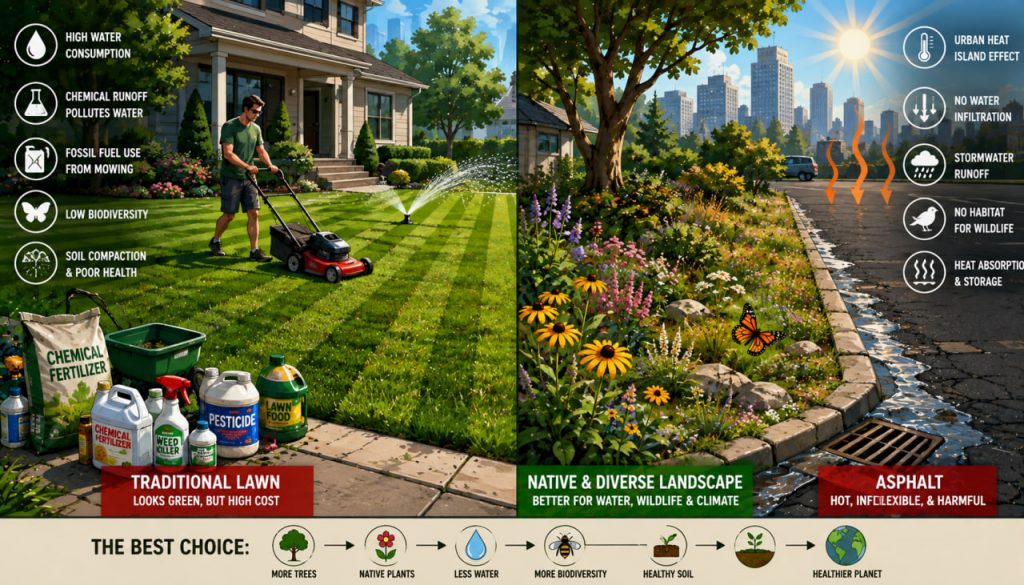
A lawn looks natural. Asphalt looks artificial. So it feels obvious that a green lawn must be better for the planet than a paved surface.
But the reality is more complicated.
A healthy meadow, forest patch, wetland, or native plant garden is usually far better than asphalt. However, a short, chemically treated, constantly watered, frequently mowed decorative lawn can become surprisingly harmful. In some situations, especially in dry climates, a manicured lawn may waste more water, support less biodiversity, and require more ongoing energy than a paved surface.
The problem is not grass itself. The problem is the modern ornamental lawn: green-looking, resource-hungry, and often ecologically poor.
The Lawn Paradox: Green Color Does Not Mean Green Ecology
A typical urban lawn is often a monoculture, meaning it is dominated by one or a few grass species.
It may look clean and orderly, but ecologically it can be almost empty. Many lawns provide little food for pollinators, little shelter for insects, little structural diversity for birds, and little value compared with native plants.
Scientific American has described lawns as environmentally costly because they require water, fertilizers, pesticides, herbicides, and fossil-fuel-powered mowing, while also homogenizing biodiversity and landscape structure.
That is the key distinction.
A lawn is alive, but it is often managed to behave like a carpet. It is cut short before flowering plants can bloom. “Weeds” that could feed bees are removed. Leaves are cleared. Soil is compacted. The entire system is kept artificially simple.
A green carpet is not the same thing as an ecosystem.
Why Asphalt Is Bad — But Predictably Bad
Asphalt has obvious environmental problems.
It seals soil, blocks water infiltration, absorbs heat, increases stormwater runoff, contributes to the urban heat island effect, and provides almost no habitat.
NASA explains that asphalt, concrete, buildings, and other impervious urban surfaces disrupt the natural cooling effect of vegetation and help make cities hotter than surrounding rural areas.
So asphalt is not “good.” It is usually bad for heat, water, and habitat.
But asphalt has one strange advantage in this comparison: it does not pretend to be ecological.
A road or parking lot is clearly infrastructure. A lawn, by contrast, can hide environmental costs behind a green appearance. People may overvalue it because it looks natural, even when maintaining it requires constant inputs.
The Water Problem
Water is where lawns can become especially damaging.
In wet climates, a small lawn may not need irrigation. But in dry regions, maintaining a bright green lawn can require enormous amounts of water.
The Associated Press has reported growing interest in low-water landscaping in warmer, drier U.S. regions because traditional grass performs poorly without irrigation in places with limited water.
This matters because drinking water, river flows, groundwater, agriculture, and ecosystems all compete for the same resource.
In arid and semi-arid cities, a decorative lawn can become a luxury maintained by hidden ecological costs. Water is pumped, treated, transported, sprayed, evaporated, and sometimes wasted through poor irrigation timing.
A local asphalt surface may be hot and ugly, but it does not demand daily watering to stay visually acceptable.
In dry climates, a thirsty lawn can be worse than asphalt because it continuously consumes a scarce resource.
Fertilizers, Pesticides, and Runoff
Many lawns are maintained with fertilizers, herbicides, pesticides, and weed-control products.
These substances do not always stay where they are applied. Rain and irrigation can wash nutrients and chemicals into storm drains, streams, lakes, and coastal waters.
The U.S. EPA warns that nonpoint source pollution can come from many diffuse sources and advises people to apply lawn and garden chemicals sparingly and according to directions. The EPA also notes that pesticide runoff can pose risks to aquatic life, fish-eating wildlife, and drinking water supplies.
Fertilizer runoff is especially important because nitrogen and phosphorus can feed algal blooms. When algae die and decompose, oxygen levels in water can drop, harming fish and other aquatic life.
Asphalt creates runoff too. But a chemically treated lawn can create runoff that looks cleaner while carrying dissolved pollutants.
A lawn can pollute invisibly.
Mowing: The Fossil Fuel Hidden in the Grass
A lawn does not stay short by itself.
It must be mowed again and again. Depending on the equipment, that means gasoline, electricity, battery production, noise, maintenance, and labor. Gas-powered mowers and leaf blowers can add emissions and local air pollution.
Even electric mowing has a footprint if the lawn requires frequent cutting over many years.
The mowing problem is not only energy. It is also ecology. Frequent mowing prevents many plants from flowering and going to seed. It removes habitat structure and keeps the lawn in a juvenile, simplified state.
A meadow changes through the season. A lawn is forced to remain almost the same.
That stability may look neat, but it is achieved by repeated disturbance.
Biodiversity: Lawn as a Biological Desert
A standard lawn offers much less biodiversity than a native garden, wildflower meadow, shrub border, or mixed urban planting.
The issue is not that grass is useless. Grass can protect soil, reduce dust, and provide play space. The issue is that most lawns are overmanaged and underdiverse.
A biodiverse yard may include native grasses, flowering plants, shrubs, leaf litter, bare soil patches for ground-nesting insects, and seasonal variation. A manicured lawn often includes one grass height, one color, one texture, and very little ecological complexity.
This is why lawn reduction can be powerful. The AP notes that reducing lawns can limit water use and create habitat benefits, especially as drier climates make traditional lawns less viable.
Replacing part of a lawn with native plants can turn dead ecological space into living habitat.
Heat: Where Asphalt Is Usually Worse
There is one major point where asphalt clearly beats lawns in harm: heat.
Asphalt absorbs and stores solar energy. It can become extremely hot and radiate heat into the surrounding air. NASA explains that dark surfaces such as asphalt streets absorb the Sun’s heat, while lighter surfaces reflect more of it. NASA also notes that asphalt, concrete, and similar materials retain significantly more heat than vegetation, making urban areas often hotter than nearby rural or suburban regions.
So it would be inaccurate to say lawns are always worse than asphalt.
A living lawn can cool the ground more than asphalt, especially when soil moisture is available. Grass also allows more water infiltration than pavement.
The real comparison is not “grass versus asphalt” in every situation. It is manicured lawn versus better ecological alternatives.
A native meadow, tree canopy, rain garden, wetland planting, or food garden can offer cooling plus biodiversity plus water benefits. A short ornamental lawn offers only part of that value.
When a Lawn Is Better Than Asphalt
A lawn can be better than asphalt when it is low-input, rain-fed, rarely treated with chemicals, used for recreation, and part of a broader landscape that includes trees and native plants.
It can help reduce dust, allow some infiltration, provide a play area, and stay cooler than pavement.
But the lawn becomes problematic when it requires:
- Heavy irrigation
- Frequent mowing
- Synthetic fertilizers
- Herbicides and pesticides
- Leaf removal
- Strict monoculture management
- Replacement of native vegetation
- Social pressure to look perfectly uniform
In other words, a modest functional lawn can be useful. A perfectionist lawn can be wasteful.
Expert Perspective
NASA climate researchers emphasize that vegetation helps limit city warming, while impervious surfaces such as asphalt and concrete contribute to urban heat islands.
At the same time, environmental science and water-conservation research show that not all vegetation provides equal ecological value. In dry regions, replacing water-hungry turf with low-water landscaping can reduce household water use; one long-term study of a Las Vegas “cash for grass” program estimated that turf removal reduced treated household water consumption by about 18%.
The expert lesson is balanced: green space is essential, but the type of green space matters.
A city does not need more decorative ecological carpets. It needs living landscapes that cool, absorb water, support species, and use resources wisely.
Better Alternatives to Traditional Lawns
The best replacement depends on climate, soil, budget, and local rules.
Good options include:
- Native plant gardens
- Clover lawns
- Wildflower meadows
- Rain gardens
- Low-water xeriscaping
- Food gardens
- Shrub borders
- Tree planting
- Permeable paths with planted edges
- Mixed grass-and-flower lawns
Clover lawns are often promoted as a lower-impact alternative because they may need less mowing, less fertilizer, and can provide flowers for pollinators, though they are not ideal for every climate or use case.
The best strategy is usually not removing every blade of grass. It is reducing unnecessary turf and replacing it with higher-value living systems.
Why This Matters for Cities
Cities need cooling, shade, infiltration, habitat, and beauty.
Asphalt alone cannot provide that. But lawns alone are also not enough.
A climate-resilient city needs trees, wetlands, green roofs, restored soils, shaded streets, rain gardens, parks, native plantings, and permeable surfaces.
The future is not asphalt versus lawn. The future is replacing both dead pavement and dead monoculture with functional urban ecosystems.
A lawn may look more natural than asphalt, but if it drinks treated water, needs chemicals, supports little life, and requires constant mowing, its green color becomes misleading.
The question should not be: “Is it green?”
The better question is: What does this landscape actually do for water, heat, soil, biodiversity, and people?
Interesting Facts
- Asphalt is usually much hotter than grass because it absorbs and stores more solar energy.
- A lawn can be cooler than pavement but still harmful if it needs heavy irrigation and chemical maintenance.
- Many common lawn “weeds,” such as clover and dandelions, can provide food for pollinators.
- Short mowing reduces flowers, seed production, insect habitat, and plant diversity.
- In dry regions, replacing turf with low-water landscaping can significantly reduce household water use.
- A native meadow can support far more biodiversity than a standard grass lawn.
- The most ecological yard is usually a mixed landscape, not a perfect monoculture.
Glossary
- Lawn — A managed area of short grass, usually maintained by mowing.
- Monoculture — A planting dominated by one species or a very small number of species.
- Biodiversity — The variety of living organisms in an ecosystem.
- Runoff — Water that flows over land instead of soaking into the soil.
- Nonpoint Source Pollution — Pollution that comes from many diffuse sources rather than one pipe or outlet.
- Fertilizer Runoff — Nutrients washed from soil into waterways, often causing algal blooms.
- Urban Heat Island — A city area that becomes hotter than surrounding rural land because of buildings, pavement, and heat-absorbing surfaces.
- Impervious Surface — A surface such as asphalt or concrete that water cannot easily pass through.
- Xeriscaping — Landscaping designed to reduce or eliminate irrigation needs.
- Native Plants — Plants that naturally occur in a region and support local ecosystems.
- Clover Lawn — A lawn made partly or mostly of clover, often requiring less fertilizer than conventional turf.
- Rain Garden — A planted depression designed to absorb and filter stormwater.