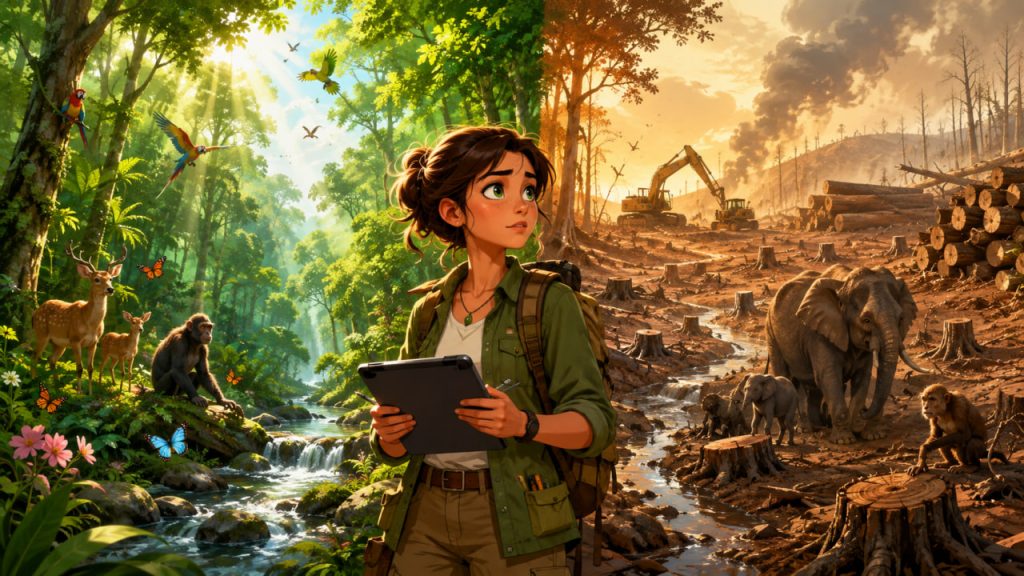
Deforestation is not just the loss of trees. It is the dismantling of living systems that regulate climate, store carbon, produce rain, protect soil, shelter wildlife, and support hundreds of millions of people.
Forests are among Earth’s most powerful natural life-support systems. When they disappear, the damage spreads far beyond the cleared land.
Deforestation affects climate stability, biodiversity, water cycles, food security, Indigenous communities, and the future of human civilization.
The tragedy is not only that forests are being destroyed. The tragedy is that many of these forests took centuries or even thousands of years to form, while humans can erase them in days.
What Is Deforestation?
Deforestation is the permanent or long-term removal of forest cover, usually so land can be used for agriculture, grazing, mining, roads, cities, or commercial development.
It is different from temporary tree loss caused by selective logging or natural disturbance, although those can also degrade forests severely.
The most destructive form is the loss of primary forest.
Primary forests are mature, naturally regenerated forests with high biodiversity and complex ecological structure. They are not easily replaced by tree plantations.
Planting new trees is valuable, but a young plantation is not the same as an ancient forest.
A rainforest is not just a collection of trunks. It is a living network of soil organisms, fungi, insects, birds, mammals, rivers, roots, seeds, and climate processes.
How Big Is the Problem?
The scale remains enormous.
According to the Food and Agriculture Organization of the United Nations, global net forest loss slowed from 10.7 million hectares per year in 1990–2000 to 4.12 million hectares per year in 2015–2025. That is progress, but it still means the world is losing forest area every year. FAO also reports that primary forests were lost at a rate of 1.61 million hectares per year between 2015 and 2025.
Global Forest Watch data also shows how serious the crisis remains in tropical forests. Its 2024 tree cover loss analysis reported a record-breaking rise in humid tropical primary forest loss, strongly influenced by fires in some regions.
These numbers are difficult to imagine.
A million hectares is 10,000 square kilometers. Losing millions of hectares means losing landscapes, watersheds, species, and carbon stores on a continental scale.
Deforestation is not a local environmental issue. It is a planetary transformation.
Why Are Forests Being Cut Down?
The main driver is land conversion.
In many regions, forests are cleared to produce commodities such as beef, soy, palm oil, cocoa, timber, rubber, and paper products.
WWF’s 2024 Living Planet Report states that around 90% of deforestation is caused by converting forests into farmland.
Other causes include:
- Mining
- Road building
- Illegal logging
- Urban expansion
- Hydropower projects
- Fires linked to land clearing
- Weak law enforcement
- Global demand for cheap raw materials
Often, deforestation is not caused by one person cutting one tree. It is caused by entire economic systems that reward short-term extraction.
The chainsaw may be local, but the demand is global.
Consumers thousands of kilometers away may unknowingly support forest destruction through food, furniture, cosmetics, clothing, packaging, or financial investments.
Climate Damage: Forests as Carbon Vaults
Forests store huge amounts of carbon in trees, roots, soil, and dead organic matter.
When forests are cleared or burned, that stored carbon is released into the atmosphere as carbon dioxide and other greenhouse gases.
This accelerates climate change.
Forests also help cool the planet by moving water into the air through evaporation and transpiration. Large forests can influence rainfall patterns far beyond their borders.
When forests are removed, regions can become hotter, drier, and more vulnerable to fire.
Deforestation is both a cause and a consequence of climate change.
A warmer climate increases drought and fire risk. Fires and clearing release carbon. More carbon intensifies warming. This creates a dangerous feedback loop.
Biodiversity Loss: The Silent Extinction Crisis
Forests are home to most of the world’s land-based biodiversity.
Tropical forests are especially rich in species, many of which are still unknown to science.
When forests are destroyed, animals lose food, shelter, breeding grounds, and migration routes.
Some species can move. Many cannot.
The WWF 2024 Living Planet Report found an average 73% decline in monitored wildlife populations since 1970, reflecting the broad pressure human activity places on ecosystems worldwide. Habitat loss and degradation are among the key drivers of biodiversity decline.
Deforestation can push species toward extinction by fragmenting their habitat into isolated patches.
Small forest fragments may not support large predators, wide-ranging mammals, rare birds, or specialized insects.
A forest can still look green from above while its ecological life is collapsing inside.
The Human Cost of Deforestation
Deforestation is often discussed as an environmental issue, but it is also a human rights and public health issue.
Millions of people depend directly on forests for food, water, medicine, fuel, shelter, income, and cultural identity.
Indigenous peoples and local communities are especially affected.
For many communities, forests are not just resources. They are homelands, sacred places, pharmacies, schools, and history.
When forests are taken, people may lose:
- Clean water
- Traditional livelihoods
- Medicinal plants
- Food sources
- Cultural sites
- Land rights
- Protection from floods and landslides
Deforestation can also increase conflict when land is grabbed for commercial use.
The destruction of forests often means the destruction of ways of life.
Soil, Water, and Food Security
Tree roots hold soil in place.
Forest canopies soften rainfall.
Organic matter enriches the ground.
When trees are removed, soil becomes more exposed to erosion, heat, and nutrient loss.
This can make land less fertile over time.
Deforestation also affects water systems. Forests help regulate river flow, recharge groundwater, reduce flood risk, and maintain rainfall patterns.
Without forests, landscapes can shift from stable ecosystems into degraded land.
This matters for agriculture.
Short-term clearing may create farmland, but long-term forest loss can damage the climate and water systems that farming depends on.
Destroying forests for food production can eventually undermine food production itself.
Fires: When Forest Loss Becomes a Disaster
Fire is one of the most dramatic forms of forest destruction.
Some ecosystems are adapted to periodic fire, but many tropical rainforests are not.
When forests are fragmented, dried by drought, or opened by logging roads, they become more vulnerable to burning.
Fires can spread beyond planned clearing areas, killing wildlife, damaging soil, and filling the air with smoke.
Smoke from forest fires can travel long distances and harm human health, especially for children, older adults, and people with respiratory conditions.
Global Forest Watch’s analysis of 2024 tree cover loss highlighted the growing role of fires in tropical primary forest loss.
A burning forest is not only an ecological loss. It is a climate, health, and humanitarian emergency.
Why Reforestation Alone Is Not Enough
Tree planting is important, but it cannot fully compensate for the destruction of old forests.
A newly planted tree may take decades to store significant carbon.
A plantation may contain only one or two species.
A restored area may not immediately bring back the animals, fungi, soil complexity, and water regulation of a mature forest.
This does not mean reforestation is useless. It means prevention is more powerful.
The first priority must be protecting existing forests, especially primary forests.
Restoration works best when it supports native species, local communities, and long-term ecosystem recovery rather than quick public relations campaigns.
What Can Help Stop Deforestation?
There is no single solution.
Real progress requires governments, businesses, investors, communities, and consumers to act together.
Important solutions include:
- Protecting Indigenous land rights
- Enforcing laws against illegal clearing
- Creating deforestation-free supply chains
- Supporting sustainable farming
- Reducing food waste
- Restoring degraded land
- Expanding protected areas
- Monitoring forests with satellites
- Holding companies accountable
- Choosing certified wood and paper products
- Reducing demand for products linked to forest destruction
Satellite monitoring has become a powerful tool because it makes forest loss visible almost in real time.
When governments and organizations can see where clearing is happening, they can respond faster.
Deforestation thrives in secrecy. Transparency helps stop it.
Expert Perspective
The Food and Agriculture Organization of the United Nations has tracked global forest resources for decades, and its latest assessment shows both warning and hope: the rate of net forest loss has slowed, yet millions of hectares continue to disappear each year.
This expert view is important because it prevents two mistakes.
The first mistake is despair: believing nothing can improve. The decline in net forest loss shows that policy, monitoring, protection, and restoration can work.
The second mistake is complacency: believing the crisis is solved. Losing millions of hectares annually is still a global emergency.
The real message is clear: progress is possible, but the current pace is not enough.
Interesting Facts
- Forests cover roughly one-third of Earth’s land surface.
- Primary forests are especially valuable because they store carbon and support complex biodiversity.
- Around 90% of deforestation is linked to the conversion of forests into farmland, according to WWF’s 2024 Living Planet Report.
- Some tropical forests help create their own rainfall through moisture released by trees.
- Forest loss can increase flood risk by reducing the land’s ability to absorb and regulate water.
- Satellite systems now allow researchers to detect forest loss far more quickly than in the past.
- A tree plantation cannot fully replace the ecological complexity of a natural forest.
Glossary
- Deforestation — The clearing or removal of forests, usually to convert land to another use.
- Primary Forest — A mature natural forest with little human disturbance and high ecological value.
- Forest Degradation — Damage that weakens a forest without completely removing all tree cover.
- Biodiversity — The variety of living species in an ecosystem.
- Carbon Sequestration — The process by which trees, plants, and soils store carbon.
- Transpiration — The release of water vapor from plants into the atmosphere.
- Habitat Fragmentation — The breaking of continuous habitat into smaller isolated patches.
- Reforestation — Replanting trees in areas where forests were removed.
- Afforestation — Creating forest on land that was not recently forested.
- Supply Chain — The full system of producing, transporting, and selling a product.