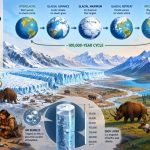
Imagine holding a piece of Antarctic ice and knowing that the tiny bubbles inside it contain air from a world that existed long before cities, agriculture, writing, or modern humans as we know them.
That is the power of paleoclimate science.
Paleoclimatology studies Earth’s ancient climate using natural archives such as ice cores, tree rings, ocean sediments, lake mud, corals, fossils, and cave deposits. Among these archives, ice cores are especially valuable because they preserve both the ice itself and small samples of the ancient atmosphere.
Air bubbles trapped in polar ice are like sealed time capsules of Earth’s past climate.
They help scientists reconstruct greenhouse gas levels, temperature changes, volcanic eruptions, dust storms, sea ice shifts, and even patterns of ancient snowfall.
What Is Paleoclimate?
Paleoclimate means the climate of the past.
It does not describe yesterday’s weather or last year’s heatwave. It studies climate over hundreds, thousands, and even millions of years.
Scientists use paleoclimate evidence to answer major questions:
How warm was Earth before modern industrial emissions?
How did carbon dioxide change during ice ages?
How quickly can climate shift naturally?
What happens when greenhouse gases rise?
How unusual is today’s climate compared with the deep past?
Paleoclimate gives modern climate science a long memory.
Without it, we would only have direct thermometer records covering a small slice of Earth’s history.
What Are Ice Cores?
An ice core is a long cylinder of ice drilled from a glacier or ice sheet.
The most important ice cores come from Antarctica and Greenland because their ice sheets are thick and ancient. Some cores are drilled thousands of meters deep.
NASA explains that scientists recover climate history by drilling ice cores, sometimes more than 3,500 meters deep, and that these ice sheets contain records going back hundreds of thousands of years.
The oldest continuous ice-core climate records from East Antarctica reach back about 800,000 years. NASA notes that the oldest ice cores from East Antarctica provide an 800,000-year-old record of Earth’s climate.
Each layer of snow that falls on an ice sheet is gradually buried by newer snow.
Over time, pressure compresses snow into firn, then into solid ice.
As this happens, air spaces close and become bubbles.
Those bubbles preserve samples of the atmosphere from the time the snow turned into ice.
How Do Air Bubbles Get Trapped?
Fresh snow is light and porous.
Air moves through the spaces between snow grains. As more snow accumulates above it, the lower layers are squeezed and compacted.
Eventually, the pores close.
At that moment, small pockets of air are sealed inside the ice.
The Australian Antarctic Program describes these air pockets clearly: air in snow becomes trapped as bubbles in ice, and each bubble is a sample of the atmosphere from the time snow was transformed into ice.
These bubbles can later be extracted in laboratories.
Scientists crush, melt, or slice carefully prepared ice samples in controlled systems to release the ancient air without contaminating it with modern air.
Then they measure gases such as:
- Carbon dioxide
- Methane
- Nitrous oxide
- Oxygen
- Argon
- Other trace gases
The gas inside the bubbles tells scientists what the atmosphere was like when that air was sealed.
Do Ice Cores Show Weather or Climate?
The phrase “weather 800,000 years ago” is understandable, but scientifically it is more accurate to say climate.
Weather means daily conditions: rain, snow, wind, temperature, storms, clouds.
Climate means long-term patterns over decades, centuries, or longer.
Ice cores usually do not tell us whether it rained on one exact Tuesday 600,000 years ago. Instead, they reveal broader conditions: colder or warmer periods, atmospheric composition, snowfall rates, volcanic activity, dustiness, and ice-age cycles.
Ice cores do not give a daily weather forecast from the past. They reveal the climate system that shaped ancient weather.
How Ice Reveals Ancient Temperature
The air bubbles show atmospheric gases, but the ice itself helps reveal temperature.
Scientists study water molecules in the ice, especially different forms of oxygen and hydrogen called stable isotopes.
When water evaporates from the ocean and later falls as snow, its isotope pattern changes depending on temperature.
In colder conditions, snow tends to contain different ratios of heavy and light isotopes than in warmer conditions.
By measuring these isotope ratios layer by layer, scientists reconstruct past temperatures.
The British Antarctic Survey notes that ice cores preserve climate signals in water isotopes, impurities, and trace gases trapped in air bubbles.
This combination is powerful because one ice core can contain several kinds of evidence at once.
Carbon Dioxide and Methane: The Greenhouse Gas Record
One of the most important discoveries from ice cores is the close relationship between greenhouse gases and climate.
During cold glacial periods, carbon dioxide and methane were lower.
During warmer interglacial periods, they were higher.
Ice cores show that today’s atmosphere is not normal.
Dust, Ash, and Chemical Clues
Ice cores are not only about air bubbles.
They also contain dust, sea salt, volcanic ash, acids, soot, and chemical particles.
These tiny materials reveal additional details about the past.
Dust can indicate dry, windy, glacial conditions.
Sea salt can tell scientists about ocean and sea-ice changes.
Volcanic layers can mark major eruptions and help date the ice.
Sulfate spikes may show explosive volcanic events that affected the atmosphere.
The Australian Antarctic Program notes that snow in remote polar regions can still contain traces of dust, ocean salts, pollutants, volcanoes, and forest fires.
Every layer of ice is a frozen environmental archive.
How Scientists Know the Age of Ice
Dating an ice core is complex.
For recent ice, scientists can sometimes count annual layers, similar to tree rings.
In deeper and older ice, layers become thinner and harder to distinguish because the ice has been compressed and deformed.
Scientists combine several methods:
- Annual layer counting
- Volcanic marker layers
- Ice-flow modeling
- Known chemical signals
- Comparison with other climate records
- Gas-age and ice-age modeling
There is also an important detail: the ice and the air inside it are not always exactly the same age.
The snow may remain porous for years to thousands of years before bubbles fully close, depending on snowfall and temperature conditions.
So scientists carefully calculate the difference between the age of the ice and the age of the trapped gas.
Ice-core science is not guesswork. It is a layered system of measurement, chemistry, physics, and cross-checking.
Why 800,000 Years Matter
The 800,000-year ice-core record covers multiple glacial and interglacial cycles.
These are the long natural swings between ice ages and warmer periods.
NASA explains that paleoclimate records show Earth passed through repeated ice-age cycles, and ice cores help reveal how climate changed during those transitions.
Over this long period, scientists can see how temperature, greenhouse gases, dust, and ice sheets moved together.
This long record helps answer a critical modern question:
What happens when atmospheric greenhouse gases rise?
The answer from ice cores is clear: greenhouse gas changes are deeply connected with Earth’s climate state.
The past does not perfectly predict every detail of the future, but it provides essential context.
Expert Perspective
NASA’s Earth Observatory describes ice cores as one of the strongest tools in paleoclimatology because they preserve both ancient ice and trapped atmospheric gases. This makes them unusually direct compared with many other climate archives, which often provide more indirect clues.
A major scientific review in Nature also emphasizes that ice cores reveal tight links among greenhouse gases, aerosols, and global climate across many timescales.
The expert message is simple: ice cores are not just frozen water. They are one of humanity’s clearest records of how Earth’s atmosphere and climate have changed together.
Why Ice Cores Matter Today
Ice cores help scientists understand natural climate variability.
They show how ice ages begin and end.
They reveal how greenhouse gases changed before humans burned fossil fuels at industrial scale.
They provide evidence for volcanic eruptions, atmospheric circulation, drought, dust, snowfall, and temperature patterns.
Most importantly, they place modern climate change in perspective.
The current rise in greenhouse gases is extremely fast compared with many natural changes preserved in ice.
The bubbles in ancient ice help us understand the atmosphere we are creating now.
They are not just messages from the past. They are warnings for the future.
Interesting Facts
- The oldest continuous Antarctic ice-core records reach back about 800,000 years.
- Scientists are now searching for even older Antarctic ice, potentially older than one million years.
- Air bubbles in ice preserve real samples of ancient atmosphere, not just indirect estimates.
- Ice cores can contain evidence of volcanic eruptions from thousands of years ago.
- Dustier ice often indicates colder, drier, windier climate conditions.
- The ice and the trapped air inside it can have different ages because bubbles close after snow has already been buried.
- Ice cores from Antarctica and Greenland are compared with ocean sediments, cave deposits, and other records to build a stronger climate timeline.
Glossary
- Paleoclimate — The climate of Earth in the distant past.
- Paleoclimatology — The science that studies ancient climates using natural records.
- Ice Core — A cylinder of ice drilled from a glacier or ice sheet.
- Firn — Compacted snow that is between fresh snow and solid glacial ice.
- Air Bubble — A tiny pocket of ancient air trapped inside ice.
- Stable Isotopes — Non-radioactive forms of elements used to infer past temperatures and climate conditions.
- Greenhouse Gas — A gas, such as carbon dioxide or methane, that traps heat in Earth’s atmosphere.
- Glacial Period — A colder interval when ice sheets expand.
- Interglacial Period — A warmer interval between glacial periods.
- Proxy Data — Indirect evidence used to reconstruct past climate conditions.