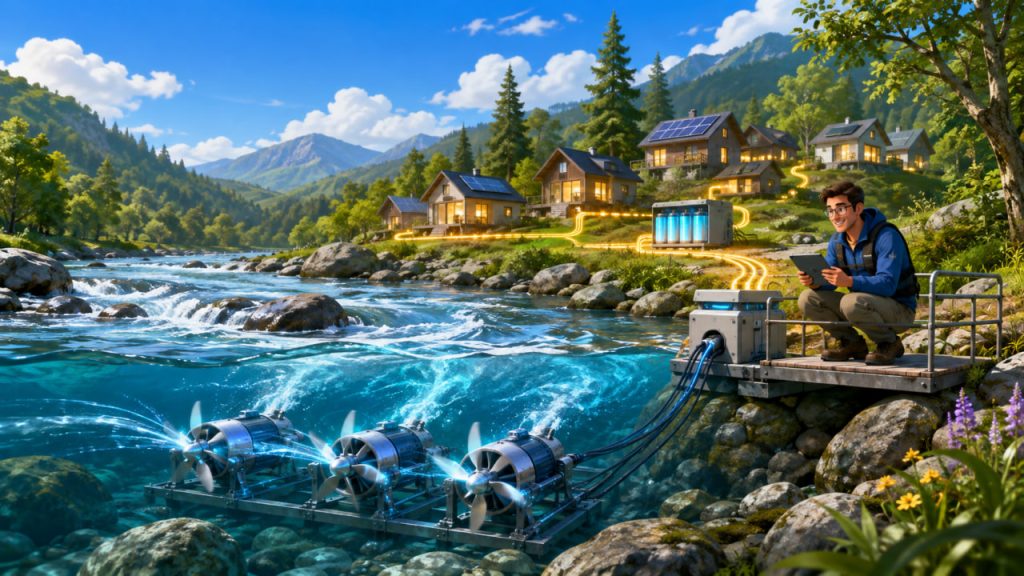
Hydropower is often associated with giant dams, flooded valleys, massive reservoirs, and huge concrete power stations.
But there is another way to use moving water.
Small damless hydropower plants can generate electricity from the natural flow of rivers, canals, tidal channels, or irrigation systems without building a large dam. Instead of storing water behind a wall, they capture energy from water that is already moving.
This technology is often called run-of-river hydropower, in-stream hydropower, or hydrokinetic power, depending on the design.
The main idea is simple: flowing water contains energy, and turbines can convert part of that energy into electricity without stopping the river.
What Is Damless Hydropower?
Damless hydropower is a form of electricity generation that uses natural water movement without creating a large reservoir.
Traditional hydropower usually depends on height difference. Water is stored at a higher elevation, then released downward through turbines. The pressure from falling water spins the turbine and generates electricity.
Damless systems work differently.
Some use a small diversion channel that guides part of the river flow through a turbine before returning it downstream. Others place turbines directly in the current, much like underwater wind turbines.
These systems can be used in:
- Rivers
- Streams
- Canals
- Irrigation channels
- Water supply systems
- Tidal channels
- Industrial water flows
The goal is to produce useful electricity while keeping the river’s natural flow mostly intact.
How River-Current Turbines Generate Electricity
A river-current turbine works by placing blades in moving water.
When water flows past the blades, it causes them to rotate. That rotation turns a generator, which converts mechanical motion into electrical energy.
The principle is similar to a wind turbine, but water is much denser than air. Because of this, even a relatively slow current can carry significant energy.
However, turbine design must be strong and efficient. River water contains sediment, leaves, branches, ice, debris, and sometimes fish. Equipment must survive changing flows, floods, droughts, and seasonal variation.
A good damless hydropower system is not just a turbine in water. It is an engineered system designed around the behavior of a specific river.
Run-of-River vs. Hydrokinetic Systems
Damless hydropower includes several different technologies.
Run-of-river systems often use a small intake structure to divert part of the water through a pipe or channel. The water passes through a turbine and then returns to the river. These systems may use a small weir, but they do not require a large storage dam.
Hydrokinetic systems capture energy directly from flowing water without needing a large elevation drop. The turbine sits in the current and uses the water’s speed.
There are also low-head systems designed for places where water drops only a small distance, such as old mill sites, canals, or small river steps.
The best choice depends on water speed, depth, seasonal flow, environmental rules, available infrastructure, and electricity needs.
Why Small Damless Hydropower Matters
Small damless hydropower is attractive because it can produce renewable electricity with less landscape disruption than large dam projects.
Large dams can provide huge amounts of power, flood control, irrigation storage, and water supply benefits. But they can also flood habitats, block fish migration, trap sediment, alter river temperatures, and displace communities.
Damless systems are usually smaller and more flexible.
They may power remote villages, farms, mountain lodges, monitoring stations, island communities, small industries, or local microgrids.
For places with reliable flowing water, small hydropower can provide steady renewable energy day and night.
This is an important advantage compared with solar and wind, which vary with sunlight and weather.
The Power of Continuous Flow
One of the strongest advantages of river-current energy is consistency.
Solar panels stop producing at night. Wind turbines slow when winds are calm. A flowing river may continue moving all day.
This does not mean hydropower is perfectly constant. River flow changes with seasons, rainfall, snowmelt, drought, and water withdrawals.
But where flow is reliable, small hydropower can provide a stable base of electricity.
This makes it useful for microgrids and off-grid communities.
A small system may charge batteries, power lights, run refrigeration, support communications, or provide electricity for workshops and clinics.
Even modest hydropower can be valuable when it replaces diesel fuel in remote locations.
Environmental Advantages
Damless hydropower can reduce some of the environmental problems associated with large dams.
Because it does not require a huge reservoir, it usually avoids large-scale flooding of land. It can also preserve more natural river flow and reduce community displacement.
Potential environmental advantages include:
- Smaller physical footprint
- Less land flooding
- Lower community disruption
- Reduced reservoir methane emissions
- Better compatibility with small rivers and canals
- Possibility of modular installation
- Local renewable power generation
Some systems can be installed in existing channels, pipes, or water infrastructure, reducing the need for new river construction.
The cleanest small hydropower projects are often those that use water systems already modified by humans.
Environmental Challenges
Damless does not automatically mean impact-free.
Any technology placed in a river can affect aquatic life, sediment movement, navigation, recreation, and water flow.
Possible challenges include:
- Fish injury or avoidance behavior
- Changes in local flow patterns
- Turbine collision risks
- Noise and vibration underwater
- Debris accumulation
- Impacts during installation
- Maintenance disturbance
- Reduced energy in downstream flow
These impacts are usually smaller than those of large dams, but they still require careful study.
Fish-friendly turbine designs, screens, slow blade speeds, careful site selection, seasonal operation rules, and environmental monitoring can reduce harm.
The right question is not whether damless hydropower has zero impact. The right question is whether the impact is low, manageable, and justified by the benefits.
Best Places for Small Damless Hydropower
Small hydropower works best where water flow is strong, predictable, and accessible.
Good locations may include mountain streams, fast rivers, canals, water treatment outflows, irrigation systems, and remote areas with limited grid access.
The site must be evaluated carefully.
Important factors include:
- Flow speed
- Water depth
- Seasonal variation
- Flood risk
- Drought risk
- Sediment load
- Debris levels
- Fish migration
- Distance to users
- Grid connection options
- Local permits
A beautiful river is not automatically a good power site. A good site must combine energy potential with environmental and practical feasibility.
How Much Power Can These Systems Produce?
The output of a small damless hydropower plant depends mainly on water flow and turbine efficiency.
For run-of-river systems, both flow rate and height difference matter. For hydrokinetic river turbines, current speed is especially important.
Because power increases strongly with water speed, a slightly faster current can make a big difference.
Small systems may produce enough electricity for a single home, a farm, a village, or a small business. Larger modular installations can produce more by using multiple turbines together.
However, small hydropower should be assessed realistically.
A river-current turbine cannot extract all the river’s energy. It can only capture a practical fraction while allowing the water to keep flowing.
Expert Perspective
Hydropower engineers often emphasize that site assessment is the foundation of successful small hydro projects.
The technology itself may look simple, but real performance depends on hydrology, civil engineering, turbine selection, environmental constraints, and maintenance access.
An expert approach starts with measuring the river, not choosing the turbine first.
The best small hydropower system is designed around the water source, not forced onto it.
This is especially important for damless projects, where seasonal flow variation can determine whether the system produces reliable electricity or disappoints users.
Maintenance and Reliability
Small hydropower systems need regular maintenance.
Rivers are dynamic. Floods can move rocks and logs. Sediment can wear turbine parts. Screens can clog. Bearings and generators need inspection. Electrical systems must be protected from moisture and corrosion.
Remote systems must be especially durable because repairs may be difficult.
Good design includes safe access, debris protection, simple controls, corrosion-resistant materials, and clear maintenance plans.
A small hydropower plant is not a “install and forget” machine. It is a long-term water-energy system.
When maintained properly, small hydro can operate for many years.
Damless Hydropower and Climate Change
Climate change affects small hydropower in both positive and negative ways.
In some regions, heavier rainfall may increase flow during certain seasons. In others, droughts may reduce river levels and power output. Snowmelt-fed rivers may peak earlier in the year, changing when electricity is available.
Floods can damage equipment. Warmer water can affect river ecosystems. Competition for water may increase between energy, agriculture, cities, and nature.
This means small hydropower planning must use future climate expectations, not only historical river data.
A project designed for yesterday’s river may not perform well in tomorrow’s climate.
Small Hydro in Microgrids
Small damless hydropower can be especially useful in microgrids.
A microgrid is a local electricity system that can operate independently or alongside a larger grid. It may combine solar panels, batteries, wind turbines, diesel backup, and hydropower.
Hydropower can support a microgrid by providing steady generation when sunlight or wind is low.
For remote communities, this can reduce fuel imports, lower energy costs, improve reliability, and support local development.
A balanced microgrid might use solar during the day, batteries in the evening, and small hydro as a continuous source.
Small hydro is often most powerful when combined with other renewable technologies.
The Future of River-Current Energy
Damless hydropower is unlikely to replace large power stations everywhere. Its output is site-specific and limited by local water conditions.
But it can fill an important niche.
As the world looks for cleaner, distributed, and resilient energy systems, small hydropower can help where rivers, canals, and existing water infrastructure provide suitable flow.
Future improvements may include better fish-safe turbines, modular floating platforms, smarter controls, improved sensors, lower-cost generators, and hybrid systems paired with batteries and solar.
The most promising future is not one where every river is filled with turbines.
It is one where carefully chosen sites provide clean power while protecting river life.
Small damless hydropower works best when energy generation and river health are designed together.
Interesting Facts
- Water is much denser than air, so moving water can carry significant energy even at modest speeds.
- Some small hydropower systems can operate day and night if river flow is steady.
- Hydrokinetic turbines work more like underwater wind turbines than traditional dams.
- Old mills, canals, and irrigation channels can sometimes be adapted for small hydropower.
- Damless systems usually have less landscape impact than large reservoir dams.
- Fish-friendly turbine design is an important area of modern hydropower research.
- Small hydro can help remote communities reduce dependence on diesel generators.
- Seasonal drought can reduce hydropower output even if the turbine is well designed.
- A microgrid can combine small hydro with solar, wind, and batteries.
- The success of small hydropower depends more on the site than on the turbine alone.
Glossary
- Damless Hydropower — Hydropower generation that does not require a large dam or reservoir.
- Run-of-River Hydropower — A system that uses part of a river’s flow to generate electricity with little or no water storage.
- Hydrokinetic Power — Electricity generated directly from moving water currents.
- Turbine — A rotating machine that converts moving water energy into mechanical energy.
- Generator — A device that converts mechanical rotation into electricity.
- Flow Rate — The volume of water passing a point in a given time.
- Head — The vertical height difference that creates water pressure in traditional hydropower.
- Microgrid — A local electricity network that can operate independently or with the main grid.
- Fish-Friendly Turbine — A turbine designed to reduce harm to fish and aquatic life.
- Sediment Load — Sand, silt, gravel, and other particles carried by flowing water.