The human body is full of features that make much more sense when viewed through the lens of evolution.
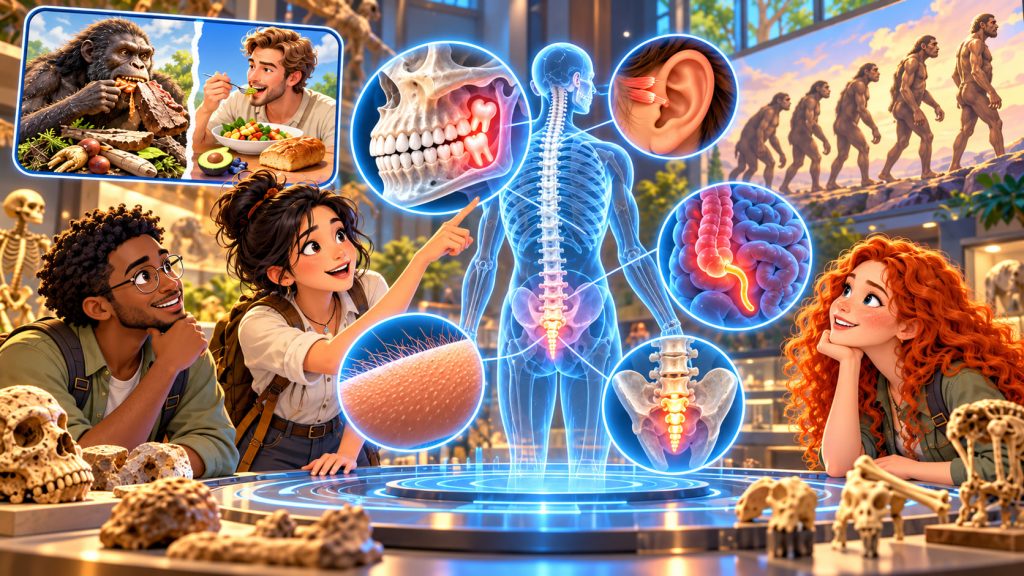
Wisdom teeth can become painfully impacted. Goosebumps appear even though humans no longer have thick fur. Some people have muscles that seem to do almost nothing, while the tailbone remains even though humans lost external tails millions of years ago.
These features are often called evolutionary leftovers, but that phrase can be misleading. Evolution rarely removes a structure simply because it is no longer essential. If a trait is not harmful enough to reduce reproductive success, it may persist for thousands or millions of years.
Our bodies are therefore not designed from scratch. They are modified versions of bodies inherited from our ancestors.
Why Do Humans Have Wisdom Teeth?
Wisdom teeth are formally known as third molars. They are the last permanent molars to develop, usually emerging in late adolescence or early adulthood.
For our ancestors, additional chewing surfaces were useful.
Earlier human populations generally consumed tougher, less processed foods that demanded more chewing. Teeth also experienced more wear during a lifetime, so an additional set of molars could be valuable.
Modern diets are softer, food is frequently cooked or processed, and dental wear is usually much lower.
At the same time, modern humans often have jaws that provide insufficient room for the final molars.
The result can be impacted wisdom teeth, crowding, infection, or damage to neighboring teeth.
Why Did Our Jaws Become Smaller?
Human jaw shape changed gradually during evolution, but genetics is not the whole story.
Food preparation, cooking, grinding, and increasingly soft diets reduced the mechanical demands placed on the chewing system.
Researchers studying craniofacial development have found that mechanical loading during growth can influence jaw development. This means modern dietary habits may contribute to an evolutionary mismatch between teeth and available jaw space.
An evolutionary mismatch occurs when a trait that developed under older environmental conditions becomes less suitable in a newer environment.
Our teeth and jaws did not necessarily change at exactly the same speed.
That mismatch helps explain why wisdom teeth can become problematic even though they once served a practical purpose.
Some People Never Develop Wisdom Teeth
Not everyone has four wisdom teeth.
Some people develop fewer, while others never develop any. The congenital absence of a tooth is known as dental agenesis.
Third molars are among the teeth most commonly affected.
The frequency varies considerably among populations, indicating a strong genetic component.
This is an interesting example of ongoing human biological variation. If lacking wisdom teeth produces no disadvantage—and may sometimes reduce dental complications—there is little reason to expect every future human population to retain exactly the same dental pattern.
Evolution does not move toward a predetermined final body plan.
The Appendix Is Not Simply Useless
The appendix is one of the most famous supposed vestigial organs.
Charles Darwin suggested that it was related to a larger ancestral digestive structure used in animals consuming different diets.
Modern biology has added important nuance.
The appendix contains lymphoid tissue and appears to participate in immune functions. It may also provide a protected environment for beneficial intestinal microorganisms.
That means it should not be described as completely useless.
A better term is vestigial structure: an inherited anatomical feature that has lost some or much of its ancestral function, even if it still performs secondary roles.
Vestigial does not mean functionless.
Why Do We Still Get Goosebumps?
Cold weather, fear, strong emotion, or even music can make tiny muscles attached to hair follicles contract.
This creates piloerection, commonly called goosebumps.
In furry mammals, raising the hair can provide useful effects.
Fluffed fur traps a thicker layer of insulating air. Raised hair can also make an animal appear larger when threatened.
Humans retain the underlying muscular mechanism, but we lost most of the dense body hair that made it effective.
When humans get goosebumps today, the physiological response remains while much of its original visible function has disappeared.
The Human Tailbone Is a Reminder of Tailed Ancestors
At the bottom of the spine is the coccyx, commonly called the tailbone.
It consists of several fused or partly fused vertebrae and represents part of the anatomical legacy of ancestors that possessed external tails.
Humans no longer have functional external tails, but the coccyx is not useless.
Muscles, tendons, and ligaments attach to it, including structures involved in supporting the pelvic floor.
This illustrates an important evolutionary principle: when a major ancestral structure disappears, parts of it can remain because they acquire or preserve other functions.
Some Humans Still Show Rare Tail-Like Structures
Very rarely, babies are born with tail-like projections near the lower spine.
These unusual developmental phenomena are sometimes discussed in connection with atavism.
An atavism is the reappearance of an ancestral characteristic that is normally absent in modern members of a species.
However, not every human tail-like structure is a true evolutionary atavism. Some are caused by developmental abnormalities involving fat, connective tissue, or spinal structures.
True biological interpretation requires careful medical examination.
Still, such cases demonstrate that human development contains ancient genetic and anatomical pathways inherited from deep evolutionary history.
A Muscle You May Not Even Have
The palmaris longus is a small forearm muscle that helps flex the wrist slightly.
Some people have it in both arms, some in one, and others lack it entirely.
Its absence usually causes no meaningful loss of hand function.
Because it is not essential, surgeons sometimes use its tendon for reconstructive procedures elsewhere in the body.
The muscle was more functionally significant in some primate ancestors that depended more heavily on climbing and gripping.
Its variable presence in modern humans shows how evolution can leave behind structures that gradually become less important without disappearing completely.
Why Can Some People Wiggle Their Ears?
Many mammals can rotate their ears toward sounds using specialized muscles.
Humans retain small auricular muscles around the external ear.
For most people, these muscles have little practical effect. Some individuals can voluntarily move or wiggle their ears, while others cannot.
The ancestral system was considerably more useful when independently moving the ears helped locate sounds.
Humans rely much more heavily on turning the head and using complex auditory processing.
Yet the old muscular machinery remains.
Evolution Does Not Aim for Perfection
One of the biggest misconceptions about evolution is that it continuously removes everything unnecessary.
Natural selection works differently.
A characteristic tends to be strongly eliminated only when it creates a meaningful reproductive disadvantage. A nearly harmless feature can persist simply because there is little selection pressure against it.
This concept is related to selective pressure, the environmental forces that influence which inherited traits become more or less common.
Wisdom teeth provide a good example.
Before modern surgery and dentistry, severe dental problems could be dangerous. But wisdom teeth are not harmful to everyone, and many erupt normally.
There has therefore never been a simple universal pressure eliminating them from the entire human species.
Expert Perspective: Evolution Works With Existing Anatomy
Evolutionary biologists emphasize that organisms are constrained by their evolutionary history.
Natural selection modifies existing structures rather than designing ideal bodies from a blank page.
The late evolutionary biologist Stephen Jay Gould frequently highlighted the importance of historical constraints and inherited body plans when explaining biological form.
This perspective helps explain why the human body contains apparently awkward compromises.
Our anatomy is not a catalog of perfect solutions. It is a record of adaptations, modifications, compromises, and inherited structures accumulated across evolutionary time.
Wisdom teeth, the coccyx, goosebumps, variable muscles, and other features are therefore valuable evidence of where humans came from.
Interesting Facts
- Wisdom teeth are the third and final set of permanent molars.
- Some people naturally develop no wisdom teeth at all.
- The appendix has immune-related functions and is not biologically useless.
- Goosebumps are produced by tiny muscles attached to hair follicles.
- Humans lost external tails millions of years ago but retained the coccyx.
- Not everyone has a palmaris longus muscle.
- Human ear muscles are related to systems that allow many mammals to rotate their ears.
- Vestigial structures can retain important secondary functions.
- Evolution does not automatically remove every feature that becomes unnecessary.
- Many characteristics of the human body make more sense when compared with other primates and mammals.
Glossary
- Third Molars — The final permanent molars, commonly known as wisdom teeth.
- Evolutionary Mismatch — A situation in which an inherited trait is poorly suited to a newer environment.
- Dental Agenesis — The congenital absence of one or more teeth because they never develop.
- Vestigial Structure — An inherited feature that has lost much of its ancestral function but may retain secondary roles.
- Piloerection — The contraction of tiny muscles around hair follicles that produces goosebumps.
- Coccyx — The small structure at the bottom of the human spine derived from ancestral tail vertebrae.
- Atavism — The unusual reappearance of a characteristic associated with distant ancestors.
- Palmaris Longus — A small forearm muscle that is naturally absent in some people without significant functional consequences.
- Auricular Muscles — Muscles surrounding the external ear that are much less important in humans than in many other mammals.
- Selective Pressure — An environmental influence that affects which inherited traits become more or less common over generations.