Evolution is often imagined as something that happened millions of years ago: dinosaurs changing over geological ages, ancient mammals diversifying, or early primates gradually giving rise to new forms.
But evolution never stopped.
Animal populations are changing genetically today as they respond to predators, climate, disease, cities, pollution, hunting, and competition. In some cases, researchers can measure these changes within only a few generations.
Evolution is not a historical event. It is an ongoing biological process happening around us right now.
Evolution Can Happen Faster Than It Looks
Evolution occurs when inherited characteristics become more or less common within a population over generations.
One of its most important mechanisms is natural selection. Individuals with characteristics that improve their chances of surviving and reproducing tend to pass those traits to more offspring.
If environmental conditions change, different traits may suddenly become advantageous.
This does not mean individual animals deliberately adapt their bodies. Evolution happens across populations because some inherited variants become more common than others.
When generations are short and environmental pressure is strong, measurable evolutionary change can occur surprisingly quickly.
Galápagos Finches Show Evolution in Real Time
Darwin’s finches remain one of the clearest examples of evolution that scientists can directly observe.
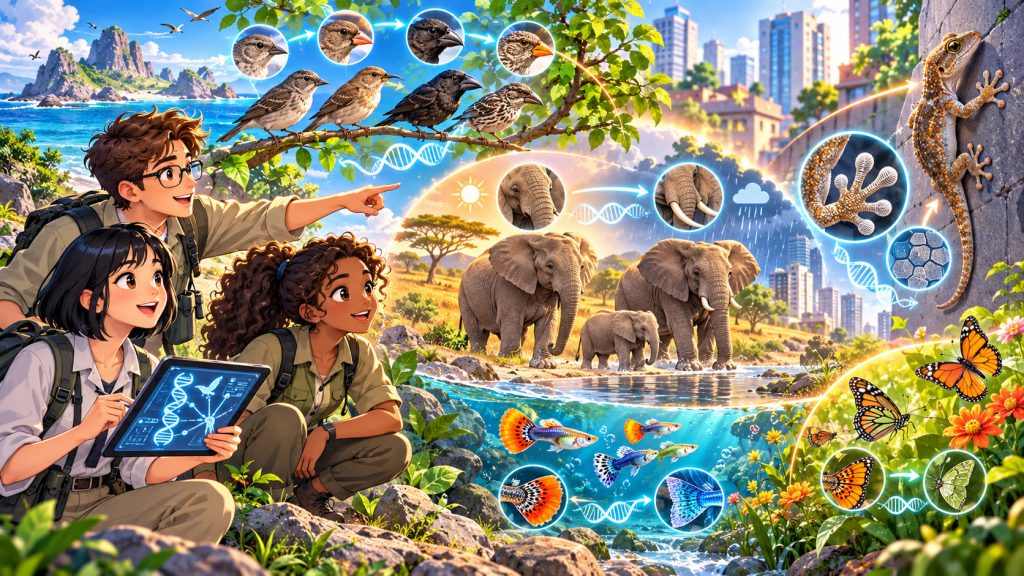
Researchers Peter and Rosemary Grant spent decades studying finches on the Galápagos island of Daphne Major. They discovered that changes in rainfall and food availability could alter which birds survived.
During severe droughts, hard seeds sometimes became more important as softer foods disappeared. Finches with deeper or stronger beaks could gain an advantage.
Because beak characteristics have a genetic component, the average shape of beaks in later generations could shift.
This process demonstrates directional selection, in which environmental conditions favor individuals toward one end of a range of traits.
Evolutionary change does not always require thousands of years. Strong selection can leave measurable effects within a few generations.
Elephants Are Responding to Poaching
Human activity can create powerful evolutionary pressures.
African elephants provide a dramatic example.
In heavily poached populations, elephants with large tusks may be disproportionately killed because ivory makes them valuable targets. Animals naturally lacking tusks can therefore have a survival advantage.
Research in Mozambique’s Gorongosa region found a striking increase in tusklessness among female elephants associated with intense ivory poaching during years of conflict.
This is an example of human-driven selection.
Humans did not intentionally breed tuskless elephants. Instead, hunting changed which animals were more likely to survive and reproduce.
The example reveals an uncomfortable truth: human behavior can influence the evolutionary direction of wild species.
City Animals Are Adapting to Urban Life
Cities create environments unlike most natural habitats.
Roads, artificial lighting, buildings, pollution, noise, warmer temperatures, new food sources, and fragmented green spaces all create new ecological pressures.
Some animals are already showing signs of urban evolution.
Populations of lizards living in cities have been studied for changes associated with climbing smooth walls, fences, and artificial surfaces. In some urban populations, differences in limb dimensions and toe structures may improve movement across human-made environments.
Urban birds can also experience different pressures from their rural relatives.
Traffic noise may influence communication, artificial light can affect daily activity, and abundant human food can change feeding behavior.
Cities are therefore becoming enormous evolutionary experiments.
Climate Change Is Creating New Selection Pressures
Rapid climate change is changing temperatures, rainfall, seasonal timing, snow cover, ocean chemistry, and the geographic distribution of species.
Animals must respond by moving, changing behavior, adjusting their physiology, or evolving.
One particularly important challenge involves phenological change.
Phenology describes the seasonal timing of biological events such as breeding, migration, hibernation, and insect emergence.
If spring arrives earlier, insects may become abundant sooner. Birds that depend on those insects to feed their chicks may benefit if their breeding schedule also shifts.
Populations that cannot keep pace may experience reduced reproductive success.
Evolution may help some species adjust, but climate change can occur faster than many long-lived animals can adapt genetically.
Fish Can Evolve Under Heavy Harvesting
Fishing can also create evolutionary pressure.
Commercial fisheries often remove the largest individuals because larger fish are particularly valuable or more likely to be caught by certain gear.
If large individuals are repeatedly removed before reproducing, characteristics associated with earlier reproduction at smaller sizes may become more common.
Scientists describe such processes as harvest-induced evolution.
This matters because evolutionary changes can influence future population productivity.
A fish population composed of smaller, earlier-maturing individuals may behave differently from the population that existed before intensive harvesting.
Sustainable wildlife management therefore increasingly considers evolution as well as population numbers.
Guppies Demonstrate the Power of Predators
Guppies from Trinidad have played an important role in experiments studying rapid evolution.
Different streams contain different predator communities.
Where dangerous predators are common, guppies often experience strong pressure to reproduce earlier because waiting too long may mean dying before producing offspring.
In safer environments, different reproductive strategies can become advantageous.
Experiments moving guppy populations between environments have demonstrated that traits such as reproductive timing can change over relatively short periods.
This illustrates life-history evolution — evolutionary change involving traits such as age at reproduction, number of offspring, growth, and lifespan.
Predators do not merely reduce prey populations. They can influence how prey species evolve.
Animals Can Evolve Resistance to Human Threats
Some animals are exposed repeatedly to pesticides and toxic chemicals.
If a population contains individuals with inherited resistance, those animals may survive treatment and reproduce while susceptible individuals die.
Over generations, resistance can become more common.
This is an example of evolutionary resistance.
Resistance has been documented in numerous insects exposed to pesticides.
The principle resembles the evolution of antibiotic resistance in bacteria, although bacteria are not animals.
Increasing chemical doses cannot always solve the problem permanently because stronger selection may continue favoring resistant individuals.
Evolution Does Not Always Produce Better Animals
Evolution has no final goal.
It does not automatically create stronger, smarter, larger, or more complicated organisms.
A trait becomes successful when it improves reproductive success under particular circumstances.
If conditions change, yesterday’s advantage may become tomorrow’s disadvantage.
This idea is central to fitness in evolutionary biology.
Fitness does not simply mean physical strength. It describes an organism’s relative success in passing genes to future generations.
A smaller animal that produces many surviving offspring can have greater evolutionary fitness than a larger, stronger individual that leaves none.
Genetic Variation Makes Evolution Possible
Evolution requires differences among individuals.
These differences arise partly through mutations and the reshuffling of genes during reproduction.
This creates genetic variation within populations.
When environments change, some existing variants may suddenly become useful.
Large populations with substantial genetic diversity often have more evolutionary possibilities available than small, genetically uniform populations.
This is one reason conservation biologists worry about severe population declines.
A species can survive numerically yet lose so much genetic diversity that its ability to respond to future diseases, climate shifts, or environmental changes becomes weaker.
Natural Selection Is Not the Only Force
Not every evolutionary change happens because a trait is useful.
Genetic drift can change the frequency of genetic variants simply through chance, especially in small populations.
Imagine a storm randomly killing many animals regardless of their characteristics. The survivors may carry only part of the original population’s genetic diversity.
Future generations may therefore look genetically different even though no particular trait provided an advantage.
Migration between populations can also introduce new genes, while mutations continuously create new genetic variants.
Evolution is produced by several forces working simultaneously.
Expert Perspective: Evolution Can Be Observed, Not Just Reconstructed
Long-term field studies have transformed scientists’ understanding of evolutionary speed.
Peter and Rosemary Grant’s work with Galápagos finches demonstrated that natural selection could be measured directly by tracking individual animals, their physical traits, environmental conditions, and reproductive success across generations.
Modern researchers can add DNA sequencing to these traditional methods.
Scientists can now observe physical changes in populations and examine the genetic changes associated with them.
Modern evolutionary biology is increasingly able to watch evolution while it happens rather than only reconstructing it from fossils.
Humans Are Becoming an Evolutionary Force
Road networks, agriculture, cities, hunting, fishing, artificial light, pollution, climate change, and chemical use now affect animals across much of the planet.
These pressures can favor animals capable of living close to humans while making survival harder for specialized species.
Some organisms may adapt rapidly.
Others may migrate, decline, or disappear before evolution can provide an effective response.
The future of animal evolution will therefore be shaped not only by predators, climate, and competition, but increasingly by human civilization itself.
Interesting Facts
- Evolution can produce measurable changes within only a few generations when selection is strong.
- Decades of Galápagos finch research have documented changes in beak characteristics associated with environmental conditions.
- Heavy ivory poaching has been associated with increased tusklessness in some African elephant populations.
- Cities can create new evolutionary pressures involving heat, noise, artificial light, buildings, and human food.
- Fishing can influence not only the number of fish but also characteristics related to body size and reproduction.
- Predator pressure can change reproductive strategies in animal populations.
- Pesticide resistance is an evolutionary process rather than an individual animal becoming resistant through effort.
- Evolution does not necessarily make animals more complex.
- Small populations can change genetically through chance even when natural selection is weak.
- Losing genetic diversity can reduce a population’s ability to adapt to future environmental changes.
Glossary
- Natural Selection — The process through which inherited traits affecting survival and reproduction become more or less common across generations.
- Directional Selection — Natural selection that favors characteristics toward one end of the existing range of variation.
- Human-Driven Selection — Evolutionary pressure produced by human activities such as hunting, fishing, or environmental modification.
- Urban Evolution — Evolutionary changes associated with animals and other organisms adapting to city environments.
- Phenological Change — A shift in the seasonal timing of events such as breeding, migration, flowering, or insect emergence.
- Harvest-Induced Evolution — Evolutionary change caused when hunting or fishing repeatedly removes animals with particular characteristics.
- Life-History Evolution — Evolutionary change in traits involving growth, reproduction, offspring number, maturation, and lifespan.
- Evolutionary Resistance — The increasing frequency of inherited traits that allow organisms to survive pesticides or other threats.
- Fitness — An organism’s relative success in passing its genes to future generations.
- Genetic Variation — Inherited genetic differences among individuals within a population.
- Genetic Drift — Random changes in the frequency of genetic variants, especially important in small populations.